The L-Word

Suze Orman, financial guru to millions, is a lesbian in a committed relationship of seven years. Money quote:

Orman says they’d like to get married, and both "have millions of dollars in our name. It’s killing me that upon my death, K.T. is going to lose 50 percent of everything I have to estate taxes. Or vice versa."

You’re a second class citizen, Suze. Do something about it. Call Tim Gill.

Quote for the Day

"I went to bed and slept as usual, but awoke the next morning in the gray of the early dawn, and to my astonishment found that the wished-for lines were arranging themselves in my brain. I lay quite still until the last verse had completed itself in my thoughts, then hastily arose, saying to myself, I shall lose this if I don’t write it down immediately. I searched for an old sheet of paper and an old stub of a pen which I had had the night before, and began to scrawl the lines almost without looking, as I learned to do by often scratching down verses in the darkened room when my little children were sleeping. Having completed this, I lay down again and fell asleep, but not before feeling that something of importance had happened to me," – Julia Ward Howe, describing how she came to write "The Battle Hym of the Republic" which was first published in the Atlantic in February 1862. She was right. Something of importance had occurred.

Sage Stossel records the full context:

Julia Ward Howe, the wife of a prominent Boston abolitionist, had visited a Union Army camp in Virginia where she heard soldiers singing a tribute to the abolitionist John Brown (who had been hanged in 1859 for leading an attempted slave insurrection at Harper’s Ferry). A clergyman at the camp, aware that Howe occasionally wrote poetry, suggested that she craft new verses more appropriate to the Civil War effort, to be set to the same rousing tune.

It was the hymn that Churchill, the great Atlanticist, mandated for his funeral.

A Paleocon Revival?

There’s some interesting chatter out there, and this post from a self-described "anti-imperialist reactionary from flyover country" is among the more interesting exhibits. Daniel Larison both loathes what he sees as the cultural degeneracy of Blue America (a D’Souza meme), and the neocon interventionist war-making endorsed by Red America (a Scowcroft meme). And he wonders if there isn’t a candidate out there who could bring them together in a total recast of U.S. foreign policy:

What is potentially quite interesting is what might happen if we could somehow miraculously get together the large constituency on the left that focuses specifically on U.S. policy and the fairly large and, I think, growing constituency on the right that focuses on cultural decadence to create a popular cause demanding the dismantling of the hegemony and moral renewal.  The only problem is that the two groups generally regard each other’s America as the heart of the problem that ‘their’ America has with the rest of the world.  I promise a nice steak dinner to anyone who can come up with the plan that unites these two basically mutually antagonistic groups together in a force for anti-imperialist cultural regeneration.

It’s well worth reading and mulling. I hear a new cultural development out there and a phrase springs to mind: a paleocon is a neocon mugged by reality.

John Brown’s Spirit

John_brown_abo

Without his passionate, violent radicalism, slavery might have endured in America. Here’s a fascinating article from the Atlantic that details the ways in which the abolitionist magazine covered the memory of Brown through the centuries. Check out Hitch’s recent essay and an insightful memoir from one Gamaliel Bradford, from 1922. Money quote:

The influence of such a man and such a life and such a death flowed out and on, beyond the men who obeyed him, beyond the men who met him, to those who never knew him and had hardly even heard of him, to the whole country, to the wide world….

That is what Brown meant when he said, ‘I am worth inconceivably more to hang than for any other purpose! That is what men of his type achieve by their fierce struggle and their bitter self-denial and their ardent sacrifice. They make others, long years after,—others who know barely their names and nothing of their history,—achieve also some little or mighty sacrifice, accomplish some vast and far-reaching self-denial, that so the world, through all its doubts and complications and perplexities, may be lifted just a little toward ideal felicity.

The Surge’s Problem

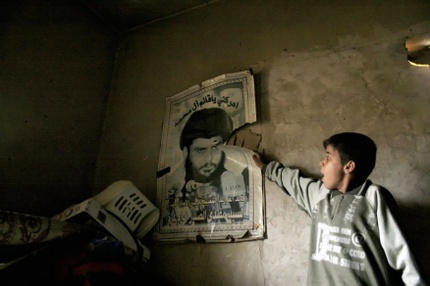
Sadrposterwissamalokailiafpgetty

It’s good to see some small progress and a few arrests of Shiite thugs. But the fundamental flaw is still obvious. This simple well-reported piece from Baghdad tells you all you need to know:

It was a translator working with the Americans, interviewed a day after the fact, who had overheard the Iraqi police tipping off the Iraqis. "They were telling people in the neighborhood to hide your weapons from the Americans," he said. The police were Shiites, he said, and inclined to favor others of their sect in the district, which is mostly Shiite but has a considerable Sunni population.

On another patrol, an American commander said, Iraqi residents told American soldiers that a national policeman had warned them to hide anything incriminating including paraphernalia about Moktada al-Sadr, the Shiite militia leader whose forces are targets of the Baghdad crackdown.

You have a military and police force so infiltrated by or beholden to Shiite militias that there is no chance of cracking down on every aspect of the insurgency in the name of a nominally "national" government. Almost all the heavy lifting is still being done by Americas; and everyone is waiting for their departure so that a real war and a new balance of power can take the country forward:

To many Sunnis the Iraqi forces remain little more than instruments of Shiite hegemony, and the Baghdad plan appears to have done little to change that view. "They can’t protect the Sunnis in the Shiite districts, and they will never fight the militias because they are from the same sect," said Ahmed al-Mashhadani, a Sunni resident of west Baghdad, where other Baghdad security operations took place last week. "We don’t trust them, and if American troops leave, we will call back the resistance platoons to protect ourselves."

If we continue as we are, I don’t see any way past this problem. We will become de facto part of a Shiite government fighting Sunnis and al Qaeda. Maybe that’s what Cheney wants – to take the Shiite side in such a civil war. If so, the repercussions of that should be on the table.

(Photo of Iraqi boy protecting a poster of al-Sadr in Baghdad after his house was inspected by U.S. and Shiite Iraqi troops. By Wissam al-Okaili/AFP/Getty.)