Top Design

Who wants

bright skylights, inset lighting fixtures, a top-floor kitchenette with a built-in espresso machine, new hardwood floors and soft pistachio carpeting up the winding stairs… heated floors, a firefighting system, speakers for music throughout the building, and spacious bathrooms, one with a Jacuzzi?

The Iraqi "government" for their new U.S. embassy. Where do they want it? Across the street from Cheney’s place.

Slavery and Torture

Slaveshipposter1

On the aniversary of the abolition of the slave trade, it’s worth recalling that torture is inextricably linked to slavery. As Scott Horton explains more fully here, when Wilberforce and Wesley aimed to persuade the British elites that the slave trade was evil, they did not cite Biblical proscriptions against slavery. Why? Because the Bible is actually very ambiguous about slavery (the Southern Baptist Convention even used scripture to defend slavery in America). So Wilberforce stressed that the slave trade required unspeakable cruelty, abuse and torture of its victims. That was his rhetorical gambit. He framed his case against the slave trade as a case against inhumane treatment of prisoners of war. The print above was part of the abolitionist case and it was designed to show human beings whose dignity has been violated. The detail I find most arresting is that the small text explains how tightly packed the slaves were on the ship "in the manner of galleries in a church." Wilberforce was appealing to his fellow Christians. And he believed he could persuade them about inhumane treatment more easily than he could persuade them about slavery.

But the two were and are inextricable. Torture was necessary to maintain slavery. It was integral to slavery. You cannot have slavery without some torture or the threat of torture; and you cannot have torture without slavery. You cannot imprison a free man for ever unless you have broken him; and you can only forcibly break a man’s soul by torturing it out of him. Slavery dehumanizes; torture dehumanizes in exactly the same way. The torture of human beings who have no freedom and no recourse to the courts is slavery.

Torture, like slavery, is the anti-freedom; it is the negation of freedom. George Washington was right when he defined the meaning of America in part by his radical, unconditional and absolute disavowal of such a practice. I find it telling that Wilberforce’s peers were more troubled by torture than they were by slavery itself. Today, slavery is unthinkable. But torture? It’s just "coercive interrogation."

This is surely Lincoln’s and Wilberforce’s lesson for us: an America that includes torture is no less a self-refutation than an America that includes slavery. There are political causes and there are moral causes that leave mere politics behind. The end of torture is now one of these causes, just as the end of slavery once was.

Remember Washington. Remember Wilberforce. It is not too late to give America back to herself. And it is not too late for the Christians in this country to follow Wilberforce’s example and speak this truth to the power that now resides in the White House. Here’s one place to start.

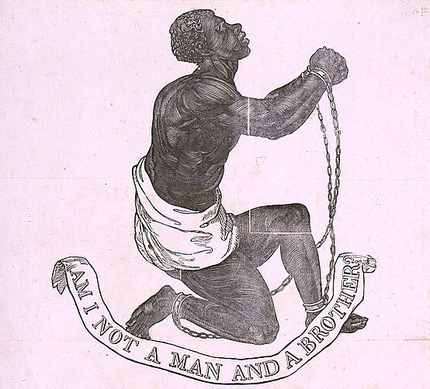
“A Man And A Brother”

Manandbrother

"A great deal is said, to be sure, about the rights of the South; but has any such right been infringed? When a man invests money in any species of property, he assumes the risks to which it is liable. If he buy a house, it may be burned; if a ship, it may be wrecked; if a horse or an ox, it may die. Now the disadvantage of the Southern kind of property is – how shall we say it so as not to violate our Constitutional obligations? – that it is exceptional. When it leaves Virginia, it is a thing; when it arrives in Boston, it becomes a man, speaks human language, appeals to the justice of the same God whom we all acknowledge, weeps at the memory of wife and children left behind – in short, hath the same organs and dimension that a Christian hath, and is not distinguishable from ordinary Christians, except, perhaps, by a simpler and more earnest faith. There are people at the North who believe, that, beside meum and tuum, there is also such a thing as suum, – who are old-fashioned enough, or weak enough, to have their feelings touched by these things, to think that human nature is older and more sacred than any claim of property whatever, and that it has rights at least as much to be respected as any hypothetical one of our Southern brethren…

The encroachments of slavery upon our national policy have been like those of a glacier in a Swiss valley. Inch by inch, the huge dragon with his glittering scales and crests of ice coils itself onward … the relic of a bygone world where such monsters swarmed. We have entire faith in the benignant influence of Truth, the sunlight of the moral world, and believe that slavery, like other worn-out systems, will melt gradually before it," – James Russell Lowell, The Atlantic Monthly, October 1860.

(The woodcut above appears on the 1837 broadside publication of John Greenleaf Whittier’s antislavery poem, "Our Countrymen in Chains." The design was originally adopted as the seal of the Society for the Abolition of Slavery in England in the 1780s, and appeared on several medallions for the society made by Josiah Wedgwood as early as 1787.)

Hewitt vs Odom

It’s a priceless interview as you hear one empty gas-bag of ideology slowly deflating. General Odom does not fully convince me that swift and total withdrawal from Iraq is in our best interests, but as time goes by and the evidence mounts up, I find him far more plausible than I did a year or two years ago. And this is a riposte I wish I’d come up with when I was subjected to Hewitt’s bad-faith questioning:

Why do you keep asking me a question that I’m giving you an answer to?

Heh. It takes time to realize who is interviewing you. There’s a sickening moment when Hewitt tries to accuse Odom to his face of being the modern equivalent of Neville Chamberlain. But Odom’s candor throughout is immensely refreshing and Hewitt deserves props for allowing him to win the argument. This interaction was particularly revealing, I thought. It’s about the consequences of withdrawal:

HH: Did you predict or see coming the Cambodian holocaust after our withdrawal from Southeast Asia?

WO: That would have happened if we’d stayed.

HH: But did you predict it?

WO: We didn’t … we were not in Cambodia.

HH: But did you …

WO: We [helped] perpetrate that.

HH: Did you or anyone you work with at the time see it coming? Did you see the reeducation camps in Vietnam?

WO: No, we didn’t. I wasn’t focused on that then. I was focused on Vietnam.

HH: And what about the reeducation camps and the boat people?

WO: Well, what about them?

HH: Did we foresee that? Did anyone sit down …

WO: Well, we said that things much worse than that were going to happen.

HH: John Kerry, when he testified before the Senate, actually thought it would be a couple of thousand people that would be…

WO: Well, I’m not John Kerry, and I don’t … I’m not defending John Kerry’s position. I’m saying the big scare in Southeast Asia was that there will be a whole group of countries that became pro-Soviet bloc, and pro-Chinese. Well, two more went communist, but they were not pro-Chinese. We were pursuing a war to contain China, the Soviet policy had become containing China. We were presenting a half a million U.S. troops in pursuit of Soviet foreign policy objectives. Right now, we are pursuing al Qaeda and Iranian foreign policy objectives in Iraq.

Ouch.

Gallup Backs D’Souza

If the battle is one for the Muslim mind, the past few years have been Dunkirk for the West. More interesting:

Gallup’s Centre for Muslim Studies in New York carried out surveys of 10,000 Muslims in ten predominantly Muslim countries… The Gallup findings indicate that, in terms of spiritual values and the emphasis on the family and the future, Americans have more in common with Muslims than they do with their Western counterparts in Europe. A large number of Muslims supported the Western ideal of democratic government. Fifty per cent of radicals supported democracy, compared with 35 per cent of moderates.

Grist for D’Souza, I’d say.

A Great Week for Romney

So says Dean Barnett, who bravely tackles the small issue of whether "Romney is a flip-flopper and an opportunist":

As someone who knows him and who is familiar with his character, it annoys me no end to see Romney’s detractors so relentlessly peddle such an inaccurate caricature.

But there’s an undeniable political upside to this development. It will hardly be possible for the press to release a big ‘breaking news’ story on the eve of the Iowa primary that says in effect, ‘This just in: Mitt Romney is a flip-flopper!!!’ By the time the public is steeling itself to take a hard look at who should be its next President, the press will have punched itself out as far as Mitt Romney is concerned. Believe me – Barack Obama and Rudy Giuliani should be so fortunate.

And when the time finally comes for Romney to counterpunch after all the breathless ‘exposés’ have been written and all the YouTubes have been aired, Romney will find his opponents in the media as easy to knock out as George Foreman was in the 8th round of the Rumble in the Jungle. The governor will be able to respond to his critics with two easy smackdowns that will be devastating when the time is right. The first is an old John F. Kennedy saw: "It’s not where you come from, but where you stand." The second will be a completely justified swipe at the pettiness and endlessly repetitive nature of these attacks: "I want to talk about our country’s future. I will, even if the press and my opponents are obsessed with my past."

The fact is, Mitt Romney will have enough money and enough political skill to define himself when the time is right. The fact that the hostile factions of the press will no longer be relevant when that time comes is a wonderful bonus.

Amazing Grace

Amazinggrace

A new movie opens today about William Wilberforce and his campaign to end the slave trade. It’s directed by Michael Apted. The website is a rich resource on the subject. Manohla Dargis’s review is here. Money quote:

The overall effect is part BBC-style biography, part Hollywood-like hagiography, and generally pleasing and often moving, even when the story wobbles off the historical rails or becomes bogged down in dopey romance. Wilberforce often comes across as too good to be true, which may be why the fine Welsh actor Ioan Gruffudd, doubtless with the encouragement of his socially minded director, plays him with a hint of madness in his eyes.

“Authentic Faith”

William_wilberforce

"I fear for the future of authentic faith in our country. We live in a time when the common man in our country is thoroughly influenced by the current climate in which the cultural and educational elite propagates an anti-Christian message… Is it any wonder then that the spiritual condition of our country is of little concern to those who don’t even educate their own children about true Christianity? Their conduct reflects their absence of concern, not only for the state of Christianity in their own country, but also for the need to communicate the message of Christ to those in other parts of the world who have not heard this truth.

Some might say that one’s faith is a private matter and should not be spoken of so publicly. They might assert this in public, but what do they really think in their hearts? The fact is, those who say such things usually don’t even have a concern for faith in the privacy of their interior lives. If you could see their hearts, you would find no trace of authentic faith. God has no place among the sources of hopes, fears, joys or sorrows in their lives. They might be thankful for their health, success, wealth and possessions, but they give no thought to the possibility that these are all signs of God’s provision. If they do give credit to God, it is usually done in some perfunctory way that reveals that their words have no sincerity.

When their conversations get really serious, you will see how little of their Christianity has anything to do with the faith taught by Jesus. Everything becomes subjective. Their conduct is not measured against the standard set by the gospel. They have developed their own philosophies, which they attempt to pawn off as Christianity," – William Wilberforce, "A Practical View of the Prevailing Religious System of Professed Christians in the Higher and Middle Classes of this Country Contrasted with Real Christianity" (1797).

Today is the 200th anniversary of the abolition of the slave trade by Great Britain. It took America a little longer. The Dish will offer up a series of posts in commemmoration today.

Beards and Dogs

A reader writes:

I had tried many times to grow a beard but was frustrated by a large bald spot on my right jaw. I finally grew a beard that covered the bald spot, but the bald spot came back after a year, leaving me looking like I had a case of he mange.   At about that time my wife and I adopted a rescued pit bull puppy.  The pup constantly licked my face, and in no time the bald spot was gone!  That was 13 years ago, and while that dog is (sadly) no longer with us, we have continued to adopt rescued dogs, my faced has been licked every day, and my bald spot has never returned.

I just thought I’d pass that along.

Er, thanks.