My Christianist Base

A reader writes:

I had to smile at your 11:36am "Christianism Watch," because by the standards of the Christianist mentioned in the linked CBN story – as long as he’s OK with Catholics – my credentials are right up there.

I have attended Mass nearly every single Sunday for the past five years, and in the event that I miss one, I usually try and make it up on Wednesday night.

I do a Confession about once every three months on average.

I’m both a eucharistic minister and an occasional lector at my church, and I’ve served as a greeter/"hospitality minister."

On one occasion I even gave out the Eucharist in place of a priest who’d had polio as a child and couldn’t stand for more than a few minutes at a time.

Yet I also favor gay adoption rights, have no problem with gay marriage, oppose the war in Iraq, and think the overturning of Roe v. Wade would have serious negative consequences for this country. Think that Harding University professor, or for that matter many CBN viewers, would be rushing out to vote for me for president? Maybe I should give it a go when I turn 35 in a few years.

Maybe you should. But I bet you that among many actual Christians under 35, your views are not that unusual.

Go To College …

… and get religion. Chad Orzel examines a new study of 10,000 students and concludes:

Clearly, militant atheists need to spend less time on education, and more time on the critical task of getting college students stoned and laid.

I’m more interested in why pot, booze and sex would weaken one’s religious faith. All three have only validated mine.

Iraq and Gaza, Ctd

Readers have offered their own take on why we can afford to allow an Islamist terror state emerge in Gaza but not in Iraq:

The glaring difference is, we created this problem in Iraq but we did not create the problem in Gaza. By irresponsibly removing Saddam we let loose violent factions. Certainly we have some responsibility to the people of Iraq.

Er, yes. But that logic means that the occupation of Iraq is completely self-perpetuating: The worse things get the more we are obliged to stay. And the longer we stay the worse things get. Wonderful, no? Being trapped in Iraq, moreover, has clearly prevented us from tackling Iran with any traction. One argument commonly made for staying in Iraq makes no sense to me at all. It’s McCain’s "if we leave, they will follow us home." But if we stay, they can follow us home as well. And by staying, we have clearly created more of them to follow us. The second argument that fails to convince is that by leaving, we give al Qaeda a propaganda coup. Yes, we would, and it would be intellectually dishonest to deny that. Any argument for withdrawal needs to take that into account. But by staying and losing, we also give al Qaeda a propaganda coup. And by constantly giving al Qaeda an anti-imperial narrative, we also prevent Muslims and Arabs from recognizing them for what they are: not anti-imperial liberators but theo-fascists.

It’s becoming clearer and clearer to me that if we want to win this long war, we have to leave Iraq. Sooner rather than later.

Hitch and God

A reader writes:

I do love Hitch – I think he’s one of the best zinger men since Tynan, etc. But it will be interesting if thoughts of sobriety eventually creep in, as they sometimes will. His calling AA a quasi-cult in VF still rankles. His right, of course, certainly. But once the Hemingway-style high life begins to pall, I do hope he can find the humility to consider the idea of a higher power. As it says in Appendix II of Alcoholics Anonymous (aka the Big Book), which addresses the sometimes slow awakening of spirituality:

"There is a principle which is a bar against all information, which is proof against all arguments and which cannot fail to keep a man in everlasting ignorance—that principle is contempt prior to investigation," – Herbert Spencer.

A line in John Updike’s Rabbit Redux always makes me think of AA, though the character was speaking of something else entirely: "It is where God is pushing through."

My own position with friends is to accept them totally, or not be friends. I have no desire for Hitch to be anything other than completely himself, and if that includes a fondness of whiskey, more power to him. I have no desire to change him in any way. His fearless brilliance, astonishingly wide reading and great wit are treasures to me and a lot of others. And my own sense from being friends with him for over two decades is that, deep down, his impulse is less hostile to God than to organized religion. He’s an anti-clericalist in a long British tradition. Besides, I’m also not in a mood to lambaste atheists these days. I disagree with them, as my long dialogue with Sam Harris testifies. But given the extremes that organized reigion has recently embraced, especially in Islam but to a lesser extent in Christian fundamentalism, there’s a reason for an atheist revival. Whatever point anti-theists want to make has been more than eloquently made for them these past few years by the idiocy of so many "believers."

Iran’s New Terror Base

Here’s Charles Krauthammer:

This is the beginning of the Palestinian civil war. Round one happened this week, and it’s over. Hamas has won in Gaza, it will take it over. And it is the worst elements.

As one high administration official said the other day, these are the extreme elements of the extremists. And this is essentially the first Palestinian independent territory — Israel is out of Gaza — and it will now become a terrorist state.

And it will also be, this is extremely important, a client of Iran. Hamas is supplied and financed by Iran.

And we do what? Invade? Or deal with it from a distance? If we can do the latter with Gaza, why not Anbar? Anbar, after all, is full of Sunni terrorists who would presumably counter the Shia terrorists. Doesn’t that make leaving Anbar less dangerous than staying out of Gaza? Just asking.

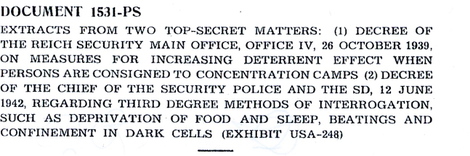
How The Nazis Defended “Enhanced Interrogation”

Muellermemooriginal1

Hint: the ticking time-bomb exception, and the need for better intelligence about an insurgency – the same defense as the GOP establishment has used for exactly the same techniques – hypothermia, stress positions, sensory deprivation, etc. – in the US and Iraq. The terms and specific methods used are the same for the Gestapo’s "Verschaerfte Vernehmung," "Third Degree," and Bush’s "enhanced interrogation." Of course, we also learn from the documents that

The GESTAPO in general believed that other methods of interrogation, such as playing off political factions against each other, were much more effective than third degree methods.

So Bush has more faith in torture than the Gestapo did. A reader writes:

I read with great interest your 19 May post about the Gestapo directive concerning "enhanced interrogation techniques". I gather that you found the document through a 1948 Norway trial. However, the same directive seems to have also been in evidence at Nuremberg (though there the Tribunal apparently translated the term as "the Third Degree"). At Nuremberg it was used as part of the case against the Gestapo in seeking to have the Gestapo declared to be a criminal organization by the Tribunal. Interestingly, a report was filed in the Nuremberg proceedings in which a Colonel Neave, acting under Commission from the Tribunal, reported the evidence of witnesses for the defense of the organizations. It is this report that draws the direct line back to the "ticking bomb exception". The passage that sets out the Gestapo’s defense of the "Third Degree" measures and authorization is as follows (pp. 55-56):

"V. DEFENSE OF THE GESTAPO AGAINST CHARGES OF BRUTALITY AND THIRD DEGREE INTERROGATIONS

BEST said that he preferred to describe the so-called "third degree interrogations" as "severe interrogations". He did not hear of the decree which authorized this type of interrogation until sometime after it had been issued and he had once told HEYDRICH his scruples concerning it. HEYDRICH informed him that the measure had been approved by very high authority and similar methods were used in other countries.

HEYDRICH told him that he reserved for himself the final approval of such measures in Germany and he would see to it that they were applied only in the most urgent cases. BEST was shown Document PS-1531, US-248 which enumerated the severities of third degree interrogations. He remarked that the specified punishments in this document went further than the measures permitted by the German police. His office took disciplinary action against members of the GESTAPO and criminal police who committed excesses. He was, therefore, able to check whether the methods of interrogation employed were kept within reasonable limits. Offenses were punished by normal disciplinary measures and through the ordinary courts.

In cross-examination BEST was shown a document which stated that the commander of the security police and SD was authorized to use third degree in Kracow. He said it was his impression that this type of interrogation was adopted in order to discover the underground movements in Poland, which had come into being at that time.

Describing the use of third degree methods in Denmark, the witness HOFFMANN reiterated that third degree methods were based on a legal decree which authorized them. Disciplinary action was always taken against those concerned with excesses. In general, third degree was applied only when the saving of German lives required it. In this connection he instanced the use of such methods in order to find the whereabouts of arms and explosives belonging to the underground movement. The GESTAPO in general believed that other methods of interrogation, such as playing off political factions against each other, were much more effective than third degree methods. Third degree methods had to be approved by his head office and approximately 20 were allowed for Copenhagen (see reference to the case of Colonel TIMROTH).

The Nazis failed in their defense. Bush has so far succeeded in exactly the same argument. But in the past, America was a bulwark against torture, rather than its enabler and defender.