"I happen to have my young son in the car …" Smokey and the Bandit.
Month: August 2007
More on Bloomberg’s nanny state (surveillance state?) plans [Liz Mair]
Michael Bloomberg is just beginning to scare me. There, I’ve said it. His excessive interest in banning smoking everywhere, forcing photographers to buy licenses, and so on, just rub me the wrong way. So, it shouldn’t be much of a shock that his plans for a "Panopticon" are doing my head in. From the Washington Times:
Even though officials in other cities are embracing and installing surveillance cameras in huge numbers — Chicago, Detroit and Washington, D.C., to name a few — the latest plan unveiled by Mr. Bloomberg and his equally surveillance-enamored police commissioner, Raymond Kelly, leaves these other American cities in the surveillance dust. Truly what we are witnessing being created here is a 21st-century Panopticon.
[…]
Already in London, vehicle owners are billed for using their cars and trucks in certain areas and at certain times, through use of surveillance cameras that photograph, record and track vehicle license plates. The multimillion-dollar system being set up by Mayor Bloomberg and Commissioner Kelly will almost certainly be similarly employed down the road.
With more than 4.2 million closed-circuit television surveillance cameras now operating in Great Britain (the vast majority in and around London), Mr. Bloomberg has a long way to catch up to his British counterparts. Yet the eagerness with which he is approaching this challenge, coupled with the easy money available to him and a largely ignorant and compliant citizenry willing to surrender their privacy in the vain hope that thousands of surveillance cameras will guarantee their safety, bodes well for the Gotham City to overtake London as the most surveilled city on the planet. Somewhere, Jeremy Bentham is smiling; and George Orwell is saying, "I told you so."
One of the things I hated most about living in London was the sense that I was under constant watch by the "authorities." Not because I was spray-painting graffiti on walls, stealing cars, dealing crack, or even throwing gum on the street (most of the time, while I lived in London, I was actually stuck at my desk in the City, working a 12-14 hour day, yelling at lawyers on the other side of a deal). Just because I prefer to be left alone, and hate being watched.
A lot of my "national security"-focused friends tell me that my hatred for, and suspicion of, CCTV is mindless since I’m not a criminal, and I have nothing to fear. That may be so, but nonetheless, I feel that constant surveillance is an infringement and that very often, in fact it leads to the "authorities" being inundated with so much information that they cannot process it– and big costs which frequently are not met.
Perhaps that is why, for as much as Britain’s CCTV system is touted, even in places where it could be an important aid in combating criminal behavior, it turns out that frequently, CCTV cameras are broken, aren’t loaded with film, or the film is only kept for 24 hours (making filming somewhat pointless).
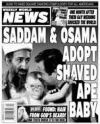
No More Weekly World News [Liz Mair]
Today is a sad day, because we learn that the Weekly World News is to be no more.
This sucks. Now, when standing in the checkout line at the supermarket, I really will have no choice but to read about Nicole Richie’s pregnancy, or Angelina Jolie going anorexic, or Britney Spears’ latest psychotic rampage.
I will no longer be able to read about Elvis being alive, Hillary Clinton having an affair with an alien, or Bat Boy (my personal favorite).
To commemorate this sad day, here are some of the best WWN covers that I could dredge up.



The News as Business [Stephen Bainbridge]
The sale of Dow Jones to Rupert Murdoch has generated an enormous amount of angst among the journalistic communities (and the left, but that’s a nother story). Last week, for example, James Fallows wrote elesewhere on this site that:
… as is obvious as soon as you think about it, the press has cultural, social, and political effects beyond the purely commercial. But its managers are being forced to make decisions on the same focused quarterly-returns basis that guides choices at Merrill Lynch or General Motors. Sometimes those pressures for maximized return (and rising stock price) make news organizations more efficient. But in general they weaken or destroy the parts of news systems that affect people in any role other than as shareholders – that is, as readers, viewers, voters, citizens.
Carping about Murdoch’s takeover of the Wall Street Journal followed at length.
Fallows’ claim that it’s "obvious" that journalism isn’t a regular business is precisely the sort of hubris that leads journalists to think of themselves as some sort of fourth branch of government, with a mandate to act as an ombudsman for society. It would be silly, if it were not so pernicious.
By way of contrast, an editorial in The Statesman reflects an understanding of the newspaper business that seems to have escaped Fallow and his ilk:
Newspapers are a strange business. They are a business whose chief employees, journalists, are invested in the notion that their business is not business.
Write stories so as to raise the newspaper’s circulation so it can sell more ads so its stockholders are happy? Hell no! We journalists answer to a far higher and loftier calling. …
Dow Jones’ current owners and journalists sincerely believe all this. If they didn’t, they would have accepted Mr Rupert Murdoch’s offer to buy Dow Jones on 17 April, the very day he made his bid. After all, he was offering US$60 (S$91) per share for the company, a premium of 67 per cent over its market price of US$36 a share. That meant the Bancroft’s family stake, valued at US$750 million by the market, would be worth more than US$1 billion after taxes, according to The New York Times.
The stake was generating only US$20 million a year in dividends for the family, a return of just 2.6 per cent. By selling to Mr Murdoch, and investing the proceeds in US treasuries, they would earn at least US$50 million a year, more than doubling their income. If Dow Jones made widgets, there would have been no doubt as to what they should do. Where do we sign, the Bancrofts would have asked. But Dow Jones didn’t make widgets. Thus the angst.
The Bancrofts finally decided to sell because newspapers are indeed a business. ….
How long would it have been possible for Dow Jones to continue surviving as now, with its high-minded, low single-digit rates of return being protected from the market by one family? … As even the Journal’s editorial page acknowledged: “Business success is vital to editorial independence."
Actually, newspapers aren’t really all that strange a business. To the contrary, as economist Michael Jensen has explained, they are a very familiar type of business:
I assert that most of the demand for the product of the various “news” services derives, not from the individuals’ demands for “information,” but rather from their demands for entertainment. In that sense, the news media are in competition with drama, soap operas, situation comedies, fictional writing, sports events, and so on.
Go read the whole thing, it’s a brilliant essay. For present purposes, however, the main point is that journalists are in precisely the business as the guys that produce Girls Gone Wild.
Tax Perceptions [Bruce]
Rasmussen has a new poll out on the way Republicans and Democrats perceive the tax system. Republicans believe that tax fairness is best achieved when everyone pays the same percentage of their income in taxes; Democrats believe that fairness demands that the wealthy pay a substantially higher percentage of their income in taxes.
This is not earth shattering news. But it is interesting to have numbers to back up one’s casual perception. According to Rasmussen, 66 percent of Republicans agree with the statement that a flat tax is the fairest, with 25 opposed. On the Democratic side, 53 percent believe that progressivity is necessary for fairness, with 34 percent disagreeing. Thus it would appear that the Republicans’ support for the flat tax is stronger than the Democrats’ support for progressivity. This is observation is borne out in the combined data. Rasmussen finds that 48 percent of all Americans would favor a flat rate tax system versus 40 percent that advocate progressivity.
Perhaps the most interesting data in the poll, however, is that Democrats overwhelmingly believe that we do not at present have a progressive tax system. By a 53 percent to 28 percent margin, Democrats believe that those earning $50,000 per year now pay a higher percentage of their income in taxes than those making $200,000. By about the same percentages, Republicans have the opposite view.
Since this is a factual question, it is a simple matter to check and see which side is right. The best data we have comes from the Congressional Budget Office. Looking at the total federal tax burden, which includes income, payroll, corporate and excise taxes, we see that those in the middle quintile, with an average income in 2004 of $56,200, paid 13.9 percent of their income in taxes. Those in the top quintile, who had an income of $207,200, paid 25.1 percent.
Thus we see that the Democrats are simply wrong in their perception. Perhaps if more of them were aware of the true facts, they would share the Republicans’ fondness for the flat tax and be less enamored of progressivity.
Tommy Thompson [Eric]
Josh has accidentally hit upon the extraordinary range of feelings that Wisconsinites have about Tommy Thompson: He is viewed as being anything from a brilliant technocrat to a foot-in-mouth buffoon.
I lived in Wisconsin for six years, having arrived there in the Fall of 2000 and leaving in the Summer of 2006. Tommy went off to Washington in January 2001, so I never actually lived under his 14-year reign. But I did get to know a lot of prominent Democrats who did live and labor through it — including a really smart woman, since deceased, who served as an appointee of his and really seemed to like him as a person, whatever their political differences were.
The consensus I found seemed to be that he did in fact have a sharp mind for policy, a genuine love of state government and all its inner workings, and really outstanding leadership qualities. Though on the dark side, he definitely had a certain autocratic notion of his powers as governor versus those of the legislature, not all that far from what we’ve seen in Bush.
At the same time, the people who saw him as a blockhead were not inaccurate, either. On a personal level, the man has never ceased to embody all the qualities of rural Wisconsin that most people would describe, in some of the more polite terms, as being those of a boorish country bumpkin.
Republicans had wanted him to run for Senate in 1998 and 2004 against Russ Feingold. If he’d run in 1998, I can say without hesitation that he would have won easily, 55%-45% at the very least. If he’d run in 2004 it would have been a tough call, but I’d lean towards a Thompson victory. The key here is that he never actually took the bait. Washington was never the right environment for him, and everybody knew it.
And when Tommy did go to Washington, everything I heard was that he hated it. Granted, my sources were Democrats rather than Republicans, but even then I’d say they were more than trustworthy. At a certain point he openly said he would serve through the end of Bush’s first term, and then leave. So when I first heard that he was running for president, I had no idea why. I’d figured he was done with Washington, and never going back.
So the bottom line, I suppose, is that Tommy Thompson is both an innovator in the world of conservative social policy and a real boob. I guess that was a huge part of his charm at the state level, giving the people a guy who was simultaneously an egghead for policy and a regular average slob. But at this point he’s really embarrassing himself, and should just get off the stage. The results at Ames this weekend will probably fix that.
More Romney [Liz Mair]
Yeah, yeah, I spend too much time on this guy. But, something interesting has emerged. When Romney originally "evolved" from being pro-choice to being pro-life, he was an anti-Roe pro-lifer and a federalist. Yes, he opposed abortion, didn’t think it should be legal everywhere, but wasn’t going to quibble with California over their approach to abortion law:
But now, it appears that he wants abortion dealt with at the federal level, after all. He wants the constitution amended to ban it in all 50 states. Or, at least, that’s what a normal person supporting the Human Life Amendment bit of the GOP Party Platform would mean. With Mitt, though, you never can tell (maybe he privately supports the goals, but his public policy stance is that he doesn’t support it– who knows):
I’m pro-choice and anti-Roe, so needless to say, on pretty much every count, I think Mitt’s new position on the issue sucks.
Democratic economics [Bruce]
I see that my old college chum Max Sawicky, whose views are about as far to the left as mine are to the right, is complaining about the campaign economists who addressed Yearly Kos. He points to Austan Goolsbee (Obama), Gene Sperling (Clinton), Robert Shapiro (probably for Clinton), and "some French dude" (possibly related to the guy from "The Big Lebowski").
Max’s point is that these guys may be liberal by conventional political definitions, but they are hardly men of the left. He finds this dispiriting; I find it reassuring. It means there is a chance that the Democrats may nominate someone I might possibly be able to vote for. I don’t know Goolsbee, but he has an excellent reputation among economists. I know Bob and Gene and would anticipate that if they have anything to say about it, the next Democratic presidency will be a rerun of the Clinton Administration on economics–free trade oriented, fiscally conservative, pragmatic.
Frankly, this sounds good to me. I think we need a few years of sober economic management that is grounded in the real world. This used to be what the Republican Party stood for.
And now, on Romney [Liz Mair]
While on an AmSpec linking fest, let me link to something that my pal Phil Klein wrote this morning about one of my and Andrew’s most favorite people, Mitt Romney, seen here wearing some very fetching 1970’s fashion.

Oh wait, that’s a Ken doll. Well, moving swiftly on…
Romney’s got himself in a spot of bother because, well, he says he’s pro-life, but he ran (twice) as a pro-choicer in Massachusetts, and then right around the time he started contemplating running for President, magically became pro-life. Personally, I have never bought that all of Romney’s various positions on abortion can have been real, and then yesterday, of course, he admitted that he’d made a political calculation to run as a pro-choicer, despite being pro-life. So we know he’s made up positions for political gain before (which naturally will lead a lot of people to wonder if he’s doing it again– I won’t even bother stating my view on that).
Sam Brownback’s campaign has assailed him before for being a "convert" to pro-life-dom– and now, he’s not only running the line that what someone did doesn’t matter, it’s what they say that matters, but also that it’s important that we just listen to candidates’ views, not assess their records because it’s early in the campaign.
Setting aside that it’s patently absurd to suggest that six months out, records don’t matter only words do, it’s totally ridiculous that a guy whose conservative outreach guy was using McCain’s record to argue that McCain wasn’t really very pro-life at all (and, to touch on the "timing" point, Romney’s camp evidently thought record-assessment was OK back in February, even though it’s evidently not OK now) is making an argument against looking at records. It’s even more ridiculous given that the Romney camp was, supposedly, actually telling conservative activists not just that McCain’s record on "life issues" sucked, but that he was actually pro-choice– and that back in January!
Ultimately, either records matter, or they don’t. And if Romney is saying they don’t, then I very much hope that in the run-up to the primaries, we will not be subjected to any attack-ads bashing his opponents for votes they have taken, bills they have signed and so on. If Romney is as good as his word (ha, ha, bad English major joke), all we will be seeing from him will be ads making him look wonderful and lovely, and attack-ads featuring only recent statements from the other candidates, with zero reference to their records.
Obviously, that isn’t going to happen– and the reason why, is because records matter. Romney knows this, he just doesn’t like it, because a look at his record, whether it is on, er, taxes (CATO says he tried to raise them), abortion, gun s, gays or even his favorite book, Romney’s record just isn’t where the majority of Republicans are going to want it to be.
So, it’s important to listen only to whatever words are currently coming out of the Presidential conteders’ mouths, then…
Not the Best Movie Line Ever [Stephen]
Instead, how Harry Potter should have ended.
 The Dish