Obama-Gore?

Let the speculation begin. I think Gore realizes that Obama is the only candidate who can break out of the brutal, polarizing, calculating, post-Vietnam syndrome and actually talk to all the country in clear ways about what practically we need to do at home and in the world. Gore would instantly erase the inexperience question over Obama; Obama would instantly erase the stylistic drawbacks of the Gore persona. The three big issues for me in this election are the war, the Constitution, and the environment. A Gore-Obama combo would be extremely hard to beat if those are your concerns.

Gore, moreover, knows what the Clintons would take us back to perhaps better than anyone else. He knows the paranoia of their operation, the Cheney-like secrecy they crave, the pathologies within our political culture they would instantly reignite, the danger that they will breathe new life into a hopefully dying Christianist movement. But the Clinton machine is in full throttle. If Gore wants to help provide an alternative, he needs to intervene before Iowa. He needs to endorse Obama. For the sake of his country.

Quotes For The Day

Padillachained

"The Constitution of the United States is a law for rulers and people, equally in war and in peace, and covers with the shield of its protection all classes of men, at all times and under all circumstances. No doctrine, involving more pernicious consequences, was ever invented by the wit of man than that any of its provisions can be suspended during any of the exigencies of government. Such a doctrine leads directly to anarchy or despotism …" – The Supreme Court, Ex Parte Milligan, 1866.

"My father is 67. My mother is 61. I have a brother who developed arthritis at 19. He still has it today. When the word ‘torture’ comes at least for my brother, I mean, all they have to do is really just press on one of these knuckles. I couldn’t imagine them doing anything to my sister… [L]et’s just say a lot of people in Egypt would stay away from a family that they know or they believe or even rumored to have anything to do with terrorists and by the same token, some people who actually could be —might try to get to them and somebody might actually make a connection. I wasn’t going to risk that. I wasn’t going to risk that, so I thought to myself what could I say that he would believe. What could I say that’s convincing? And I said okay," – Abdallah Higazy, explaining why he confessed to being a terrorist after the FBI threatened to have his family identified and tortured by the Egyptian authorities. Higazy is innocent.

Imaginationland

Wtctimothyaclaryafpgetty

I posted an email earlier today trying to understand the extraordinary powers that president Bush has accrued to himself since the 9/11 attacks. No president has ever had so much power over the citizenry of the United States in American history – the permanent power to name anyone an enemy, detain them indefinitely and torture them into confession anywhere in the world. My reader suggested that this extraordinary shift in America’s constitutional balance – the creation of an extra-legal dictatorship within a putatively democratic society – was explicable only if you believe that the very existence of the U.S. is in peril.

I believe Cheney believes that. In the hours after 9/11, you can understand why. The question then becomes: what evidence did they have that the danger was that grave? My reader cites the following anecdote in a Graham Allison book:

"On October 11, 2001 … at the Presidential Daily Intelligence Briefing, George Tenet, the director of central intelligence, informed the president that a CIA agent code-named Dragonfire had reported that Al Qaeda terrorists possessed a ten-kiloton nuclear bomb, evidently stolen from the Russian arsenal. According to Dragonfire, this nuclear weapon was now on American soil, in New York City."

Now, obviously, this was untrue. It was untrue on a cataclysmic scale in the way that Abdallah Higazy’s conviction of being an al Qaeda member was untrue on a much smaller scale. The question in my mind is: how did they get that information? They’ll Cheneyalexwonggetty never tell us, of course. We found out that the Higazy conviction was a result of a false confession, after threatening to have his family tortured in Egypt. But the nuclear scare was a huge untruth gained by a CIA agent a month after Bush and Cheney had secretly let loose the dogs of torture. And the one thing we know about torture is that it was never designed in the first place to get at the actual truth of anything; it was designed in the darkest days of human history to produce false confessions in order to annihilate political and religious dissidents. And that is how it always works: it gets confessions regardless of their accuracy.
The longer this war goes on and the more we find out, the following scenario seems to me to be the best provisional explanation for a lot of what our secret, unaccountable, extra-legal war-government has been doing – and the countless mistakes which have been laid bare. On 9/11, Cheney immediately thought of the worst possible scenario: What if this had been done with WMDs? It has haunted him ever since – for good and even noble reasons. This panic led him immediately to think of Saddam. But it also led him to realize that our intelligence was so crappy that we simply didn’t know what might be coming. That’s why the decision to use torture was the first – and most significant – decision this administration made. It is integral to the intelligence behind the war on terror. And Cheney’s bizarre view of executive power made it easy in his mind simply to break the law and withdraw from Geneva because torture, in his mind, was the only weapon we had.

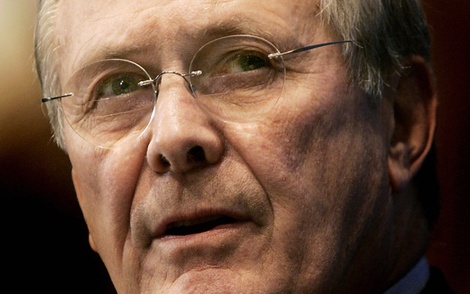
Bush, putty in Cheney’s hands, never wanted torture, but was so cowardly and lazy he never asked the hard questions of what was actually being done. He knows, of course, somewhere in his crippled fundamentalist psyche. But this is a man with clinical – Christianist and dry-drunk – levels of reality-denial, whose interaction with Rumsfeldjimwatsonafpgetty reality can only operate on the crudest levels of Manichean analysis. All he needs to be told is that whatever it is they’re doing, it isn’t torture. He won’t ask any more questions. They’re evil; we’re good; so we can’t torture. Even when they were totally busted at Abu Ghraib, his incuriosity and denial held firm. After all, what if he were to find out something he didn’t want to know? His world might collapse.

But torture gives false information. And the worst scenarios that tortured detainees coughed up – many of them completely innocent, remember – may well have come to fuel US national security policy. And of course they also fueled more torture. Because once you hear of the existential plots confessed by one tortured prisoner, you need to torture more prisoners to get at the real truth. We do not know what actual intelligence they were getting, and Cheney has ensured that we will never know. But it is perfectly conceivable that the torture regime – combined with panic and paranoia – created an imaginationland of untruth and half-truth that has guided US policy for this entire war. It may well have led to the president being informed of any number of plots that never existed, and any number of threats that are pure imagination. And once torture has entered the system, you can never find out the real truth. You are lost in a vortex of lies and fears. In this vortex, the actual threats that we face may well be overlooked or ignored, as we chase false leads and pursue non-existent WMDs.

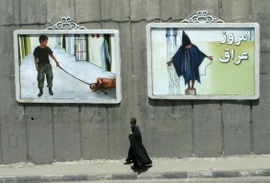
My original concern with torture was moral and sprang from Abu Ghraib. It never occurred to me that the US would be Torturebehrouzmehriafpgetty doing it before. Poring over all the data, it became simply impossible to deny that Abu Ghraib was not an exception to the rule, but a horrible, predictable result of an existing torture policy that spread beyond the limits Cheney and Rumsfeld wanted. My second concern with torture is that  much of our actionable intelligence may have come from it. Think of what that means. Much of it may be as valid as that nuclear bomb in New York City or the notion that Abdallah Higazy was a member of al Qaeda.
We may have entered a world, in other words, where the empirical reality of our national security is less important than the imaginationland that every torture regime will create. We may therefore be sacrificing our liberties for a phantasm created by brutality spawned by terror. We don’t know for sure, of course. But that’s what torture does: it creates a miasma of unknowing, about as dangerous a situation in wartime as one can imagine. This hideous fate was made possible by an inexperienced president with a fundamentalist psyche and a paranoid and power-hungry vice-president who decided to embrace "the dark side" almost as soon as the second tower fell, and who is still trying to avenge Nixon. Until they are both gone from office, we are in grave danger – the kind of danger that only torturers and fantasists and a security strategy based on coerced evidence can conjure up. And since they have utter contempt for the role of the Congress in declaring war, we and the world are helpless to stop them. Every day we get through with them in power, I say a silent prayer of thanks that the worst hasn’t happened. Yet. Because we sure know they’re looking in all the wrong places.

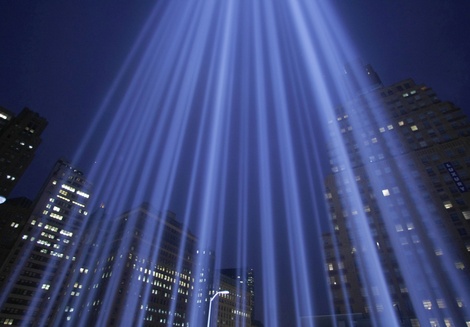
(Photos: A ‘Tribute in Light’ illuminates the night sky over lower Manhattan near Ground Zero at the World Trade Center site, 11 September 2007 in New York, on the sixth anniversary of the 11 September 2001 attacks. By Timothy A Clary/AFP/Getty. Cheney: Alex Wong/Getty. Rumsfeld: Jim Watson/AFP/Getty. Tehran street scene: Behrouz Mehri/AFP/Getty.)

Getting To Love $100 A Barrel

The Economist looks on the bright side of oil price increases:

Adjusted for inflation, the $100 barrel would not exceed the record set in 1980. Also, big economies today are generally better insulated from oil-price fluctuations. Developed countries use half as much oil per real dollar of GDP as in the mid-1970s, thanks to improved energy efficiency. This year the price of oil has increased by about 70% since January without stunting economic growth in America.

Not only could the world withstand higher prices, some argue that further increases would be beneficial. A growing number of economists suggest that pricier oil is healthy, particularly for the environment. But the rise must be gradual and predictable so that economies can adjust. Large and sudden increases are the ones that tend to create recessions.

Meanwhile, some Germans are freaking out.

In Defense Of The Decider, Ctd.

A reader writes:

Your reader wrote: "What if 9/11 had been a nuclear attack?"

‘What if,’ indeed. On the first page of his excellent and disturbing book, "Nuclear Terrorism – The Ultimate Preventable Catastrophe" – Graham Allison, a former deputy secretary of defense under Clinton (and no fan of the Bush administration), relays the following anecdote:

On October 11, 2001, a month to the day after the terrorist assault on the World Trade Center and the Pentagon, President George W Bush faced an even more terrifying prospect. At that morning’s Presidential Daily Intelligence Briefing, George Tenet, the director of central intelligence, informed the president that a CIA agent code-named Dragonfire had reported that Al Qaeda terrorists possessed a ten-kiloton nuclear bomb, evidently stolen from the Russian arsenal. According to Dragonfire, this nuclear weapon was now on American soil, in New York City.

Think about it. A month after 9-11, you are president Bush.

You are still struggling to get to grips with the 9/11 attacks when you are told that the same people who have just destroyed twin towers have a nuclear weapon in New York city. What do you do? How do you defend the country?

A big scare like this is, to me, the only reasonable explanation of why Bush and his cadre of advisers have been so willing to push their response to the 9/11 attacks so far. Bush and his crew were – and remain – scared shitless. They are terrified that the next report won’t be a false alarm, and this fear informs every decision, every cost-benefit analysis they make. Don’t get me wrong, I believe many of the steps taken by the Bush administration have been badly misguided, and are likely to harm US interests in the long run. If Allison’s anecdote is true, it doesn’t excuse the Bush administration’s many bad decisions and policies, but it does go a long way towards explaining them.

No Impact Man

I predict his kids will be voting Republican as soon as they get the chance:

You click off family’s electricity and make them go to bed at nine every night because it’s too dark to do anything else. You ban them from the elevator so they have to walk up and down nine flights of stairs. You take away their fridge so they can’t keep more than a day or two of food around the house.

All this and then they turn around and say it’s life as usual?

Some happier medium is surely possible.

Why Have US Casualties In Iraq Fallen?

It’s good news, but befuddling. I thought the surge would mean more casualties but with the prize of real counter-insurgency. And we’ve certainly seen a decline in Iraqi deaths. Fred Kaplan spots a fascinating statistic that should surely merit further examination:

Since the surge began and Gen. Petraeus shifted the strategy to counterinsurgency, the number of U.S. airstrikes has soared.

From January to September of this year, according to unclassified data, U.S. Air Force pilots in Iraq have flown 996 sorties that involved dropping munitions. By comparison, in all of 2006, they flew just 229 such sorties—one-quarter as many. In 2005, they flew 404; in 2004, they flew 285.

In other words, in the first nine months of 2007, Air Force planes dropped munitions on targets in Iraq more often than in the previous three years combined.

More telling still, the number of airstrikes soared most dramatically at about the same time that U.S. troop fatalities declined. (Click here for month-by-month figures.)

My best bet is that Petraeus is doing the best he can with insufficient troop levels to succeed. Hence the airstrikes. But they can create more civilian casualties and alienate the populace. The emerging CW that the surge has "worked" seems to me to be extremely premature.

An Evangelical Meets A Homosexual, Ctd.

A reader writes:

Your reader wrote:

"And so, on some distant day, once my friend has realized I still love and care for him, I will also have to tell him what my religious beliefs dictate concerning homosexual behavior. To stay silent would be to live as morally compromised a lie as those who choose not to come out of the closet."

As an atheist, should I be compelled to tell every Evangelical I meet that their God doesn’t exist just so that I can feel better about myself?

Yes, you should, if you want to save their mind if not their soul. But I’d rather you just left them alone. For some reason, I have never felt it incumbent to tell anyone what their view of existence should be. Maybe it’s the Catholic in me, but this is something I remember believing – and arguing with my mother about – when I was barely out of elementary school: I’ve always found evangelism to be unspeakably rude. That’s my only problem with Mormons. Knocking on my door and interrupting my life to save my soul is an act of astonishing presumption and poor manners. I respond in kind. Another reader writes:

I find myself genuinely furious at this letter, more so than from someone outright condemning homosexuality as perverse and sick.

This hand-wringing, this clutching at pearls over how awful it is to be Christian today and have your beliefs challenged, questioned or even outright denied.  Do they know how silly that comes across?  I have no doubt it’s genuine, it’s just – man.  Here’s how I see it – this persona has a problem with people like me challenging his life, belief and personal truth.  This is bad and should change.  However, if people like him challenge my and every gay person’s life, belief and personal truth, we have to deal?  because they have the Bible supposedly on their side?  I really see this line as being the next line of attack on gay rights, the Woe Is Me: A Christian’s Life Censored tack that this writer employs.  I for one am not buying it for a second.

Another makes what I believe is the deeper point:

Your reader is right to say that Jesus came to bring division to the land. The problem with this fellow is that he is on the wrong side of the divide. Jesus did not condemn homosexuals. He stands with them, not against them. There are certainly parts of the Old Testament and the New, such as Revelations, which condemn homosexuality. There is no evidence that Jesus supported these views. He stands in radical contrast to these attitudes. He did indeed bring about division, by rejecting intolerance and embracing the approach of unconditional love. I empathize with your reader’s dilemma in attempting to be a good Christian while asserting the immorality of homosexuality, but in the end, this is not possible. He is trying to be good. Unfortunately, he is simply wrong, as are those portions of the Bible which make such charges.

The Bible is not inerrant, as even some conservative Jews have recognized in this matter. A major part of Jesus’ own message was that the Old Testament tradition had errors in it which needed to be corrected. So to claim inerrancy would be tantamount to rejecting Jesus himself. If your reader truly wants to "get right with Jesus", he has got to recognize that he has made an error in this matter, and correct himself. Faith in Jesus himself would be the correct route to make this change. This friend of his could be the vehicle of that grace, and that message, if he would only recognize it as such.

This fear of homosexuality has nothing to do with the message of Jesus – nothing. It is, in fact, a huge obstacle to hearing his words.