How To Talk About Books You Haven’t Read

Easy, really:

Fortunately, the book’s absence from my life hasn’t prevented me, as a citizen of the United States of Amazonikipedia, from learning everything there is to know about it. I know, for instance, that Bayard, a respected literature professor, admits in the preface that he doesn’t enjoy reading, has little time for it, and lectures frequently on books he hasn’t read—scandalous revelations that helped make the book a sensation in Europe. I know, from a photo of the book, that it is small and blue. I know, from Bayard’s author photo, that he is fiftyish and improbably slim, and likes to dress entirely in black. In fact, in lieu of reading the actual book, I’ve spent a very long time scrutinizing this picture, which strikes me as a masterpiece of calculated faux-casual self-revelation: Bayard leans against a railing in front of a scenic spray of graffiti—a touch of vérité to anchor all the abstraction—and his eyes simmer like coq au vin, and his forehead bunches with a devastating whisper of wrinkle-cleavage (my God, he is about to _think_!), and he appears to be sucking on something, perhaps the word oeuvre. In short, he looks like a foot soldier in the vast army of impish popular intellectuals France has been training since the days of Roland Barthes, just in case the struggle for freedom should ever come down to the ability to wring paradoxes out of a stone or unriddle the world with Lacanian decoder rings.

Almost ready to be a blogger.

Rudy’s Turbulent Priest

Exhibit A in Rudy Giuliani’s Bush-like loyalty is his longtime refusal to fire a priest credibly accused of teen molestation from his consulting firm or campaign. As Brian Ross reports, he even hired him at the firm months after the accusations surfaced:

Presidential candidate Rudolph Giuliani hired a Catholic priest to work in his consulting firm months after the priest was accused of sexually molesting two former students and an altar boy and told by the church to stop performing his priestly duties.

The priest, Monsignor Alan Placa, a longtime friend of Giuliani and the priest who officiated at his second wedding to Donna Hanover, continues to work at Giuliani Partners in New York, to the outrage of some of his accusers and victims’ groups, which have begun to protest at Giuliani campaign events.

"This man did unjust things, and he’s being protected and employed and taken care of. It’s not a good thing," said one of the accusers, Richard Tollner, who says Placa molested him repeatedly when he was a student at a Long Island, N.Y. Catholic boys high school in 1975.

Giuliani, who seems unable to hold any of his friends accountable for anything – remind you of anyone? – still sticks by the guy:

"I know the man; I know who he is, so I support him," Giuliani said. "We give some of the worst people in our society the presumption of innocence and benefit of the doubt," he said. "And, of course, I’m going to give that to one of my closest friends."

What does Sean Hannity say about presidential candidates harboring child molesters? And Bill O’Reilly?

The Danger Of Rudy

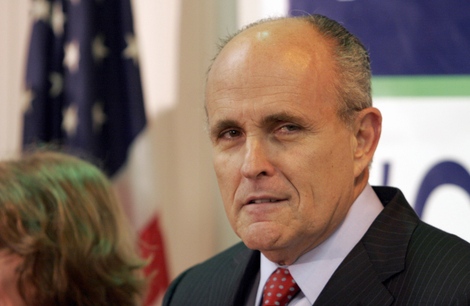
Giulianinicholasrobertsafp

I’ve long had a soft spot for Rudy Giuliani. I’d have gladly supported him for Mayor if I’d lived in Gotham. For all his many faults, he turned a city around. I like his social liberalism, his refusal to pander to the pro-life lobby because, on the critical issue of a woman’s right to choose in the first trimester, he disagrees with them. But any cursory look at his record reveals the real danger of electing him to the presidency. If you think Bush has been too loyal to incompetent or corrupt subordinates, Giuliani’s record is far worse. If you worry about Bush’s and Cheney’s unprecedented seizure of expansive executive power, then Giuliani is unthinkable. The Washington Monthly provides a helpful review of Rudy’s history of personal dictatorship:

As mayor, Giuliani tried to rewrite the city’s governing document on multiple occasions to enhance his power  at the expense of the City Council’s.

He repeatedly attempted to eliminate or obstruct agencies charged with oversight of his administration–often successfully.

He flouted the First Amendment to crush dissent inside and outside government. And he shrouded his administration in secrecy (at one point, his government even denied a Freedom of Information request inquiring how many Freedom of Information requests had been denied.)

Embedded in his operating style was a belief that rules don’t apply to him, and a ruthless gift for exploiting the intrinsic weaknesses in the system of checks and balances.

A man with this record, a hotheaded temperament and an inability to deal with foes without waging pre-emptive war on them is not someone we should risk in the White House in the perilous days ahead. We need calmer minds and less compromised souls.

(Photo: Nicholas Roberts/AFP/Getty.)

Bush’s ENDA Veto

The president’s threat to veto a bill that provides employment protections for gay employees draws this response from Dale Carpenter:

Whether Bush will actually veto the bill if it ever reaches his desk is unknown. The reasons given for a veto by OMB seem transparently thin, which suggests either that they’re a sop to religious conservatives and that Bush may sign ENDA anyway or that they’re a pretext for deep political concerns Congress simply won’t be able to allay while Bush is president. It’s still worth it for political reasons to pass a bill the President may well veto, just as it was politically advantageous (according to gay groups) to pass the seemingly doomed Hate Crimes bill. But a dose of cold realism about the law’s prospects until at least 2009 has now been added to the mix.

Chris Crain adds:

I continue to believe there is a strong likelihood the president will not veto either the (trans-inclusive) hate crimes bill or ENDA (so long as it’s not trans-inclusive), should either reach his desk — whether solo or attached to some larger piece of legislation.  The veto threat was an easy political move to satisfy conservative rabble rousers, and in ENDA’s case seemed a direct response to the LaBarbera rally cry.

Of course, the United ENDA trans-first’ers still have a chance to beat President Bush’s advisers to the punch, and derail historic gay rights legislation because it doesn’t also expressly protect transsexuals, cross-dressers and transvestites as well.  If they succeed, whether in the House or by scaring the Senate away from the legislation, the president will owe them a debt of gratitude.

NPod Bequeaths To JPod

Another institution; another dynasty:

"Of course Norman was involved," said a longtime contributor who agreed to speak on condition of anonymity. "Neal is brilliant but spineless. His entire role in life is to be the Podhoretz family steward. Neal defers to Norman about everything and looks to Norman for everything."

"On the one hand it’s obvious, but no one saw it coming," the contributor said. "The nepotism is shocking. This is a magazine, not a little family business."

The contributor went on: "The people who have worked there a long time have been misled about the succession. These are people who are in the prime of their careers who would not have been putting in year after year as editors if they knew Norman’s son was going to jump over their heads." Several Commentary editors contacted by The Observer declined to comment.

In Defense Of The Decider

A reader writes:

I think a lot of President Bush’s attempts to super-empower the presidency have to do with his perception of crisis stemming from 9/11.

I’m not endorsing Bush’s policies — I agree with a lot of your positions about the inherent antidemocratic dangers of his "Decider" presidency. But as a thought exercise, it’s worth hypothetically changing the magnitude of 9/11 to test your positions.

What if 9/11 had been a nuclear attack? What if, instead of two towers in New York and one wing of the Pentagon getting destroyed, a Hiroshima-sized atomic bomb killed, say, 300,000 people in New York, in under one second? Studies have been made of these type of scenarios showing that the resulting crisis would not only engulf this country, but the entire world would ignite. From just one bomb.

If, for the past six years, we had been reeling from the aftermath of a nuclear attack, would your positions on Bush’s policies and his flaunting the Constitution be identical to what they are now? Change the hypothetical scenario again — make it 5 nukes, have 10 million people dead on 9/11. Or even bigger. In so doing, is there a line — one that none of us really likes to think about — where the crisis is so drastic, so desperate, that a Decider presidency that sanctions torture is inevitable? Where do you draw the line? And if you don’t draw a line — if you effectively say that there is no crisis possible that could justify a Decider presidency, are you being realistic?

If we were attacked on an unthinkable scale, I doubt that many people would be eager to watch Congress agonize and cat-fight over a response during a dire emergency. In times of crisis, people look to a strong man — a decider. Crisis evokes fearful radicalism — not a strict adherence to the rule of law, so easily countenanced during peaceful times.

I have to be honest with myself about that line. I don’t know exactly under what dire circumstances that I might cross it. As it is, I stood with President Bush when he went into Iraq and Afghanistan, against the grain of my liberal background. Even with the comparatively small crisis created by plane attacks on 9/11, I was jarred enough to sanction some aspect of the "decider" presidency. And so did you.

Raising the specter of rogue nuclear attacks has become the fodder of scare-mongers. It’s cynical politics and low-minded to appeal to people’s instinctive fear of mass annihilation. But that doesn’t mean it’s not possible, or not in the deck of cards. It just means we can’t discuss the elephant in the room.

President Bush perceives what happened on 9/11 as though it really were a nuclear attack. He’s attempting to manage a crisis on a much larger scale than it turned out to be. I think that explains nearly all his behavior since then. It’s possible, if you or I woke up every morning to an intelligence briefing that lists the numerous credible plots and attempts to bring down the United States, that our perception of the crisis stemming from 9/11 might be inflated as well. We might also have a greater sense of existential crisis.

In the end, I don’t know what else to tell you. As I said, I agree with a lot of your positions on this blog. But while reading your very reasoned, rational positions here, there’s a little voice in me that says this is a salon debate that could so easily be made moot. So very quickly moot. I think that in President Bush, it’s not a little voice — it’s a roaring lion.

I understand – and this is indeed the strongest defense of what he has done. In some ways, an excessive response in the days, even months, after 9/11 was understandable. And many of us gave this president the benefit of the doubt thereafter on exactly these grounds for exactly these reasons. But it has equally become clear that the possibility for an attack on this scale has been over-estimated. And the right response to more information is to adjust accordingly. It was also perfectly possible to seek a consensus on this in the Congress and to bring in the opposition party. It was possible to abandon the torture policy after it had been revealed to be counter-productive and illegal. To continue in this vein – against the violence – and to repeat the hysteria with respect to Iran after the fiasco of Iraq is not, in my judgment, merited by the true nature of the threat we face. It is an idee fixe, perpetuated by a fundamentalist psyche unable to seek evidence outside itself and its own ideology.

An emergency is not, by definition, a permanent state of affairs. If it is, then the American experiment in self-government is over; and the president should cop to it.