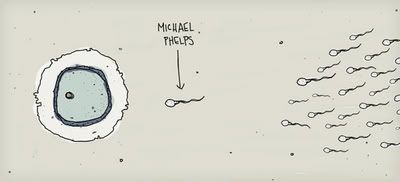
Following up on the post about body bakeries, here’s proof that there really is a blog for everything: a digest of "when professional cakes go horrendously, hilariously wrong."
Following up on the post about body bakeries, here’s proof that there really is a blog for everything: a digest of "when professional cakes go horrendously, hilariously wrong."
Stories like this one predicting – with almost no dissent – a solid Democratic Senate this November highlight just how presidency-centric elections have become. There are three branches of government, and two parts of the legislative branch. Both McCain and Obama will have to deal with this, even in foreign policy. And yet the focus on these races in the national media is infinitesimal for the most part. If you need evidence of America’s slow transformation into an elective monarchy, this campaign, combined with the war-powers of the last eight years, is certainly helpful.
From Photobucket via 2parse:

In the end, however, the semi-colon is like death; we must all face it alone.
Schwenkler flogs Ben Smith for pointing out Jill Stanek’s extremism.
"At the risk of heresy, let it be said that setting up the two presidential candidates for religious interrogation by an evangelical minister — no matter how beloved — is supremely wrong. It is also un-American.
For the past several days, since mega-pastor Rick Warren interviewed Barack Obama and John McCain at his Saddleback Church, most political debate has focused on who won… The winner, of course, was Warren, who has managed to position himself as political arbiter in a nation founded on the separation of church and state. The loser was America…
His format and questions were interesting and the answers more revealing than the usual debate menu provides. But does it not seem just a little bit odd to have McCain and Obama chatting individually with a preacher in a public forum about their positions on evil and their relationship with Jesus Christ?" – Kathleen Parker, Townhall.com.
Reihan has a smart dispatch on Musharraf’s legacy:
During a landmark speech in January 2002, Musharraf essentially declared war on the Islamic extremists who’d been hollowing out the Pakistani state from within. Popular support for the government – and for the government’s decision to side with the United States – was extremely high. The United States and its allies had offered a generous aid package, and the Islamists were at their weakest. Had Musharraf sought a power-sharing arrangement with the secular opposition at this point, he would have had tremendous moral authority to crush armed opponents of the government and to reform Pakistani society. But instead Musharraf chose to nurse various Islamist guerrilla armies back to health, to continue to use them against India and, later, Afghanistan. He undermined the rule of law to cling to power, and in doing so he undermined all of the goals he had originally set out to achieve. So it is no wonder that Pakistan’s tenuous alliance with the United States has also been discredited in the eyes of the Pakistani masses. After all, the United States stood by as Musharraf made a mockery of his democratic commitments, and turned a blind eye as he armed Islamist militants with one hand while "fighting" them with the other.
Rudy Giuliani is going to deliver the Republican keynote address.

In response to this post, a reader directs me to this arresting series of drawings made by a former Vietnam POW Mike McGrath. They detail how the Vietnamese tortured American soldiers and sailors. The depictions are almost identical to those now used by the Bush administration against terror suspects. The picture above shows a combination of a stress position, sleep deprivation and hypothermia, all used separately and in combination by the Bush-Cheney team.
Many men were handcuffed or tied to a stool as a means of slow torture. The POW sat in one position, day and night. Each time he would fall over, the guards would sit him upright. He was not allowed to sleep or rest.
Exhaustion and pain take their toll. When the POW agreed to cooperate with his captors and acquiesced to their demands, he would be removed. Here, I have pictured a guard named "Mouse," who liked to throw buckets of cold water on a man on cold winter nights.
The Bush torture program doesn’t have to wait for cold winter nights. They use air-conditioning to freeze prisoners into submission.

 The Dish