Party And Personal Interests

Andrew Gelman contemplates strategic retirement:

It’s expected to be a good year for the Democrats, and so now should be the time for them to make some investments in new, young candidates. They should encourage lots of their incumbents to retire, because in 2008, they can win a lot of these districts without needing the incumbency advantage (estimated to be about 10% of the vote, i.e., enough to take you from 50% to 60%). Conversely, this is the time for the Republican Party to hold on to what it has, and to keep all their incumbents in, trying to hold out until 2010 when the pendulum might swing back in their favor. But we don’t see that—actually, something like 30 Republican House members are retiring this year.

Republicans retiring, Democrats sticking around—that’s a recipe for big Democratic gains this year. But then in 2010, or 2014, or whatever year it is when the Democrats get wiped out—then a bunch of their incumbents will probably retire, and boy will the Democrats wished they had put in younger incumbents back in 2008 when they had a chance!

One of the difficulties here is that I’m talking about the long-term goals of the parties, but “the parties” are, to a large extent, simply their officeholders. And congressmembers’ incentives can be much different from those of the party as a whole. In particular, it makes sense that an incumbent congressmember will want to quit in a year when he or she would be facing a tough reelection battle, and when the prize for winning is to remain in the minority. Conversely, why step down when you’re facing an easy reelection and the prospect of some juicy committee assignments? So the individual officeholders have an incentive for pro-cyclical behavior, even if it harms their party’s long-term interest.
Correction Of The Day

"In yesterday’s column about badminton, I misspelled the name of Guatemalan player Kevin Cordon. I apologize. In my defense, I want to note that in the same column I correctly spelled Prapawadee Jaroenrattanatarak, Poompat Sapkulchananart and Porntip Buranapraseatsuk. So by the time I got to Kevin Cordon, my fingers were exhausted," – Dave Barry, The Miami Herald.

McCain Responds, Again

Goldfarb, at the McCain Report, talks to another POW, Bud Day, one of McCain’s closest allies, who backs McCain’s story:

"We were bringing each other up to date, he was telling me how he [McCain] had been tortured," Day said. The guards had "busted his arm," and "John was complaining that they’d treated him like an animal." Day said "the only friendly thing the [guards] ever did was hit me on the leg instead of on the head." But, according to Day, McCain wouldn’t condemn them all, telling the other men of the occasional act of decency he’d witnessed from his captors. Day says McCain told him how one of those guards had "made a cross with his foot and wiped it out."

So the ad imagery with the stick is wrong, according to Day. And no Christmas dating.

Does Bush Believe McCain Was Tortured?

Agabuse

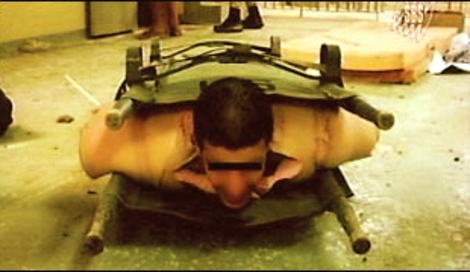
In all the discussion of John McCain’s recently recovered memory of a religious epiphany in Vietnam, one thing has been missing. The torture that was deployed against McCain emerges in all the various accounts. It involved sleep deprivation, the withholding of medical treatment, stress positions, long-time standing, and beating. Sound familiar? According to the Bush administration’s definition of torture, McCain was therefore not tortured.

Cheney denies that McCain was tortured; as does Bush. So do John Yoo and David Addington and George Tenet. In the one indisputably authentic version of the story of a Vietnamese guard showing compassion, McCain talks of the agony of long-time standing. A quarter century later, Don Rumsfeld was putting his signature to memos lengthening the agony of "long-time standing" that victims of Bush’s torture regime would have to endure. These torture techniques are, according to the president of the United States, merely "enhanced interrogation."

No war crimes were committed against McCain. And the techniques used are, according to the president, tools to extract accurate information. And so the false confessions that McCain was forced to make were, according to the logic of the Bush administration, as accurate as the "intelligence" we have procured from "interrogating" terror suspects. Feel safer?

The cross-in-the-dirt story – although deeply fishy to any fair observer – is in the realm of the unprovable. But the actual techniques used on McCain, and the lies they were designed to legitimize, are a matter of historical record. And the government of the United States now practices the very same techniques that the Communist government of North Vietnam once proudly used against American soldiers. When they are used against future John McCains, the victims will know, in a way McCain didn’t, that their own government has no moral standing to complain.

Now the kicker: in the Military Commissions Act, McCain acquiesced to the use of these techniques against terror suspects by the CIA. And so the tortured became the enabler of torture. Someone somewhere cried out in pain for the same reasons McCain once did. And McCain let it continue.

These are the prices people pay for power.