Sarah’s Pork

No different than anybody’s, it turns out. Including that "bridge to nowhere." In fact, of course,

The Alaska governor campaigned in 2006 on a build-the-bridge platform, telling Ketchikan residents she felt their pain when politicians called them "nowhere."

She then switched, faxed the press release to New York, kept the money for other pork projects and built the road to the bridge to nowhere, which makes it, I think, the road to nowhere.

The Future Of The GOP?

Larison is back from his vacation:

…should McCain-Palin win in ‘08, Palin is not going to be the future of the Republican Party at a national level.  Barring some accident or a one-term pledge, should they somehow prevail this time, Palin will likely remain second fiddle to McCain in 2012 as well and will probably then be reduced to the status of Thomas Marshall and, yes, Dan Quayle.  Should McCain not seek renomination, Romney, Huckabee and Pawlenty are all going to be waiting to take advantage of discontent with a President McCain, of which there will be plenty. 

Hurricane Palin

Josh Green talks to stunned Republicans in Minneapolis:

Most Republicans have never met Sarah Palin and are processing the news of her selection as VP with the stunned-but-well-meaning emotions you might feel toward an acquaintance who just came out of the closet. Those given to caution when discussing such things at a brunch with journalists put a hopeful, might-be-a-stroke-of-genius spin on their astonishment. Those less inhibited–who are also better people–generally see the pick as irresponsible and politically motivated (and not in a good way). No one believes Palin was fully vetted. And no one has any idea how this will play out.

Conservative Internationalism?

Henry Nau turns a phrase:

Ronald Reagan tapped into a new and different American foreign policy tradition that has been overlooked by scholars and pundits. That tradition is “conservative internationalism.” Like realism and liberal internationalism, it has deep historical roots. Just as realism takes inspiration from Alexander Hamilton and Teddy Roosevelt and liberal internationalism identifies with Woodrow Wilson and Franklin Roosevelt, conservative internationalism draws historical validation from Thomas Jefferson, James K. Polk, Harry Truman, and Ronald Reagan. These four American presidents did more to expand freedom abroad through the assertive use of military force than any others (Lincoln doing as much or more to expand freedom domestically by force). But they expanded freedom on behalf of self-government, local or national, not on behalf of central or international government, as liberal internationalists advocate, and they used force to seize related opportunities to spread freedom, not to maintain the status quo, as realists recommend. All of these presidents remain enigmas for the standard traditions.

The Case For Staying Indefinitely

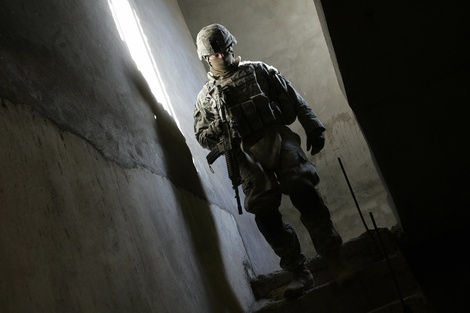
Baqubagianluigiguerciaafpgetty

Stephen Biddle, Michael O’Hanlon, and Kenneth Pollack argue that withdrawing from Iraq is a mistake:

Some argue that to [raise the potential of creating a new and better political order in Iraq], the United States must withdraw, or threaten to withdraw, its troops. They believe this would force Iraqi leaders to put their differences aside and reach a grand compromise on reconciliation, because Iraqis would need to solve their own problems either without a U.S. military crutch or in order to preserve a U.S. presence as a reward for reconciliation. There is some merit to this logic. It is true that the presence of U.S. forces reduces the stakes for Iraqi politicians, since it limits violence. And if Iraq faced chaos otherwise, a threat of withdrawal would certainly be worth trying. But withdrawal is a risky gambit. And progress is now being made without it: violence is down dramatically, and political change, although slow, is under way. Threatening withdrawal might speed this progress, but today it seems more likely to derail it instead.

Reconciliation will require all the major Iraqi factions to accept painful compromises simultaneously. If any major party holds out and decides to fight rather than accept risky sacrifices for the larger good, then its rivals will find it very hard to hold their own followers to the terms of a cease-fire — likely plunging Iraq back into open warfare. If reconciliation can be done slowly, via small steps, then each stage of compromise is likely to be tolerable, with the risk of one holdout party exploiting the others kept to a manageable level. In contrast, if reconciliation must be done quickly, with a grand bargain rapidly negotiated in the face of an imminent U.S. withdrawal, the necessary compromises will be great — making them extremely risky for all parties. In a factionalized, poorly institutionalized, immature political system such as Iraq’s, many parties would doubt their rivals’ motives and could refuse to make such large and risky compromises. The Iraqis, out of fear for their own safety, might well respond to a threatened U.S. withdrawal by preparing for renewed warfare. Rather than persuading the Iraqis to accept huge risks together, a threat of withdrawal would more likely produce the opposite effect.

Leverage to encourage compromise is important, as advocates of withdrawal argue, and U.S. policy has up to now erred in rejecting conditionality for U.S. aid and cooperation. But threatening withdrawal is hardly the only or the best way of gaining such leverage. Any element of U.S. policy can be made conditional — economic assistance, military aid, the U.S. position in negotiations over the legal status of U.S. forces — by offering benefits only in exchange for Iraqi cooperation. Withdrawal is the biggest potential threat that Washington can issue, but it is also a blunt instrument with great potential to damage both parties’ interests. In an environment of increasing stability, the United States can now hope to succeed with subtler methods.

The whole thing is worth a read. It’s really the case for an open-ended liberal imperialism. It’s good in a way that that agenda is now honestly on the table.

(Photo: US soldier in Baquba by Luigi Guercia/AFP/Getty.)

Bug Oil

A nibble of Lisa Margonelli’s article on how termites could save the world:

A worker termite tears off a piece of wood with its mandibles and lets its guts work on it like a molecular wrecking yard, stripping away sugars, CO2, hydrogen, and methane with 90 percent efficiency. The little biorefineries inside each termite allow the insects to eat up $11 billion in U.S. property every year. But some scientists and policy makers believe they may also make the termite a sort of biotech Rumpelstiltskin, able to spin straw—or grass, or wood by-products—into something much more valuable. Offer a termite this page, and its microbial helpers will break it down into two liters of hydrogen, enough to drive more than six miles in a fuel-cell car. If we could turn wood waste into fuel with even a fraction of the termite’s efficiency, we could run our economy on sawdust, lawn clippings, and old magazines.

Will The Levees Hold?

Kathryn Jezer-Morton and Gray Miles report:

Gustav is expected to be comparable in strength to Katrina, which was also a Category 3 hurricane. However, Katrina, which breached levees and flooded low-lying areas like Lakeview, Gentilly and the Lower 9th Ward, made landfall east of New Orleans. Gustav is on track to hit west of the city, and those eastside levees that are still not fully repaired may not have to bear the brunt of the storm surge. In 2008, the levees on the west bank of the Mississippi River are more threatened.

This time, at least, city and state officials have done an excellent job of getting everyone out.