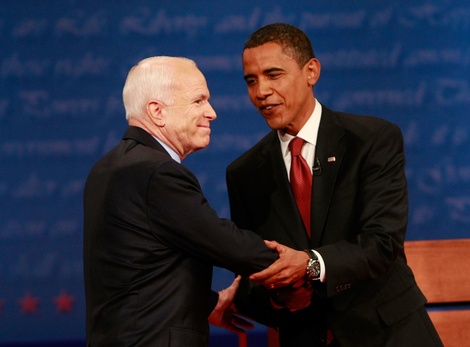
The Polls Say Obama Won

That was my impression too. I was much more impressed with Obama’s performance than many other bloggers. Here’s the CNN poll:

Thinking about the following characteristics and qualities, please say whether you think each one better described Barack Obama or John McCain during tonight’s debate:

Was more intelligent: Obama 55%, McCain 30% Expressed his views more clearly: Obama 53%, McCain 36% Spent more time attacking his opponent: McCain 60%, Obama 23% Was more sincere and authentic: Obama 46%, McCain 38% Seemed to be the stronger leader: Obama 49%, McCain 43% Was more likeable: Obama 61%, McCain 26%

Was more in touch with the needs and problems of people like you: Obama 62%, McCain 32%

Since the economy has emerged as the biggest issue, these two findings on who did better on what topic are pretty important:


The economy: Obama 58%, McCain 37%


The current financial crisis: Obama 54%, McCain 36%

And from CBS:


Thirty-nine percent of uncommitted voters who watched the debate tonight thought Barack Obama was the winner. Twenty-four percent thought John McCain won. Thirty-seven percent saw it as a draw.
 
Forty-six percent of uncommitted voters said their opinion of Obama got better tonight. Thirty-two percent said their opinion of McCain got better.  
 
Sixty-six percent of uncommitted voters think Obama would make the right decisions about the economy. Forty-two percent think McCain would.

Kissinger Speaks

He’s not happy according the Weekly Standard:

"Senator McCain is right. I would not recommend the next President of the United States engage in talks with Iran at the Presidential level. My views on this issue are entirely compatible with the views of my friend Senator John McCain. We do not agree on everything, but we do agree that any negotiations with Iran must be geared to reality."

Debate Reax

Fallows:

Unless it happened when I glanced away, up until this moment, 77 minutes into the 90-minute debates, John McCain has not once looked at Obama — while listening to him, while addressing him, while disagreeing with him, while finding moments of accord.

This is distinctly strange — if anyone else notices.  Obama is acting as if this is a conversation; McCain, as if he cannot acknowledge the other party in the discussion.

Rod Dreher:

I think Obama has to be judged the winner. Nobody’s mind will be changed by this debate, but Obama seemed loose and confident and not intimidate by McCain. McCain seemed growly and tense, though more focused than usual. Because McCain didn’t beat Obama, and because Obama is ahead right now, Obama wins a narrow victory.

Ambinder:

No  memorable moments.  Fascinating body language. No major gaffes by either candidates. No major surprises…A good debate for both men…Thresholds are artificial, but both candidates seemed to meet them – although Obama’s threshold was arguably higher.  The press will probably conclude that McCain did not fundamentally change impressions tonight.  And that Obama held his own.

Alex Massie:

McCain can’t pronounce Ahmadinejad. Calls him "Armada Dinner Jacket". Since the bearded wonder doesn’t control Iranian nuclear or foreign policy this doesn’t matter so much. Woo! Obama points this out. Then suggests McCain is no Henry Kissinger. That may not be a bad thing of course. (Admittedly, Obama is talking about Iran.) Admits his Iranian policy "may not work". A welcome breath of realism…

Michael Crowley:

A key element to political speech is colorful detail and anecdote. McCain is better at that. The story about defying Reagan on the Lebanon deployment, the bracelet belonging to the mother of a dead soldier, the firing of Chris Cox, the bear DNA. These things breathe life into policy positions and prevent the eyes from glazing. It’s something Obama could learn to do better.

Ross:

A win for McCain. That’s my insta-verdict, at least…the spectre of fiscal calamity blunted Obama’s edge on domestic policy, and on foreign affairs McCain set the tempo and kept his rival on the defensive almost throughout, I thought: The Democratic nominee found himself alternating between me-tooism and defensiveness, albeit without making any serious missteps.

Michael Graham:

Obama win because he didn’t lose.  Sen. McCain was better, but not by enough.

Ezra Klein:

This is a pretty traditional debate performance for Obama. Strong on substance. Few mistakes. Little in the way of killer instinct or decapitating lines. McCain, by contrast, is offering an uncommonly strong performance powered, as far as I can tell, by his raging contempt for Obama. He won’t look at him. He’s using "what Senator Obama doesn’t understand" the way Joe Biden uses "ladies and gentlemen." His constant refrain is the places he’s visited, leaders he’s befriended, aging advisers and presidents he’s known. Obama is conveying the fact that he thinks McCain wrong. But McCain is conveying the fact that he thinks Obama an unprepared lightweight. One of these is a stronger claim than the other.

Jay Reding:

Here’s my take: in the economic section, Obama very narrowly won. On the foreign policy section, McCain won. In the end, the dynamics of this race won’t change. McCain didn’t do what he needed to do to take Obama out, but Obama didn’t do anything to take down McCain either. McCain had the best lines of the night, especially on talking to Iran. However, the foreign policy part of the debate was overshadowed by the economic parts, which gives the narrowest advantage to Obama. 

Drum:

Am I off base, or was this one of the most soporific presidential debates in a while? Frankly, I didn’t think either one of them did very well. There was way too much rambling, and way too few sharp points. Overall, McCain was more lively than Obama, but if the point of the debate was for Obama to show that he could hold his own on national security, then count it a win for Obama. I wouldn’t call him a big winner, but he certainly did at least as well as McCain, and that might have been all he needed.

Althouse:

In the end, I’d say, McCain made more good points and got in more punches, but Obama stood his ground and maintained his stature on stage next to McCain, even as McCain repeatedly tried to portray him as a lightweight. I should add that McCain never seemed too old, short, or lacking in vigor, even on HDTV. Obama looked fine too, and I never saw that upturned face, with the eyes gazing downward, that made him seem supercilious in those old debates with Hillary Clinton.

John Hinderaker:

As the evening went on, McCain did better. He started landing some shots against Obama. But I suspect it was too little, too late. It’s always hard to guess what the typical "swing voter"–which is to say, for the most part, people who are ill-informed–will make of a Presidential debate. I hope that some, at least, got a sense that Obama is a BSer who often has little idea what he is talking about and constantly runs away from his record. That’s just a hope, though. I think Obama probably improved his chances tonight.

Yglesias:

All things considered, it’s about a draw. McCain got a couple of good punches in and so did Obama. Insofar as the idea is supposed to be that McCain has a domineering advantage on national security he certainly didn’t prove that point. And for the candidate who’s losing, a tie amounts to a loss. He needs to find opportunities to gain ground on Obama and he doesn’t seem to me to have gotten much done.

Watching With The Sound Down

A reader writes:

If you judge this debate purely on the "how to debate on tv" standards, McCain did poorly. He never looks at Obama. He giggles nervously and his eyes dart away, and at the precise moments when Obama is landing a punch–when McCain should be standing tall and looking elegant or bemused, as JFK or Clinton would have–his eyes blink and he looks down nervously and away, like he’s hiding something, just like Nixon used to!

Basically, here it is: With the sound down, Obama took it, hands down.

My main stylistic impression was that Obama was crisper than usual, sharper, and more aggressive than in his debates with Clinton.

Live-Blogging Reax

Olemissreaxtimsloanafpgetty

Lots of other live-blogging going on tonight. Larison:

Obama is doing quite well, especially as compared to some of his clumsy primary performances.  McCain is starting to let his contempt for Obama show.  He keeps laughing like some sort of disturbed gremlin.  Obama has avoided his old habit of disjointed, professorial answers. 

Ben Smith:

A sharp contrast in their approach to the crisis: Obama seeks, twice, to pin blame on McCain and on the Republicans; McCain looks forward and tries to cast his efforts in Washington, and the House Republican stance, as a triumph of bipartisanship.

Michael Crowley:

Obama would do well not to say things like "al Qaeda are attacking our troops in a brazen fashion, they feel emboldened." It’s academic language to describe something he should be passionate and visceral about. It reminds me of John Kerry.

Peter Suderman:

Obama projects understanding, intelligence, and confidence.

He’s a politician, yes, and thus speaking with the requisite platitudes and bromides, but he’s someone who projects comfort with his own presence, with the issues at hand, with politics in America as they stand — and with his ability to deal with the current situation effectively and competently.

McCain, on the other hand, already seems dejected and down — slow, morose, unhappy with his lot. He’s falling back on easy populist talking points, and he seems almost entirely unprepared — which is why, when answering questions about the financial crisis, he’s rambling on about essentially tangential issues like drilling for oil and earmarks.

John Cole:

Obama seems to be keeping his cool, and McCain is testy.

Ambinder:

Headline of debate so far: McCain Calls For Federal Spending Freeze.

Yglesias:

NBC, at least, is gerrymandering their split screen views of the two candidates in such a way as to obscure the fact that Barack Obama is considerably taller than John McCain.

Josh Marshall:

So far I think this is basically a draw, a lot of jousting, not a lot of hits. But Obama seems to have come into the debate with a much clearer strategy.

Megan:

I don’t understand why the moderator is letting McCain and Obama talk about their budget proposal as if there is a snowball’s chance in hell that they will be enacting any of these plans.  They won’t.  The current crisis has blown any chance of big spending plans or tax cuts.  Even without the bailout package, America’s tax revenues are going to look pretty anemic next year.  As goes Wall Street, so go income taxes.

Hilzoy:

I think Obama is being basically clear; if he has a weakness, it’s moving through too many points. It’s as though he’s reading a very crisp outline, very quickly. McCain, by contrast, is rambling, but in an aggrieved sort of way.

Jim Geraghty:

Twenty-five minutes in, McCain started a little sleepy and now seems to have his Irish up. (And I’m not just saying that because he compared the American corporate tax rate to Ireland’s.) Obama isn’t terrible, but he really is a different guy when he’s debating than when he’s giving a speech – much less polished, almost halting. Also, he seems determined to go after McCain, and I don’t think that is precisely what he needs to do tonight. All he’s got to do is convince people, "I can handle this job."

Think Progress:

McCain has already used the joke that he wasn’t “elected Miss Congeniality in the Senate” twice during this debate. Ironically, Sarah Palin was Miss Congeniality.

I’ll round up more considered reactions to the debate later tonight.

(Photo: People watch the first televised presidential debate between Republican John McCain and Democrat Barack Obama at a bar called Top of The Hill on September 26, 2008 on Capitol Hill in Washington, By Tim Sloan/AFP/Getty Images.)

Kissinger On Engaging Iran

I don’t want to get into semantics about preparations and preconditions, but here’s a recent article that cites Kissinger:

Former U.S. Secretary of State Henry Kissinger says the United States should begin direct negotiations with Iran over its nuclear enrichment program. Kissinger, speaking Monday at George Washington University along with four other former U.S. State Department secretaries, said the next president should initiate high-level discussions with Iran "without conditions," ABC News reported.

In general there is no doubt that Kissinger, who was prepared to meet with Mao, is not exactly queasy about directly engaging foreign tyrants. He’s a realist and McCain is now a full metal neocon. Obama is much more in the Kissinger tradition than McCain is. But, frankly, I’m not sure what McCain is any more. And I’m not entirely clear he knows either.

Live-Blogging Ole Miss

Olemisswinmcnameegetty 10.31 pm. It strikes me as a mistake for McCain to end the debate on his commitment to staying in Iraq indefinitely. Obama’s emphasis on the broader global conflict and our broader responsibilities will reach more people. His vision seems broader, wiser, and more focused on ordinary people. A masterful performance tonight, I think. Obama’s best ever debate performance. McCain was fine, but it’s wrong for him to attack his opponent at the end. And then he gave a slightly rambling defense of his experience. I give Obama an A – and I give McCain a B. 10.30 pm. Obama ends with a focus on al Qaeda and loose nukes. Vital. Important. People get it. And Obama’s nod to McCain on torture was graceful. We may soon end this nightmare of barbarism in the heart of the United States. And then we can bring the war criminals to justice. 10.28 pm. I must say I am grateful that John McCain has now stated twice that the United States has engaged in torturing prisoners. The use of that word clearly is important. It reassures me that he would, if president, end the shameful record and war crimes of Bush and Cheney. 10.27 pm. On the connection between energy independence and national security, Obama was very strong. He’s the most forceful and commanding candidate the Democrats have put up in my living memory. 10.21 pm. McCain has argued that Russia is run by the KGB and that Georgia should be included in NATO which means going to war if Russia were to attack Georgia.

10.17 pm. Does McCain understand that talking directly to the Iranians does not necessarily mean Ahmadinejad? In his foreign policy approach, he seems identical to Bush-Cheney. I can’t believe most Americans want to continue the foreign policy of the last eight years.

10. 08 pm. Obama’s answer on Iran was strong and cogent. And his deployment of Kissinger against McCain was brilliant. I really say that between the realism of Obama and the posturing of McCain, the foreign policy maturity is on the Democrat’s side.

10.05 pm. McCain has framed his policy toward Iran almost exclusively around Israel and preventing a second Holocaust. These are both admirable concerns. But the first priority of the president must be the national security of the United States.

10.02 pm. Obama just pwned McCain on using the troops as an emotional weapon. And then he has kept intense focus on Afghanistan. All McCain can do is suggest that Petraeus opposes Obama which is untrue, and to say how far he’s traveled around the world.

9.53 pm. McCain concedes the failure in Afghanistan. Obama seems very authoritative. He seems to be passing the presidential. His exchange on Pakistan seemed to me to be a real turning point. He basically outed McCains distortion of his position and yet managed to seem more aggressive in foreign policy than the Republican. He’s no Dukakis. He’s no Kerry. He’s winning on the issue of national defense. That’s new. And McCain keeps gong back to claims that he knows more. And goes back to the Reagan era. This is the first exchange on national security in a presidential debate where the Democrat out-hawked, in a responsible way, the Republican.

9.46 pm. Obama doesn’t know the difference between a tactic and a strategy! That’s according to McCain.

9.43 pm. I cannot believe that Obama has not been tougher on the war in Iraq.

9.37 pm. Finally Obama manages to pin the massive spending increases in spending on the Republicans. About time!

9.30 pm. Both candidates refuse to say that spending can only be brought down by tackling entitlements and defense. McCain keeps talking about minor spending issues. Obama is also only talking about minor issues.

9.28 pm. What strikes me is McCain’s insistence on pork. What strikes me about Obama is his forcefulness. He doesn’t sound academic or pointy-headed. He seems decisive and executive. McCain seems more of a debater.

9.15 pm. Does McCain really believe that earmarks are the only problem with government spending? They’re bad, but they are not anything like the real problem.

9.11 pm. McCain is still defending his silly proposal to fire Chris Cox. Obama keeps bringing it back to ordinary Americans and the recent past. He keeps trying to return to the theme of the Republican responsibility.

9.08 pm. McCain seemed a little less engaged and forceful. And the reference to the Republicans in Congress seemed a little insidery to me.

9.06 pm. Obama’s opening statement struck me as more forceful and energetic, and less academic than usual.

The Stakes

Marc has a pre-debate run-down:

What resonates are moments — the debate is taking place against the backdrop of a crisis, and it is the candidates’ responses to the crisis, in real time, that will leave the most impressions.

The stakes are high for Obama here as well, but McCain is the one who’s going to be defending his questionable choices of late.

Before The Debate

Where things stand going in:

On the eve of the first Presidential Debate, Barack Obama is perhaps in as strong a position in the polls as he has been all year, now projecting to win the election 74.7 percent of the time. Both the state and the national polls that have come out within the past 48 hours have generally been quite favorable to Obama, and suggest that he may gained an additional point or so above and beyond his "Lehman Leap" from last week.

Which means Obama has to look presidential and make no obvious mistakes. I think all he needs at this point is to pass the commander-in-chief threshhold. Like Reagan had to in 1980. And then if it breaks, it probably breaks big – big enough, one hopes, to overcome the race-based five point margin that will always have to be subtracted from his total.