Adam Thierer groups the web optimists and the web pessimists. Yglesias adds his two cents here.
Month: September 2008
Pigs And Lipstick
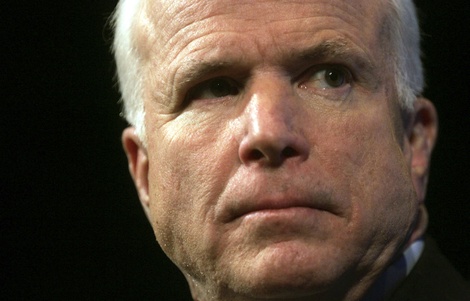
So it’s come to this. The full context of Barack Obama’s quote is as follows:
“John McCain says he’s about change, too — except for economic policy, health care policy, tax policy, education policy, foreign policy and Karl Rove-style politics. That’s just calling the same thing something different.”
With a laugh, he added: “You can put lipstick on a pig; it’s still a pig. You can wrap an old fish in a piece of paper called change; it’s still going to stink after eight years.”
We are being asked to believe that he called Sarah Palin a pig. If the people making that accusation have half a brain they know it’s not true. This is not a question of interpretation. It is a fact. So we now find out again that John McCain is prepared to tell an absolute lie – in public, verifiable, uncontestable.
He does not have the minimal public integrity to be president of the United States.
Game this all you want; distort it all you want; bamboozle the morons at cable news all you want; win however many news cycles you want.
This claim is absurd on its face, like the Palin nomination to begin with. Absurd. And you can now tell who on the right has even a scintilla of intellectual honesty. That’s all this episode is about: another tail-spin in the death throes of the Republican party.
My only advice to Obama: stay calm; stay cool; focus on the issues; behave like the president you want to be. They are trying to get into your head. But you are so much smarter and more decent than they are. Patience. And steel.
(Photo: Mario Tama/Getty.)
Sarah Palin Preps For Charlie Gibson
The War Spreads To Pakistan
Clint Douglas is wary:
Our efforts in Afghanistan have never been a priority, lacking both urgency and focus, something that was frustratingly obvious when I deployed there back in 2003. The latest trend points to an American expansion of operations into western Pakistan. The most recent involves a Predator drone strike on a madrassa run by Jalaluddin Haqqani, an infamous Taliban commander. This on the heels of other Predator strikes and a raid deep inside Pakistan by American and Afghan troops marks a significant escalation.
I have no problem with denying our enemies the secure rear areas that they have enjoyed in Pakistan, however, the consequences of these operations cannot be overstated. Pakistani madrassas have always driven the fighting in Afghanistan. They are already flooding Afghanistan with both fighters and suicide bombers. Given that attacks on Pakistani soil have and will result in civilian casualties, this trend can only significantly accelerate. There could be a pay off to all of this if we and our allies had enough troops to secure Afghanistan itself, but we don’t and won’t for the immediate future.
Web Records
Rob Horning questions if music is still a product:
…despite the hype about the long tail and Web 2.0, the internet doesn’t give musicians new ways to make money. It creates conditions in which musicians are paid instead in a different currency, recognition, and whether or not this has any value depends on the context one’s working in. If you need to sell music to feed yourself and pay rent, you are not cheered by the number of views your song’s video has received. But if you are making money through some other job and make music for a feeling of cultural participation, the clicks count.
But where’s my Internet money?
Why Trig Matters

A beautiful column by Michael Gerson this morning on the power of an infant to help open our eyes to the horror of abortion:
Of the cases of Down syndrome diagnosed by prenatal testing each year, about 90 percent are eliminated by abortion. Last year the American College of Obstetricians and Gynecologists recommended universal, early testing for Down syndrome — not just for older pregnant women. Some expect this increased screening to reduce the number of Down syndrome births to something far lower than the 5,500 we see today, perhaps to fewer than 1,000.
Say all you want about Sarah Palin’s non-existent record on foreign policy, series of public lies, non-existent vetting and absurd, unprecedented shielding from the press. At least we know this for sure: she went through the psychological, emotional and spiritual test of eight months of pregnancy and a painful, difficult, endless labor for a cause she believes in.
Trig represents in one simple, indelible image one mother’s decision not to do the expedient thing. Tyler Cowen was right when he wrote at the very outset:
There is one biographical fact about Palin’s life that the critics (Drum, DeLong, Yglesias, Klein, Sullivan and Kleiman are among the ones I read) are hardly touching upon. I mean her decision to have a Downs child instead of an abortion. This is the fact about her life and it will be viewed as such from now through November and perhaps beyond.
I agree (and I have said so from the start). Some people talk about the culture wars. Other people live them. And Palin did it at some risk to herself. A Down Syndrome baby at 43 is no cake-walk. There could have been many complications. Palin, moreover, was the governor of a state – at the peak of her career. Unlike most pro-life women, Palin had to be prepared for such a public pregnancy and take the small risk to her unborn child of an amniocentesis.
Despite what some on the far right believe, I am not a woman and not the governor of a state and have no idea what the experience of an inconvenient pregnancy is. But I do respect someone who walks the walk of their ideals – even if their career is in full swing, even if there are dangers to the pregnancy, even if her own family is unfortunately lit up by the klieg-light of attention. In this ecision, Palin was both pro-choice and pro-life, which is where I come down on this issue. She didn’t force anyone else to have this child by law. She made the choice herself – with all the possible consequences.
My hat is off to her. I this respect, if on nothing else, I think both pro-choice and pro-life people can agree.
The Most Dangerous Nation
Hampston Stephens worries about Pakistan’s new president:
Steve Coll asks another interesting question: Given that Zardari seeks to bring Pakistan’s nuclear arsenal under greater civilian control (it’s now controlled by the country’s military), should we worry about reports that Zardari suffers from "dementia, major depressive disorder and post-traumatic stress disorder"?
Bush’s Speech
Marc Lynch speculates about why Bush has decided not to lower troop levels before the end of his presidency:
Bush clearly fears – rightly or wrongly – that a reduction of American military forces would lead to an outbreak of violence which might interfere with the McCain campaign’s ‘return on success’. The military commanders, meanwhile, understand all too well the fragility of the current situation in Iraq: the risks of the upcoming ‘transition’ of the Sons of Iraq program, the conflicts between Iraqi government forces and the Kurdish Peshmerga in Diyala, the intensifying conflicts between the Anbar Salvation Council and the Islamic Party in Anbar, the political stalemate which led to the postponement of the provincial elections, and so on. They don’t want fewer troops at their disposal if they can get away with it because, frankly, why would they if they don’t have to? Bush’s refusal to significantly draw down troops as a "return on success" tells you what you need to know about how the decision makers really feel about the amount of "success."
What The Surge Did
Judah Grunstein concedes a few points about the surge:
…the Surge did accomplish two things. By signalling Bush’s unwavering commitment to America’s military engagement, it helped convince the various Iraqi factions that whether or not they ultimately resolve their differences through bloodshed, they’d stand to gain by waiting until after we’re gone to do so. And should the security gains hold until the American drawdown is complete (whenever that is), the Surge will have allowed the American military to withdraw from Iraq with its coercive reputation intact. And that’s indispensable if American power, in both its soft and hard expressions, is to be credible.
If you see the surge as an exit strategy, it makes some sense. As Petraeus himself notes, he was also lucky – and shrewd enough to capitalize on his luck. The question that still worries me is whether the Awakening Movement can come to terms with the Shiite government. I see plenty of reasons for extreme worry on that count. I think some civil war is inevitable once we leave, if we ever do.
Modern Nomadic Living
The lifepod. I need one.
 The Dish