
Four years’ ago, before I ever dreamed it would happen to me, I wrote the following short essay for Time, trying to explain to people who might not fully understand why the m-word means so much to many of us gay men and lesbians. We may not be a majority of human beings – we are probably only 2 to 3 percent – but that doesn’t make us any less human beings, and for us, access to marriage, to full membership in our own families, is the dream of our lives, and the struggle of my own life. Please, do what you can in California not to have this taken away from so many:
As a child, I had no idea what homosexuality was. I grew up in a traditional home — Catholic, conservative, middle class. Life was relatively simple: education, work, family. I was raised to aim high in life, even though my parents hadn’t gone to college. But one thing was instilled in me. What mattered was not how far you went in life, how much money you earned, how big a name you made for yourself. What really mattered was family and the love you had for one another. The most important day of your life was not graduation from college or your first day at work or a raise or even your first house. The most important day of your life was when you got married. It was on that day that all your friends and all your family got together to celebrate the most important thing in life: your happiness — your ability to make a new home, to form a new but connected family, to find love that put everything else into perspective.
But as I grew older, I found that this was somehow not available to me. I didn’t feel the things for girls that my peers did. All the emotions and social rituals and bonding of teenage heterosexual life eluded me. I didn’t know why. No one explained it. My emotional bonds to other boys were one-sided; each time I felt myself falling in love, they sensed it, pushed it away. I didn’t and couldn’t blame them. I got along fine with my buds in a nonemotional context, but something was awry, something not right. I came to know almost instinctively that I would never be a part of my family the way my siblings might one day be. The love I had inside me was unmentionable, anathema. I remember writing in my teenage journal one day, "I’m a professional human being. But what do I do in my private life?"
I never discussed my real life. I couldn’t date girls and so immersed myself in schoolwork, the debate team, school plays, anything to give me an excuse not to confront reality. When I looked toward the years ahead, I couldn’t see a future. There was just a void. Was I going to be alone my whole life? Would I ever have a most important day in my life? It seemed impossible, a negation, an undoing. To be a full part of my family, I had to somehow not be me. So, like many other gay teens, I withdrew, became neurotic, depressed, at times close to suicidal. I shut myself in my room with my books night after night while my peers developed the skills needed to form real relationships and loves. In wounded pride, I even voiced a rejection of family and marriage. It was the only way I could explain my isolation.
It took years for me to realize that I was gay, years more to tell others and more time yet to form any kind of stable emotional bond with another man. Because my sexuality had emerged in solitude — and without any link to the idea of an actual relationship — it was hard later to reconnect sex to love and self-esteem. It still is. But I persevered, each relationship slowly growing longer than the last, learning in my 20s and 30s what my straight friends had found out in their teens. But even then my parents and friends never asked the question they would have asked automatically if I were straight: So, when are you going to get married? When will we be able to celebrate it and affirm it and support it? In fact, no one — no one — has yet asked me that question.
When people talk about gay marriage, they miss the point. This isn’t about gay marriage. It’s about marriage. It’s about family. It’s about love. It isn’t about religion. It’s about civil marriage licenses. Churches can and should have the right to say no to marriage for gays in their congregations, just as Catholics say no to divorce, but divorce is still a civil option. These family values are not options for a happy and stable life. They are necessities. Putting gay relationships in some other category — civil unions, domestic partnerships, whatever — may alleviate real human needs, but by their very euphemism, by their very separateness, they actually build a wall between gay people and their families. They put back the barrier many of us have spent a lifetime trying to erase.
It’s too late for me to undo my past. But I want above everything else to remember a young kid out there who may even be reading this now. I want to let him know that he doesn’t have to choose between himself and his family anymore. I want him to know that his love has dignity, that he does indeed have a future as a full and equal part of the human race. Only marriage will do that. Only marriage can bring him home.
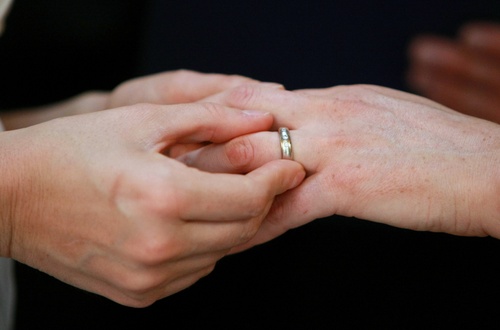
(Photo: Justin Sullivan/Getty.)
her plan is beside the point). The evil person must have tried to carry out this plan with the hope of "causing considerable harm to others," Bringsjord says. Finally, "and most importantly," he adds, if this evil person were willing to analyze his or her reasons for wanting to commit this morally wrong action, these reasons would either prove to be incoherent, or they would reveal that the evil person knew he or she was doing something wrong and regarded the harm caused as a good thing.


 The Dish
