That Alleged Baathist Coup, Ctd.

Judah Grunstein sizes up the news from Baghdad:

Whoever’s version you believe about the wave of arrests of government officials in Baghdad, the news is troubling, if not surprising. Either we’re propping up an Iraqi government that faces even more security threats than we realized, or else one that is guilty of ruthless tactics of political suppression. My first reaction to the news that these guys were plotting a coup was that it takes a serious pair to seize power by force in a country where 130,000 American troops are deployed in defense of the currently constituted government. Either that or a nod of approval from the Green Zone, which seems on the face of it absurd.

Yglesias Award Nominee

"I  have given up trying to convince most of my conservative friends of the necessity of speaking out against what has transpired these last several years with regards to the approval of torture at the highest levels of our government. But I will continue to write about it because it is something about which I feel very strongly. I will not, as many liberals do, berate those of you who disagree with me. This is a matter of conscience. Each of us must examine our own beliefs, our own mind, and come to our own conclusions in this matter.

So in the end, while the issue is a legal one, where you stand is matter of opinion. One can dismiss the legal questions and file it under the rubric of justifiable actions taken by the chief executive during a time of war. We can try and sweep the entire matter under the rug, claiming there are more important issues to address like the economy and the continued prosecutions of the wars in Iraq and Afghanistan.

Or we can bite the bullet and risk the partisan political consequences that would surely flow if any attempt is made to investigate and prosecute lawbreakers. It may drive the two sides further apart — if it is done inexpertly and in a partisan manner. But we should risk the consequences if only to prove to ourselves that the number one reason to oppose what these men did in our name is that we are a better nation and a better people than that," – Rick Moran, Pajamasmedia.

Taking Yes For An Answer

Obamajeffhaynesafp

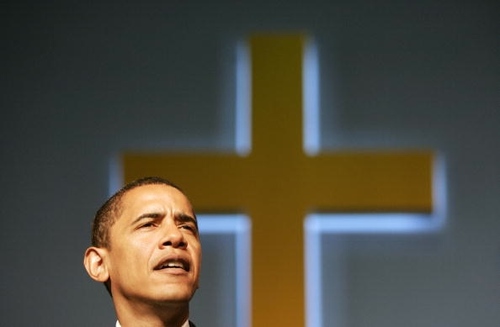
Dish readers will know my own conflicted feelings about the selection of Rick Warren for the Inaugural Invocation. But feelings must at some point cede to reason. And I sense an understandable but, the more I think about it, misjudged response on the part of my fellow gays and lesbians. In our hurt, we may be pushing away from a real opportunity to engage and win hearts and minds. Here’s Glenn Greenwald:

Reasonable arguments can certainly be advanced in defense of the virtues of Obama’s post-partisan theory of politics.  But it’s simply unreasonable to depict any of it as new.  It’s exactly what Democrats have been clinging to, desperately and mostly with futility, for two decades at least.

I disagree. I think Obama is different. I think the earnestness and sincerity of his campaign, and its generational force, have given us a chance for something new, and I fear that in responding too viscerally to the Warren choice, we may be throwing something very valuable away far too prematurely. There is no question that gays and lesbians have made enormous strides in explaining who we are in the last couple of decades. There is equally no question that Obama has substantively committed his administration to more gay inclusion and gay equality than any president in history. We absolutely do need to be vigilant on this. But we should also understand Obama’s attempt to bridge some gaps in America that the Clintons, with their boomer baggage and Dick Morris cynicism, couldn’t and didn’t. This is what matters. Do gays and lesbians want to be a part of this – or sit fuming on the sidelines at symbolic slights?

I know the arguments against this, and if Obama delivers nothing on gay equality, the critics will have every reason to complain loudly, as they should. But I’m not going there yet. And the truth is: if we cannot engage a Rick Warren on the question of our equality, we may secure a narrow and bitter victory in some states (just as the Christianists won a narrow and bitter victory in California in November). But we will not win the bigger argument and our victories will lack the moral legitimacy they deserve.

The greatest distortion of our politics in this respect is the notion that gays are in some way opposed to faith and in some way that our cause is a function solely of the left. Neither is true.

Gay people contribute disproportionately to the religious and spiritual life of this country and we seek no attack on free religion freely expressed and celebrated. I find the idea of silencing my opponents abhorrent. Many gays voted for McCain. I believe in family, which is why I have tried my whole life to integrate my sexual orientation with my own family and finally two summers ago, to become a full part of it as a married man. I love my church, however much pain it still inflicts on itself and others. And I am not alone in this, as I have discovered these past two decades.

If I cannot pray with Rick Warren, I realize, then I am not worthy of being called a Christian. And if I cannot engage him, then I am not worthy of being called a writer. And if we cannot work with Obama to bridge these divides, none of us will be worthy of the great moral cause that this civil rights movement truly is.

The bitterness endures; the hurt doesn’t go away; the pain is real. But that is when we need to engage the most, to overcome our feelings to engage in the larger project, to understand that not all our opponents are driven by hate, even though that may be how their words impact us. To turn away from such dialogue is to fail ourselves, to fail our gay brothers and sisters in red state America, and to miss the possibility of the Obama moment.

It can be hard to take yes for an answer. But yes is what Obama is saying. And we should not let our pride or our pain get in the way.

Caroline Palin, Ctd.

Just another flash of recognition:

Actually, she did speak briefly in Syracuse.

"I wanted to come upstate and meet with Mayor Driscoll and others to tell them about my experience and also learn more about how Washington can help these communities," Kennedy said. Her quick remarks fell flat. Reporters seemed to feel brushed off and they pursued her out.

"You’re not going to answer questions at all?" one asked. "Where you headed next?" another demanded.

To the car.

Paging Katie Couric.

Another Bank Bailout?

Manzi sums up where we are at:

The bailout appears likely to have helped stave off the immediate emergency we faced less than three months ago. It is very unclear how relatively fragile the credit situation is today versus September and October. While interest rate spreads have declined, it may be that Treasury knows of or suspects specific hidden weaknesses like credit default swaps that might put us right back to four-alarm-fire mode any moment.

The endless stream of huge bailout requests has come on more quickly than I expected, and appears to be contributing significantly to the momentum behind incredible spending plans, especially stimulus plans, by the new administration. The equity injection approach that has been used to date runs the risk of avoiding the necessary restructuring and financial pain that will be required to get the financial sector healthy again; and there is at least anecdotal evidence that we may be developing exactly such a zombie bank problem right now. In sum, the bailout so far has been painful, expensive and sloppy, but we’re still in one piece.

Congress has the right to approve or deny any request that Treasury might make for the second tranche of the additional $350 billion. This should be treated as a separate request. We have the luxury of time, as compared to a few months ago, to vet this request with far greater rigor, and in light of what we have learned. Specifically, before authorizing this money, Congress should perform its oversight function, and demand to know: (1) what underlying risks, not to shareholders or employees, but of systemic financial collapse now exist or are latent that would justify this much money, and (2) how we will avoid the zombie bank problem, including potential application of lending requirements in return for capital, as has been done in the UK.

I supported the original bank bailout, and continue to believe that it was a painful, but correct, decision. However, supporting the next tranche will require a lot of convincing.

Warren On Atheists

Heather Mac Donald is outraged by the Warren pick. Here’s why:

After his over-hyped and intrusive interviews of Obama and John McCain this last August, the best-selling author of A Purpose-Driven Life disclosed to his congregation at Saddleback Church in Lake Forest, Ca., the one kind of person he couldn’t vote for. “I could not vote for an atheist because an atheist says, ‘I don’t need God,’” Warren preached, according to the Los Angeles Times. “They’re saying, ‘I’m totally self-sufficient by [myself].’ And nobody is self-sufficient to be president by themselves. It’s too big a job.”

And, of course, not all atheists are on the left.

Not Going To Hell Yet

Joe Klein doesn’t mind the Warren choice:

I have no problem with Barack Obama asking Reverend Rick to deliver a prayer at the Inauguration. It will have zero–repeat, zero–impact on the policies of the Obama Administration. And it may do some good, especially if it gives pause to all those people who think that I–and the crypto-Muslim Barack Obama–are going to hell…

One thing I’d say in defense of Obama. There were a few times in the campaign when my first reaction was that he had screwed up. In almost every case, he subsequently proved me wrong. And I think we need to take him seriously about a change in tone on these subjects. He’s asking a lot from us. That doesn’t mean we should not try to reciprocate. More later.