The Latest In Baby Swinging

by Chris Bodenner
Neighbors secretly tape a man swinging his grandchild with a long rope. Videogum’s Lindsay: "The only funny thing about this video is the conversation of the people making it."

Meanwhile, the man who posted the fake baby-swinging video last month says he was arrested, claiming that Australian authorities "raided his home and office, and seized his computers" before "charging him with accessing, downloading and uploading child abuse material with the intent to distribute."

Europe Checks Britain

by Chris Bodenner
The European court of human rights just issued a landmark ruling that threatens to delete from the British DNA database samples from more than 857,000 innocent citizens (including children) who have been charged but never convicted of a crime. The Guardian:

In one of their most strongly worded judgments in recent years, the unanimous ruling from the 17 judges, including a British judge, Nicolas Bratza, condemned the "blanket and indiscriminate" nature of the powers given to the police in England, Wales and Northern Ireland to retain the DNA samples and fingerprints of suspects who have been released or cleared. The judges were highly critical of the fact that the DNA samples could be retained without time limit and regardless of the seriousness of the offence, or the age of the suspect. … The Home Office acknowledged yesterday that its plans to extend the retention of DNA to low level, so-called non-recordable offences, including littering and minor traffic offences were now dead in the water.

Fixing The Economy By Screwing In Light Bulbs

By Patrick Appel
Tyler Cowen analyzes parts of Obama’s fiscal stimulus plan:

When it comes to fiscal policy, many projects are not very good.  Most projects take a long time to come on-line.  The fiscal stimulus should, most of all, be directed at an effective marginal incentive scheme to keep up state and local spending.  I am still enthusiastic about Obama’s economic team, but I am starting to worry a little.  How many of these expenditures actually help needy people?  How many actually will help the economy?  In fairness to Obama this was a radio address, and thus hardly the setting for meaty analysis, but still I am a little underwhelmed.

Watching Old Media Die

By Patrick Appel

Andrew’s column this week tackles the economics of blogging:

The terrifying problem is that a one-man blog cannot begin to do the necessary labour-intensive, skilled reporting that a good newspaper sponsors and pioneers. A world in which reporting becomes even more minimal and opinion gets even more vacuous and unending is not a healthy one for a democracy. Perhaps private philanthropists will step in and finance not-for-profit journalistic centres, where investigative and foreign reporting can be invested in and disseminated by blogs and online sites. Maybe reporter-bloggers will start rivalling opinion-mongers such as me and give the whole enterprise some substance. Maybe papers can slim down sufficiently to produce a luxury print issue and a viable online product. There’s always a hunger for news, after all.

Or maybe, as I urged in this space a few years ago, you should take a moment to savour the piece of grubby newsprint in your hands this Sunday. Because it is going to disappear far sooner than most analysts predict.

The GOP’s “Yes We Can”, Ctd.

By Patrick Appel
A reader writes:

I don’t buy the idea that this video is un-criticizable amongst liberals or those like myself, conservatives who support Obama. Though it made me misty to watch the video and appreciative of this man’s sacrifice, the argument that those serving under the premise of a mistake are thereby blamed for committing a mistake does not hold water.

67 years ago today, the massive destruction that the Japanese Zero Fighters were able to inflict was largely attributable to a military decision to ignore certain intelligence and to group battleships side-by-side to prevent sabotage. This was obviously a mistake but absolutely no sane person confuses this mistake with the unbelievable heroism & sacrifice of those civilians and soldiers who fought and died that day to do their best against the attack. I think this video is illustrative of the main issue with the GOP when it comes to national security. Arguing that the idea of going to war in Iraq is wrong does not make those soldiers employed by those mistake-makers wrong; yet, the GOP uses it as a tool and insults the intelligence of men & women in uniform by trying so hard to convince us that we’re insulting the troops by trying our idealistic best to prevent the loss of their lives. Heroism on the battlefield is independent of the rationale of going to war.

A Portrait Of NYC

Irving_place_lexington_avenue_16th_
By Patrick Appel

Richard Howe photographed every street corner in Manhattan, about 11,000 total: 

I photographed each corner just as I found it, almost always as seen from its diagonally opposite corner. Some of the photographs have no people and no traffic, others are completely dominated by people or even, in some instances, by traffic; the majority are somewhere in between. Most of the photographs simply show what people were doing on the corner when I got there: crossing the street or waiting to cross it, shopping, hanging out, riding a bicycle, and so on — in short, doing what people do at almost any street corner anywhere in Manhattan.

(Hat tip: Kottke)

Endangered Languages

By Patrick Appel
Barry Gewen reviews One Thousand Languages edited by Peter K. Austi:

Obviously, nothing will help Njerep, with four speakers left, none of them younger than 60. But what about Burushaski, with 90,000 speakers, or Kunwinjku, with only 2,000? I know that if I learned there were only 2,000 polar bears or blue whales left in the world, I’d favor heroic measures to save them. But a language is not the same thing as a species.

Think about it. When a small population gives up its language voluntarily (as opposed to compulsorily), it does so to become part of a larger or more powerful community. To preserve such peoples, we’d have to isolate them or maintain their languages through some other artificial, even coercive, means. But that very artificiality is a signal that a language is on its deathbed.

The author of the chapter on endangered languages tells us that 90 percent of the languages currently spoken will probably disappear by the end of this century. Scholars who record native speakers and compile dictionaries should be supported in their efforts: we ought to have as full a record as possible of the wonderful diversity in human history. But probably the best we can do for dying tongues (and cultures) is, hospice-style, to make the transition to a wider, more cosmopolitan world as painless and humane as possible.

The Baby Trade

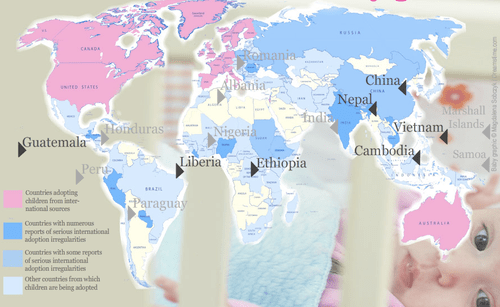
Adoptionmap

By Patrick Appel

A disturbing report from E. J. Graff:

Westerners have been sold the myth of a world orphan crisis. We are told that millions of children are waiting for their “forever families” to rescue them from lives of abandonment and abuse. But many of the infants and toddlers being adopted by Western parents today are not orphans at all. Yes, hundreds of thousands of children around the world do need loving homes. But more often than not, the neediest children are sick, disabled, traumatized, or older than 5. They are not the healthy babies that, quite understandably, most Westerners hope to adopt. There are simply not enough healthy, adoptable infants to meet Western demand—and there’s too much Western money in search of children. As a result, many international adoption agencies work not to find homes for needy children but to find children for Western homes.

Since the mid-1990s, the number of international adoptions each year has nearly doubled, from 22,200 in 1995 to just under 40,000 in 2006. At its peak, in 2004, more than 45,000 children from developing countries were adopted by foreigners. Americans bring home more of these children than any other nationality—more than half the global total in recent years.

Where do these babies come from? As international adoptions have flourished, so has evidence that babies in many countries are being systematically bought, coerced, and stolen away from their birth families. Nearly half the 40 countries listed by the U.S. State Department as the top sources for international adoption over the past 15 years—places such as Belarus, Brazil, Ethiopia, Honduras, Peru, and Romania—have at least temporarily halted adoptions or been prevented from sending children to the United States because of serious concerns about corruption and kidnapping. And yet when a country is closed due to corruption, many adoption agencies simply transfer their clients’ hopes to the next “hot” country. That country abruptly experiences a spike in infants and toddlers adopted overseas—until it too is forced to shut its doors.

(Map by Schuster Institute for Investigative Journalism)

Less Than Overwhelming Evidence, Ctd.

By Patrick Appel

A reader writes:

I think that Mr. Ward doesn’t understand certain things about the scientific process. He writes:

If a belief is forced (you cannot avoid it), vital (of great practical import), and living (a realistic and plausible option), then, James suggests, it is rational to commit yourself to it even with less than overwhelming evidence. That seems to me to do no more than reflect the practice of good scientists when they believe that “there is no event without a cause,” “there are universal laws of nature,” or “the universe is comprehensible and mathematically intelligible.

These are hypothesis, not just beliefs. There is a difference, and it has to do with whether or not your beliefs can change as the evidence changes. These hypothesis can and have changed as more evidence has accumulated.

Take, for example, the weather. There are no real fundamental scientific issues concerning the weather, and there haven’t been for quite some time. There are, for example, no scientists hoping to overthrow General Relativity or the Standard Model by looking at thunderstorms or hurricanes. Likewise, as far as I know, there are no religious bodies that claim that we cannot predict next week’s weather because of Weather Gods that make it rain, or that Hurricanes and tornados (both highly organized structures) show evidence of Intelligent Design.

However, we now know that the weather is, in a deep sense, not "comprehensible and mathematically intelligible." The weather is chaotic, and is not predictable more than a few weeks into the future. We will never be able to predict whether it will rain in some location August 1, 2020, at least not until July, 2020, rolls around. This was a surprise to the mathematicians and meteorologist working in weather prediction; they expected to be able to predict the weather like astronomers predict the motions of the planets. John von Neumann even thought we could control the weather by using its chaotic nature. He was wrong and they were wrong and people have adjusted their thinking.

Unlike in (most) religion, there are no scientific hypothesis (beliefs) that could not be changed if the evidence so indicated.