Contra Krugman

James Surowiecki is troubled by the "nationalization is easy" crowd:

I think that as the “nationalize now” meme has taken hold in the blogosphere, people are talking about nationalization “awfully casually.” One way this manifests itself is in the argument that the only reason people are skeptical of nationalization is because it’s “un-American,” when, in fact, I think people are skeptical of it for two big reasons:

1) Two years of financial crisis does not invalidate the general principle that private enterprise is typically better at efficiently allocating resources than government; and

2) the idea of the state literally determining which companies and individuals do or don’t get credit is, even to a non-libertarian, at least a little troubling.

Hoi Polloi

An amazing satellite image of yesterday’s crowd. Marc explains:

Geoeye, a commercial satellite company, took this image of Washington, D.C. during the inauguration. Notice the dark clumps on the mall; those are people, massed around the big Jumbotrons.  The resolution has been resampled to a half-meter, which means that, if you had a big enough picture, you could identify objects that were a half meter across.

Day 2

Marc Lynch offers Obama a few tips:

The idea of a speech in a Muslim capital in the first 100 days is a good one. But don’t wait. The enormous excitement about Obama’s election throughout the Muslim world has been palpably eroded by Gaza. He should try to recapture that sense of hope and possibility by engaging from the outset with a world desperate for a change from the Bush administration. He should lay out a vision of America’s relations with the Islamic world, as he is so uniquely qualified to do.  But engagement doesn’t just mean talking — it means listening,  learning, and treating others with respect rather than simply as objects to be manipulated. That should include a forceful defense of liberal freedoms in Arab countries, including our allies. Obama’s administration should seek out ways to reach out, early and often, to a wider range of Arabs and Muslims than usually get heard…and to take them seriously.

“No Words That Will Be Quoted In A Hundred Years”

800pxwashington_crossing_the_delawa

Packer on yesterday’s proceedings:

He delivered something better than rhetorical excitement—he spoke the truth, which makes its own history and carries its own poetry. As for the poet who had the impossible job of immediately following the new President, I’ll leave it to you to judge.

Allow me: she was pretty pedestrian (but better than Aretha).

Mulling over the address yesterday, I felt in retrospect that the restraint and classical tropes of the speech were deliberate and wise. From the moment he gave his election night victory speech, Obama has been signaling great caution in the face of immense challenges. The tone is humble. We know he can rally vast crowds to heights of emotion; which is why his decision to calm those feelings and to engage his opponents and to warn of impending challenges is all the more impressive. He’s a man, it seems to me, who knows the difference between bravado and strength, between an adolescent "decider" and a mature president, between an insecure brittleness masquerading as power, and the genuine authority a real president commands. He presides. He can set a direction and a mood, but he invites the rest of us to move the ball forward: in a constitutional democracy, we are always the ones we’ve been waiting for.

He is not a messiah and does not act or speak like one. He’s a traditionalist in many ways. A reader gets it:

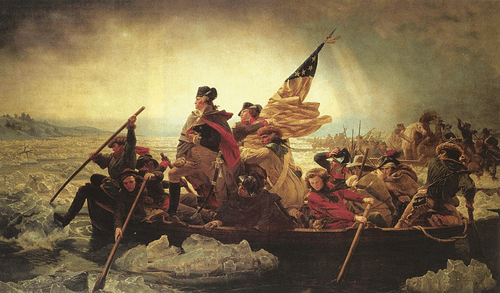
The keynote of the speech is strikingly a conservative one–he calls us to remember the best of our traditions and history, to cherish them, to recall the sacrifices made to preserve them.  He uses the conservative sense of loss against his predecessor, a feat of considerable rhetorical elegance.  And the final image of Washington crossing the Delaware in that bitter winter that marked the real opening of our struggle for national identity–perfect.  This man has the makings of real greatness. And yet, even now I cannot forget that politicians who inspire can also severely disappoint and require our critical scrutiny.

I have learned the lesson of misjudgment the hard way these past seven years – but not to the extent of being incapable of trust (especially now – when we have no option, given the immensity of the overlapping constitutional, economic, military and diplomatic crises we have inherited). And that trust, in turn, requires constant vigilance and skepticism and open minds to stay true and honest – even to the point of brutal criticism.

In this president, we at last have someone who doesn’t see that criticism as disloyalty. He sees it as our responsibility. He’s right. And it’s about time Americans lived up to the challenge.

Quote For The Day

"A message to Rick Warren? Let’s sit down. I think what would happen, which might frighten him, is that we have so much more in common than that which separates us. I would want to tell him about my relationship with my partner, about how just as in marriage–and by the way I was married so I’m in a position to compare these two – the church believes in marriage because it believes that kind of love between two people, that selfless, self-giving love, is a place where God can show up. And I would like to tell him where God has shown up in my relationship with my partner. Scripture says, "by your fruits you will know them" and the fruits of the spirit are appearing in gay and lesbian relationships, then couldn’t he acknowledge those fruits of the spirit and begin to rejoice with us over those relationships," – Bishop Eugene Robinson, who might want to rethink the whole "fruits" metaphor.

I’ve put out some feelers to ask Rick Warren to have a public dialogue/debate with me about homosexuality and Christianity. No word back as yet.

History Will Vindicate George W. Bush? II

Peter Wehner praises his old boss:

George W. Bush’s unpopularity created the context for what I believe was easily his most impressive act as President: his advocacy of the surge despite the enormous opposition to it. People forget what many of us in the White House at the time never will: the across-the-board resistance — from all Democrats, most Republicans, the entire foreign policy establishment, the Joint Chiefs of Staff, the President’s own commanding general in Iraq, and the overwhelming majority of Americans — to the surge. There was the very real sense that this plan might be strangled in its crib.

We will find out at some point if this really was in our long-term interest. What we do know is that this meme will be insisted on by those who still refuse to take responsibility for the worst foreign policy decision in modern times. But the last eight years were all about the refusal to take responsibility. Why would we believe these people would change now?