Something Is Rotten

Glenn Greenwald notes it:

Note how warped our political culture is: Sen. Dick Durbin was forced to tearfully apologize on the Senate floor for accurately comparing our treatment of detainees at Guantanamo to the techniques used in Soviet gulags and by Gestapo interrogation squads, but those who perpetrated these war crimes have apologized for nothing, remain welcome in decent company, and are still shielded by our Government from all accountability.

Quote For The Day

From the International Committee of the Red Cross report:

To this end, the ICRC recommends the following:

that the US authorities investigate all allegations of ill-treatment and take steps to punish the perpetrators, where appropriate, and to prevent such abuses from happening again.

Why did the Bush administration ignore this recommendation? And why is the Obama administration doing the same?

The Doctors Who Tortured

We have been told that lawyers who provided the patently bogus clearance to torture terror suspects – against all legal precedents – are somehow peripheral to the act itself. Perhaps too the same might be said of doctors, who monitored the broken and abused bodies of those subjected to George W. Bush's "alternative set of procedures." But the ICRC report makes plain – in plain English – what was done, and the betrayal of the Hippocratic oath it required:

Health personnel offered supervision and even assistance as suspected al-Qaeda operatives were beaten, deprived of food, exposed to temperature extremes and subjected to waterboarding, the relief agency said in the 2007 report, a copy of which was posted on a magazine Web site yesterday. The report quoted one medical official as telling a detainee: "I look after your body only because we need you for information."

This is not news, but the specificity of the testimony of the torture victims is striking and backs up evidence produced by Stephen Miles three years ago:

Of the 136 documented deaths of prisoners in detention, Miles found, medical death certificates were often not issued until months or even years after the actual deaths. One prisoner's corpse at Camp Cropper was kept for two weeks before his family or criminal investigators were notified. The body was then left at a local hospital with a certificate attributing death to "sudden brainstem compression." The hospital's own autopsy found that the man had died of a massive blow to the head. Another certificate claimed a 63-year-old prisoner had died of "cardiovascular disease and a buildup of fluid around his heart." According to Miles, no mention was made that the old man had been stripped naked, doused in cold water and kept outside in 40 degrees cold for three days before cardiac arrest.

We have known about this incontrovertibly for years, specifically in the log of Qahtami's torture:

According to Miles, Medics had to administer three bags of medical saline to Qhatani — while he was strapped to a chair — and aggressively treat him for hypothermia in the hospital. They then returned him to his interrogators. Elsewhere in Guantanamo, one prisoner had a gunshot wound that was left to fester during three days of interrogation before treatment, and two others were denied antibiotics for wounds. In Iraq, according to the Army surgeon general as reported by Miles, "an anesthesiologist repeatedly dropped a 2-lb. bag of intravenous fluid on a patient; a nurse deliberately delayed giving pain medication, and medical staff fed pork to Muslim patients." Doctors were also tasked at Abu Ghraib with "Dietary Manip (monitored by med)," in other words, using someone's food intake to weaken or manipulate them. Of the 136 documented deaths of prisoners in detention, Miles found, medical death certificates were often not issued until months or even years after the actual deaths.

And people wonder why torture is regarded as a cancer. Because it metastasizes quickly and poisons everything it touches.

The Conservatism Of Obama

A nice insight from George Packer:

What underlies so many of Obama’s decisions is an attachment to the institutions that hold up American society, a desire to make them function better rather than remake them altogether… [Obamaism]’s also a pretty good description of what used to pass for conservatism—a sense that social relations and institutions are fragile things, and that, while government can’t create wealth or impose equality, at moments like this it has to establish a new equilibrium between individuals and huge economic forces, so that society doesn’t crumble. But modern conservatism has grown into exactly the opposite of its origins, in Burke’s respect for tradition and Madison’s promotion of countervailing checks on concentrations of power. Instead, like any revolutionary creed, it is abstract, hard-edged, and indifferent to experience and existing conditions.

Torture

Ag19

The one symbol as offensive as the Bush administration's decision to use Abu Ghraib prison for the deployment of cruel and inhuman punishment of prisoners was the use of former Soviet black sites for other "interrogations" of high value suspects. But I never felt this resonance as viscerally as I do after reading this. The parallels with the Gestapo "enhanced interrogation" program have been established. But Mark Danner shows the Soviet parallels – explains them physically and psychologically – in really helpful, if chilling, ways. Take this example of classic torture methods from the Soviet State Political Directorate (GPU):

They consisted usually of tying the victim in a strait-jacket to an iron bunk. The strait-jacket was his only clothing; he had no blanket, no food and was unable to go to the lavatory. With a gag in his mouth and a stopper in his rectum he would be given periodic beatings with rubber poles.

Now compare what Bush and Cheney authorized:

In the “black sites,” the same end was achieved by forced nudity and what the Red Cross terms, in its chapter of the same name, “prolonged use of handcuffs and shackles.” One of the fourteen detainees, for example, tells the Red Cross investigators that

he was kept for four and a half months continuously handcuffed and seven months with the ankles continuously shackled while detained in Kabul in 2003/4. On two occasions, his shackles had to be cut off his ankles as the locking mechanism had ceased to function, allegedly due to rust.
This technique, like other of the “alternative set of procedures” detailed by the Red Cross, seems to have been consistently applied to many of the fourteen “high-value” detainees. Walid bin Attash told the Red Cross investigators that

he was kept permanently handcuffed and shackled throughout his first six months of detention. During the four months he was held in his third place of detention, when not kept in the prolonged stress standing position [with his hands shackled to the ceiling], his ankle shackles were allegedly kept attached by a one meter long chain to a pin fixed in the corner of the room where he was held.
As with the GPU set of procedures, prisoners were kept naked, deprived of blankets, mattresses, and other necessities, and deprived of food. As for “the stopper in the rectum,” it was supplied by the GPU to deal with the practical if unpleasant problem of how to cope, in the case of a person who is naked and entirely under restraint and at the same time experiencing prolonged and extreme pain, with the inevitable consequences of his bodily functions. The Americans at the “black sites,” who had also to face this unpleasant necessity, particularly when holding detainees in “stress positions,” for example, forcing them for many days to stand naked with their hands shackled to a bolt in the ceiling and their ankles shackled to a bolt in the floor, developed their own equivalent:

While being held in this position some of the detainees were allowed to defecate in a bucket. A guard would come to release their hands from the bar or hook in the ceiling so that they could sit on the bucket. None of them, however, were allowed to clean themselves afterwards. Others were made to wear a garment that resembled a diaper. This was the case for Mr. Bin Attash in his fourth place of detention. However, he commented that on several occasions the diaper was not replaced so he had to urinate and defecate on himself while shackled in the prolonged stress standing position. Indeed, in addition to Mr. Bin Attash, three other detainees specified that they had to defecate and urinate on themselves and remain standing in their own bodily fluids.
One turns, finally, to those “periodic beatings with rubber poles” that the GPU administered. No rubber poles are to be found in the Red Cross report. Once again, Agabuse though, as with the stopper in the rectum and the diapers, the rubber poles simply represent the GPU’s practical solution to a problem shared by the CIA at the “black sites”: How can one beat a detainee repeatedly without causing debilitating or permanent injury that might make him unfit for further interrogation? How, that is, to get the pain and its effect while minimizing the physical consequences?
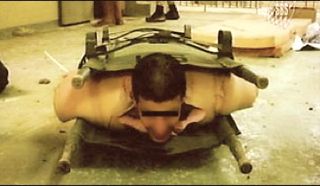
Where the GPU responded by developing rubber poles, the CIA created its plastic collar, “an improvised thick collar or neck roll,” as the Red Cross investigators describe it in Chapter 1.3.3 (“Beating by use of a collar”), that “was placed around their necks and used by their interrogators to slam them against the walls.” Though six of the fourteen detainees report the use of the “thick plastic collar,” which, according to Khaled Shaik Mohammed, would then be “held at the two ends by a guard who would use it to slam me repeatedly against the wall,” it is plain that this particular technique was perfected through experimentation. Indeed, the plastic collar seems to have begun as a rather simple mechanism: an everyday towel that was looped around the neck, the ends gathered in the guard’s fist. The collar appeared later and brought with it other innovations:

Mr. Abu Zubaydah commented that when the collar was first used on him in his third place of detention, he was slammed directly against a hard concrete wall. He was then placed in a tall box for several hours (see Section 1.3.5, Confinement in boxes). After he was taken out of the box he noticed that a sheet of plywood had been placed against the wall. The collar was then used to slam him against the plywood sheet. He thought that the plywood was in order to absorb some of the impact so as to avoid the risk of physical injury.


Do Protests Matter?

Brayden King, a professed expert on the issue, says they do:

Our model demonstrates that protests matter by drawing attention to issues and sustaining a public discussion about that issue, which in turn forces Congress to pay more attention to the issue. But to be successful in shaping the agenda, an issue must receive more protest treatment than other issues do. Protestors are actually competing with other protestors for agenda space.

A War Budget

BOBGATESHaraz N. Ghanbari-Pool:Getty Images

Fred Kaplan likes Gates's budget:

After Gates was confirmed as George W. Bush's defense secretary in December 2006, he gave several speeches outlining major reforms that his successor should undertake—in weapons procurement, promotion policy, and the whole careerist culture inside the Pentagon. (With only two years in office, combined with a plateful of crises in Iraq and elsewhere, he knew he wouldn't have time to take those steps himself.) When he stayed on at Barack Obama's request, and thus became his own successor, many wondered whether he would turn his words into action.

With this budget, he has begun to do just that.

More reaction here, here, and here.

(Photo: Haraz N. Ghanbari-Pool:Getty Images).

A Sucker’s Rally?

Buttonwood warns:

Teun Draaisma of Morgan Stanley, who has made some good market calls in the course of this crisis, does not think the bear market is over yet. He thinks there are further hits to be taken on earnings and house prices and there is still bad news to come on banks' balance sheets.  He makes a very good point on housing, the subject of many posts on this blog; the average duration of downturns has been 43 months, against 28 so far this time. And US house prices have never bottomed when unemployment is still rising.

So the balance of evidence suggests this rally will peter out before long.  Alas, we probably need to plumb some greater depths of despair before this crisis is over.