Last fall, an architect for Bush's library indicated that Cheney's records and artifacts would be coming soon, but that apparently was a mix-up. Cheney wants them to remain in Washington as he writes his memoirs.
Month: April 2009
What Stress Does To Children, Ctd.
Jim Henley uses the new stress and poverty study to argue for a larger welfare state. Drum is less sure of the policy consequences:
This is, in a sense, discouraging news. You can't solve problems unless you first understand the objective reality underlying them, so if Evans's results are confirmed it will be good in that sense. But stress? What would it take to make the lives of poor children substantially less stressful? The resources to tackle that could be harder to marshal than the resources to eradicate poverty itself. If stress really turns out to be a significant factor in the cognitive development of poor children, addressing the problem may have just gotten harder, not easier.
End Of Gay Culture Watch
Seth Rogen does it again:
The Last Man
Poulos prods the left:
…our public obsession with security and health parallels our ‘private’ tastes for risk and self-poisoning, and our loving, de-eroticized pieties concerning Respect for All grow apace with our beastly appetite for erotic impieties. The ultimate hero of our civilization is a sixteen-year-old sexpot who saves Darfur and bitchily destroys her rivals, all in a day’s work…
Mr. Nice Gay
John Corvino advocates for civility:
Even though my being "Mr. Nice Guy" wasn't chosen for strategic purposes, I try to work it to my advantage. It gives me influence with a certain group of people. And it's shaped my career as a gay-rights advocate, one who aims for thoughtful engagement with the other side.
Such engagement can be productive.
For one thing, the more our opponents know us personally, the harder it is for them to demonize us. (Not impossible, obviously, but harder.) Part of my life's mission is to create cognitive dissonance for those who would label all gays as angry deviants.
But engagement is also important because, like it or not, our opponents still capture majorities in most states. I don't doubt that the tide is shifting strongly in our favor, but we've got a lot of work to do. One effective way to reach the movable middle is to take opponents' concerns seriously.
Why Newspapers Need to Get Over Themselves II
Genesis
Manzi ponders intelligent design, the multiverse, and science:
It’s tempting to see ID and multiverse theory as mirror images – one looking desperately to prove scientifically that humans are special, and the other desperately seeking to avoid this conclusion. This is almost, but not quite, appropriate in my view. The proper question to ask about both multiverse theory and ID is whether they are fruitful.
Ultimately, either each framework will help scientists develop physical theories in the form of predictive rules that can be tested through observation, or it will not. It’s very hard to see how ID can do this, but I guess that anything’s possible. Multiverse theory is more likely to do so, if only because it is a point of view that embeds a metaphysic that is far more congenial to so many more smart scientists.
But to look to science to answer a metaphysical questions like “Did God create us?” or “Are there completely unobservable aspects of reality?” is a category error of the first order.
Why Newspapers Need To Get Over Themselves
The outbreak of smug is currently suffocating. Which is why the one-man anti-smug machine, aka Michael Kinsley, is still essential:
Two recent articles in Slate argued that newspapers (1) actually play a fairly unimportant role in our democracy and (2) are in this pickle because of financial shenanigans, not inexorable forces of technology. But let’s say these are both wrong: that technology is on the verge of removing some traditionally vital organs of the body politic. What should we do?
How about nothing?
CJR remains chastened but finds some reasons for cheer. Yglesias, meanwhile, calls out beat sweetening, i.e. when a hack trades early good publicity for access:
The underlying logic of the transaction strikes me as so compelling that I’m confident it will long outlive the newspaper or even the idea of journalistic ethics. Still, the widespread social and professional acceptance of this kind of thing—nobody thinks it’s a shameful thing to do—is one of several dozen reasons why I think most journalists could stand to be less self-righteous about their profession.
Why Legalization Is Gaining Steam
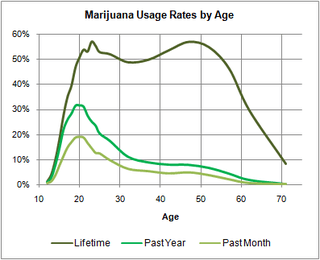
Nate Silver runs the numbers on cannabis legalization and finds that pot attitudes correlate with age:
There is not, of course, a one-to-one correspondence between having used marijuana and supporting its legalization; one can plausibly support its legalization without having ever inhaled, or vice versa. Nevertheless, I would venture that the correlation is fairly strong, and polls have generally found a fairly strong generation gap when it comes to pot legalization. As members of the Silent Generation are replaced in the electorate by younger voters, who are more likely to have either smoked marijuana themselves or been around those that have, support for legalization is likely to continue to gain momentum.
The Rump Isn’t Happy
Pew reports:
Barack Obama has the most polarized early job approval ratings of any president in the past four decades. The 61-point partisan gap in opinions about Obama’s job performance is the result of a combination of high Democratic ratings for the president — 88% job approval among Democrats — and relatively low approval ratings among Republicans (27%)
Peter Wehner pounces:
It became apparent quite early that bipartisanship was a fictional commitment for Barack Obama; shutting Republicans out of negotiations and promoting what ranks among the most left-wing domestic agendas in our lifetime was all the evidence some of us needed. Apparently most of the rest of the nation understands that as well.
Er, most of the rest of the nation? The percentage of Republicans approving of Obama at this point is almost identical to that approving of Clinton in 1993. And it seems obvious to me that this is not a reflection of the president, but of the opposition. Republicans are historically far more hostile to presidents of the opposite party than the Democrats. And this year, as Obama clearly reached out, and as Fox/Limbaugh/Drudge went into near parodic outrage, it's clearer than ever who is responsible. Check out the Independent vote. That's what matters.
 The Dish