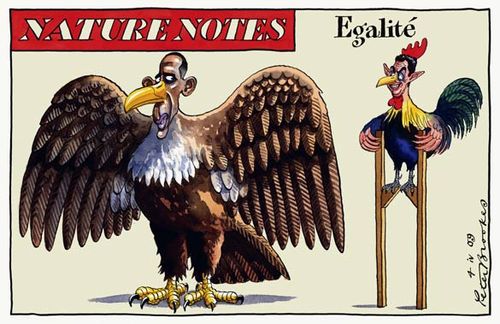
The genius Peter Brookes has a gallery of similar wildlife here.
The genius Peter Brookes has a gallery of similar wildlife here.
An attempt to think some current questions through:
I've been a green conservative for as long as I can recall. Perhaps my first ecological feelings welled up as a boy when I saw the copses and fields of my rural Sussex neighborhood torn up for new housing developments. The sense of dislocation I felt at
seeing familiar places altered, of trees uprooted, ponds drained and woodlands paved was, I realized later, a conservative impulse. I liked the world as it was. It was a home of sorts and I was happy in it. And when it was changed by the forces of market capitalism, forces that seemed utterly indifferent to the human impact of their upheaval, the cultural contradictions of conservatism became much clearer in my mind. That was a long time ago, and I can appreciate now the parochialism and narrowness of my childhood perspective. But the contradiction – or, perhaps, more accurately the tension – between conservatism and environmentalism endures. You can pet as many huskies as you want, and you can rebrand the Tory party all you want, but green growth is not an easy concept. In practice, it's hard and costly and in a recession, much easier said than done.
In America, there is, alas, some residual and powerful forces on the right that still want to insist that climate change is not real. For myself, I cannot see how an empirical and skeptical review of the data can lead one to the conclusion that warming is a hallucination. And the good news is that, increasingly, the old conservative debate about whether warming is occurring is being replaced by a much more interesting one about what to do about it if it is.
Should we bear the heavy economic and social costs of trying to mitigate it in the teeth of a global depression? Or should we find creative ways to adjust to and live with it and hope that the faster growth of a less green world might be the long-term key to developing the new energy resources and technologies to restrain it?
To be perfectly honest, I'm unsure. But a lack of certainty does not seem to me to be a crippling disadvantage in this debate. For one thing, the scientists are themselves unsure precisely how much warming will occur and what its potential effects could be. If you read the very careful and much hedged IPCC reports, you find that good scientists do not proclaim total disaster with the zeal of Al Gore. They forecast a range of possibilities, with another range of effects. And they freely admit the difficulty of judging which is the likeliest. And economists, at least the good ones, in turn exercize the same sort of empirical caution.
The rest here. The photograph – of the kind of woodlands I grew up around (Beeches and bluebells in Micheldever Woods, Hampshire, UK.) – by Jim Champion from Wiki here.
As tribal Muslim society returns to its violent, bigoted normal. But this time, Americans died to ensure gays could be lynched.
A reader writes:
In the interest of dispelling some of the misconceptions about marijuana, let me first preface with my firm belief that it is by far the least harmful drug out there, much less so than
alcohol, and that I believe it should be legalized. That said, there is research to show that if chemical dependency on a drug is defined by withdrawal effects, then marijuana can indeed be chemically addictive.
Do you get the shakes like alcohol? No. Do you get severe nausea like heroin? No. Do you get violent outbursts like crystal meth or cocaine? No. When I decided to quit smoking pot and checked myself into an out-patient rehab program, it wasn't as someone whose life had completely spun out of control. There was no intervention by friends and family or some court-ordered mandate. As my therapist told me, I could have continued using pot the way I had been for the rest of my life. That wasn't the issue. The issue was that you only get to live once and that pot, when used every day, can inhibit one's ability to live life to its fullest. The problem was that I had grown so accustomed to being constantly stoned since my teenage years, that I'd failed to learn how to relate to my emotions and to develop many of the skills suited to successful adulthood.
I had tried quitting pot many times on my own, but as someone who smoked it nearly every day for 13 years, what I got initially when I stopped was a racing mind and a severe case of anxiety and irritability which lasted for about a month and which invariably led me to pick it up again. With rehab I was able to get over the initial hump of withdrawal symptoms, but what came next was extreme agony, more attributable to the insidious psychological effects of long-term use: namely every emotion, both good and bad, felt magnified ten-fold.
I cried nearly every day for four months. When I wasn't crying, I could easily be on the other end of the spectrum practically skipping down the street. I used the 12-step program to help right my course, and it worked. At first it was difficult to relate to others in the rooms with stories I felt to be much more depraved than my own. Some hustled to get crack. Some killed people while driving drunk. My stories of sitting on the couch eating Ben and Jerry's and ignoring the bills that were piling up seemed silly in comparison. But again, numbing your senses and blunting your awareness of the world around you for your entire life can still, unsurprisingly, cause serious complications in the long run.
This month, if everything goes as hoped, I will celebrate a year of continuous sobriety. I've learned to pay bills, file paper work, feel my emotions and act responsibly. In short I live a life I never could have imagined while I was constantly stoned. I've tried every drug in the book, many times, but marijuana remains the only drug I miss. I think my story exemplifies, not so much how dangerous pot is, but that it is addictive and habit-forming and can be harmful when it is used irresponsibly as a means of escaping life. I know many, many pot smokers and none of them formed the same sort of dependency on the drug that I did. I don't believe marijuana ruins the life of everyone with whom it comes into contact–far from it. But, like any other drug or behavior, it can.
Hilzoy is all you need:
This is not about the general issue of gun control. I don't have strong views about gun control, at least if we're talking about rifles and handguns, as opposed to mortars or rocket-propelled grenades. I am not saying this as the opening salvo in a ban to criminalize the private possession of firearms. This is not the entering edge of any wedge, or the first step down a slippery slope. I just think that there should be some process, with safeguards and due process to guard against abuse, that makes it possible to prevent someone who from getting a gun when there is clear evidence that that person is homicidal.
This quote to Kathleen Parker says it all:
"If people who call themselves Christians want to see any influence in the culture, then they ought to start following the commands of Jesus and people will be so amazed that they will be attracted to Him. The problem isn't political. The problem is moral and spiritual…. You have the choice between a way that works and brings no credit or money or national attention. Or, a way that doesn't work that gets you lots of attention and has little influence on the culture."
Michael Levi is skeptical:
The fundamental problem is that there's no solid evidence that green policies—even those aimed explicitly at creating jobs—will actually lower the long-term unemployment rate.
Most of the research on how these sorts of programs might build up the work force simply tallies the payrolls, current or projected, of companies in renewable energy and other sectors. (Analyses typically include not only jobs installing solar panels or engineering algae for biofuels but also secondary activities like making widgets for use in windmills.) This approach is a natural winner: Green policies inevitably generate jobs in green industries, so the studies inevitably deliver good news. But skeptics argue that simple windmill-counting ignores an important fact: Every unit of energy generated from alternative sources displaces a similar amount generated by traditional means, so forgoing those other energy sources means giving up whatever jobs they were providing. This doesn't mean that greening the economy will have no net impact on jobs, but it muddies the math considerably.
OOO from The Juzzard on Vimeo. (hat tip: today and tomorrow)
John Grohol investigates:
Virtually all people swear, and people swear pretty consistently throughout their lifetime — from the moment they can speak to the day they die. Swearing is almost a universal constant in most people’s lives. Research, according to [Timothy Jay], has shown we swear on average from 0.3% to 0.7% of the time — a tiny but significant percentage of our overall speech (frequently-used personal pronouns occur at approximately 1.0% rate in speech). Swearing is more common than you might think. But personality research suggests that people who swear more, not surprisingly, score higher on traits such as extraversion, dominance, hostility and Type A personalities. Swearing is not just for the uneducated or people of a lower socioeconomic class — it knows no social boundaries in its expression.
Mark Buchanan brings the science:
Lea and Webley propose that money, like nicotine or cocaine, can activate the brain’s pleasure centres, the neurological pathways that make biologically beneficial activities such as sex feel so rewarding. Of course, money does not physically enter the brain but it might work in a similar way to pornographic text, argue Lea and Webley, which can cause arousal not by giving any biochemical or physiological stimuli, but by acting through the mind and emotions.
 The Dish
