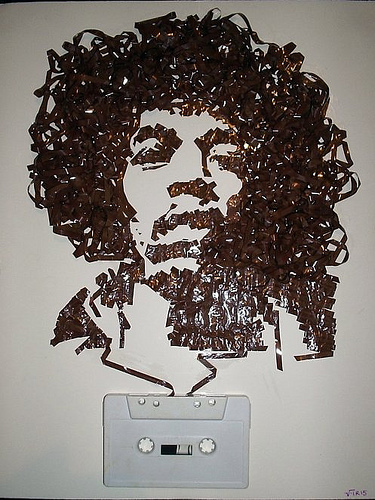
Finally, a use for cassette tape: Jimi Hendrix.
Finally, a use for cassette tape: Jimi Hendrix.
Via Conor Friedersdorf, a detail from Mark Bowden's article on the NYT's management:
[Former C.F.O. Diane Baker's] biggest disappointment came when she crafted a potentially lucrative partnership with Amazon.com, already the biggest bookseller on the Internet. The Times would link all the titles reviewed in the paper’s prestigious Sunday Book Review section, ordinarily a money drain, to the online bookseller and receive a percentage on every book sold. “We could have made the Book Review into a big source of revenue,” she recalls. … “You know what they said?,” Baker recalls. “They said, We can’t do it, because Barnes & Noble is a big advertiser.”
Jaymis rocking out to his own CT scan:
Some context:
I had a CT scan today, and the nice people sent me on my way with a CD filled with hundreds of images of my insides. So what else could I do but turn them into an animation. The frames have been colour corrected so as to only show the bones. Next version will include organs as well. I’ve time stretched the clips (otherwise it’s all over in 10 seconds) and used After Effects’ Pixel Motion frame blending mode to make it smoother, so there’s a little bit of morphing visible at various times.
Rebecca Traister test-drives a novel piece of software:
Freedom [is] an application created by University of North Carolina-Chapel Hill Ph.D. candidate Fred Stutzman, who made it available to the public for free — though he asks for donations — a little over a year ago. In an e-mail, Stutzman writes that he came up with the idea after talking with lots of people trying to find places to work without Wi-Fi; he doesn't know how many people have downloaded it, but estimates the number at about 10,000. He has received 50 donations, all of which he's used to pay for software.
Freedom will disable the networking, only on a Mac computer, for periods of anywhere from one minute to eight hours. No Web sites, no e-mail, no instant messaging, no online shopping, no Facebook, no Twitter, no Jezebel, no iTunes store, no streaming anything. Once it is turned on, as it hilariously claims, "Freedom enforces freedom"; you cannot turn it off without rebooting your computer.
A new study suggests that stressful childhoods are responsible for the achievement gap:
Given a sequence of items to remember‚ teenagers who grew up in poverty remembered an average of 8.5 items. Those who were well-off during childhood remembered an average of 9.44 items. So-called working memory is considered a reliable indicator of reading, language and problem-solving ability — capacities critical for adult success.
When Evans and Schamberg controlled for birth weight, maternal education, parental marital status and parenting styles, the effect remained. When they mathematically adjusted for youthful stress levels, the difference disappeared.
In lab animals, stress hormones and high blood pressure are associated with reduced cell connectivity and smaller volumes in the prefrontal cortex and hippocampus. It’s in these brain regions that working memory is centered. Evans and Schamberg didn’t scan their human subjects’ brains, but the test results suggest that the same basic mechanisms operate in kids.
Jonah Lehrer adds his own thoughts.
(Photo: an orphaned boy in Gaza by Mahmud Hams//AFP/Getty.)
Christopher Orr fires back at Dreher:
There was a time, not that long ago, when it was possible to imagine, however inaccurately, that gay sex was in and of itself a self-destructive pathology, something no happy, healthy person would willingly engage in. That time is past.
The evidence of stable, loving relationships between well-adjusted, successful people is all around us. Indeed, this abundant evidence–and not the tides of the sexual revolution, which peaked more than three decades ago and have since receded–is the reason that gay rights, and in particular the question of gay marriage, have moved so quickly in recent years. Dreher fails to grasp this, prefering to imagine a straight line from the sexual experimentation of the 1960s and '70s to the gay marriage question of today to the, yes, polygamy debates of tomorrow.
…This is an argument impossible to falsify, but it's worth noting that Dreher's assertion that actions often have unanticipated consequences (and, again, I think gay rights are only peripherally a consequence of '60s sexual liberation) isn't an argument for the consequences Dreher foresees, it's an argument that the consequences may be unanticipated.
Dreher imagines that the "next logical step" is polygamy, an assertion for which there is no evidence beyond Dreher's own apocalyptic vision, and a goal for which there is virtually no support among proponents of gay marriage. I, by contrast, believe we will see the incorporation of same-sex couples into what Dreher calls the "moral order," an assertion for which I think there is already considerable evidence, and a goal explicitly held by virtually all gay marriage proponents. We will see who is proven correct.
Filmmakers Andy and Carolyn London interviewed New Yorkers and fused their voices with inanimate objects. IMHO it's fantastic:
The Lost Tribes of New York City from Carolyn London on Vimeo.
Salon ran a column by Rush Limbaugh's cousin, Julie Limbaugh:
Even though our ideologies do not align, I have always admired Rush for his humor and savvy. I would like to believe that he has created a semi-tongue-in-cheek persona for entertainment's sake, a self-aware self-parody, the original Stephen Colbert. While his haters have always been too busy running in angry frenetic circles to notice the irony, Rush Limbaugh, the caricature, has had the time of his life; and there's something to admire in he who gets the last laugh.
Rush once told me, "The only way to make millions is for half the nation to hate you." He told me this at his mom's funeral when I was 13, and I think the reason he was talking business was because he was trying not to look so sad.
It's funny how the subject of half the nation hating him could effectively lighten his mood. I wanted to say, "But I don't want half the nation to hate you."
Yet lately, I must admit, being a Limbaugh has been a little tough. When listening to Jon Stewart or just about everyone lay into the latest outrageous thing Cousin Rusty has said, it just doesn't seem like he's in on the act, and that makes it hard for me to separate my cousin from his persona. Maybe it's just me — afraid of facing my student loans in our crumbling economy, or maybe I have officially become one of the "crazy liberals" my uncles always warn me of, but it seems that Rush is no longer just playing the political game he plays so well. Rather, he has been attacking hope, and now it feels like there's little room for that.
It's worse than many think. A reader writes:
I was reading your blog the other day, when I saw a post called "The Young and The Right". It talked about how not only do the young have a high approval rating of Obama, but we have a distinctly low approval rating of the Republican leaders in congress. I'm two months from graduating High School in North Carolina, a 40 year Republican stronghold, and newly minted swing state. I've grown up with my only personal memories of politics being that of the Bush Administration.
Every friend of mine that registered to vote last year registered not as an independent but as a Democrat. Many more too young to vote told me they wanted to do the same. The lasting political effect of the Bush Administration is not only that's created a new generation of (for now) solid up-ticket to down-ticket Democratic voters, but a new generation of leftists.
What the Bush Administration has done is make words like "Statism" "Democratic socialism" and "Welfare State" spoken with praise by Teenagers in Western North Carolina.
All we know of the right is the Ultra-reactionary and barbaric performance of President Bush and the Congressional republicans, and, for the most part, all we've seen from the Left is dogged opposition to the right's inane or insane policies. Conservatism as a movement has lost its future, because it has, from what I can see, completely lost the young. The Hour is getting very late for the Right to talk about deficits or of social squabbles. It only reinforces their image to the young as the political group that has to be stopped. They are fast digging their own graves.
Until the right thoroughly accounts for what happened over the last eight years – and not in a perfunctory aside – they will have no credibility in reshaping their movement. And they should be ignored.
From 

 The Dish