Afraid Of No One

Wired interviews Matt Stone and Trey Parker. Stone:

"Trey and I used to say we'd stop doing the show by the time we were 40 because we wouldn't be cool anymore, but Trey's almost 40 now — so maybe we'll change that to 50."

I've watched this season as avidly as usual. It may be their best ever. Last night did something that only South Park regularly does in any medium: it still retains the capacity to shock. The laughter comes from real subversion, from not just crossing red lines but going so far past them you forget the red lines exist. It isn't just puerile bravado either (not that there's anything wrong with that). Parker and Stone actually take on powerful entities, people that can actually harm them and their careers. Who else has tackled Islamists, scientologists, and the Disney company? Who else is able to use the word "faggot" and have every gay man laugh along with them? Who skewers the Hollywood left more effectively?

Or in three words that sum it all up: Martha Stewart's queef.

No, I don't have the balls to put it above the jump. Watch it if you dare. But do not watch it if you have any squeamishness about anything. But mazel tov, Matt and Trey and the entire gang. You don't just still have it. You're still reinventing and reimagining what you have.

“Makers And Takers,” Ctd.

A reader writes:

Thank you for clarifying your "makers" vs. "takers" comment. I still don't buy it. I'm a professor at a state university. My education was paid for by the government, my salary comes from the government, and most likely I'll retire on a government pension.  I guess that means that I primarily rely on government to get me through my life, putting me solidly on the "taker" side of the ledger.  If the shoe fits I'm willing to wear it, but I can't see how the world would be a better place if I moved to the private sector.  Through my government funded research and the government subsidized training I give my students, I believe I support the long-term health of our economy much more than I could as a scientist in private industry focused on product development and short-term profits. Everyone takes something from the government, and everyone makes something for society. To pretend that's not true by setting up a simplistic divide between makers and takers just obscures the real questions we should be addressing.

Another reader:

Andrew, populist conservatism is a mirage. Those who broadly consider themselves the "makers", i.e. those in control of capital and large enterprises, will always use their power to get themselves the "corporate welfare" you denounce, gutting regulation and skewing the tax code in their own favor, all in the name of maximizing incentives to produce wealth. Believing that you can disentangle their eternal wish list on the tax front from some kind of purist cerebral conservative commitment to minimal taxation is like believing in clean coal.

Another:

"It's about those who contribute their labor to produce something of value, and those who primarily rely on government, directly and indirectly, to get them through their lives."

I fear that the new cultural divide you are trying to describe will never take hold.  Why?  Because the line is so fuzzy that I cannot tell for most professions on which side they are on.  Is the policeman paid by the state to protect his neighborhood a maker or a taker?  How about Warren Buffet?  A realtor?  A retired vet?  A professional baseball player?

I don't see why "relying on the government" is such an important distinction.  When Rick Wagoner gets a $23 million severance package, does the fact that the $23 million are paid by GM (as opposed to the government) matter to decide whether he is a maker or a taker?  Not in my view of the world.

Yet another:

I think some of the umbrage your "Makers and Takers" comment faced is due to the fact that there has been a comfortable place in American discourse for vilifying the less fortunate, as if "welfare queens" were by any stretch of the imagination the source of our troubles, especially compared to the Financial Products division of AIG.  And to see you participate, however accidentally in that habit, is part of what many of us see as a dangerous dark side of American politics – something to be dragged into the light and criticized.  It's part of that dynamic where the powerful like nothing more than the weak being seen as the problem.

You also mention "mandatory entitlement benefits to the comfortable middle and upper classes", but if anything we are learning these days, who is a member of the "comfortable middle class" is a rapidly moving target.  It's the reason we fought privatization of Social Security for what it was, a fool-hardy, short-term, rose-colored glasses approach to unknown long-term problems.

We all agree, on the left and right, that we do not want to waste our remaining resources, and suggesting that Democrats just can't wait to start burning dollar bills is a great way to get actual Democrats to wish you would modernize your views.  The tendency of the right to manipulate that discussion by hauling out old straw-men like "welfare queens" is a lack of change we do not believe in.

One more:

Regarding your clarification of "makers and takers": right on!  But I think there was a subtle, but important shift from your original post.  You initially said:

"It will be between the makers and the takers, the producers of wealth and the recipients of redistribution."

It's the phrase "producers of wealth" that traps many modern conservatives.  It's the Larry Kudlow view of the world, in which the debt-fueled paper profits of Wall Street were repeatedly lionized as "the greatest story never told."  Bernie Madoff, AIG, and the Saudi royal family are (or were) incredible producers of wealth.  The financial services industry got away with its destructive behavior for so long because it was driving GDP growth.  Clearly there is a difference between producing "wealth" and producing, as you write in your clarification "something of value."  To the extent that wealth production is decoupled from value production, capitalism is failing.  The scam artists that drove Wall Street into the ground are walking away insanely wealthy and largely unscathed, and future scam artists are surely taking note.

With that in mind, I'm curious as to how you propose we restore the association between wealth production and value creation.

A Thousand Points Of Blindness

The striking thing about the letter organized by the Christianist Center For Military Readiness is the complete absence of any evidence or substantiation for its assertions, or indeed any engagement with the arguments involved at all. This sentence stands out:

We believe that imposing this burden on our men and women in uniform would undermine recruiting and retention, impact leadership at all levels, have adverse effects on the willingness of parents who lend their sons and daughters to military service, and eventually break the All-Volunteer Force.

The idea that allowing a small minority of service members to tell the truth if they so wish about their sexual orientation would "break" the military is just bizarre.

One of the retired generals, Carl Mundy, says:

"We just see a great many downsides to attempting to enforce on the military something I don't know is widely accepted in American society," he said.

The latest poll shows that 75 percent of the country supports ending the gay ban. That is not "widely accepted"? To give you an idea of where this guy's coming from, here's what he said in 1993:

"In the military skills, we find that the minority officers do not shoot as well as the non-minorities. They don't swim as well. And when you give them a compass and send them across the terrain at night in a land navigation exercise, they don't do as well at that sort of thing."

Why do all these bigotries run together? And why should a man who said such a thing still be taken the slightest bit seriously?

Building Nations, Breaking Eggs

Matt Steinglass presents a troubling theory about ethnic cleansing and nation-building:

One thing nobody reflected on much back in 2003, when neo-cons were arguing that we built a democracy in postwar Germany so why not Iraq: as Tony Judt writes in Postwar: A History of Europe since 1945, the postwar settlement in Europe involved vast amounts of ethnic cleansing, which left the states the US (and USSR) proposed to rebuild neatly settled on linguistic and ethnic lines. Czechoslovakia and Poland expelled millions of Germans. Yugoslavia expelled Italians. Hungary expelled Rumanians and vice versa. And of course the Jews were dead, and those that weren’t soon left for Palestine. The map of Central and Eastern Europe was sorted of most of its troublesome Austro-Hungarian complexity. And as it turns out it’s much easier to build a nation when its population doesn’t have murderous long-running internal religious and ethnic differences.

Well, the ethnic cleansing carried out in Iraq under US control was pretty impressive too – just not out of the country, within it. Which is, of course, the worst of both worlds: evil and no solution. Still: we paid for it!

CATO’s Green Denialism

Ryan Avent has a devastating post on the incompatibility of climate science and some libertarians at CATO:

…confronted by a problem demanding solutions inimical to libertarian beliefs, libertarians were faced with the choice of reneging on their beliefs or turning their back on science. Tellingly, they chose the latter. One might think that’s a rather drastic decision, given the role scientific endeavors have played in delivering the material prosperity so dear to the hearts of the libertarian world, and one would be right.

A belief system that cannot grapple with the fundamental reality of a situation is, quite simply, not a belief system worth having.

Not all libertarians are in denial about the science, and some even have ideas about how to counter climate upheaval without cap and trade.

The Power Of Brown

Jerry Baldwin recommends two tablespoons of coffee per six fluid ounces of water:

Semantics aside, on countless occasions I've served our coffee to people for the first time. On first sip, they say, "This is strong." By the third or fourth sip, they say, "This is good." The main surprise, I think, is that most coffee is weak and that's what people are expecting. But as soon as they actually taste the full flavor of fresh, freshly ground, full strength coffee, they have a coffee epiphany.

Flying Blind

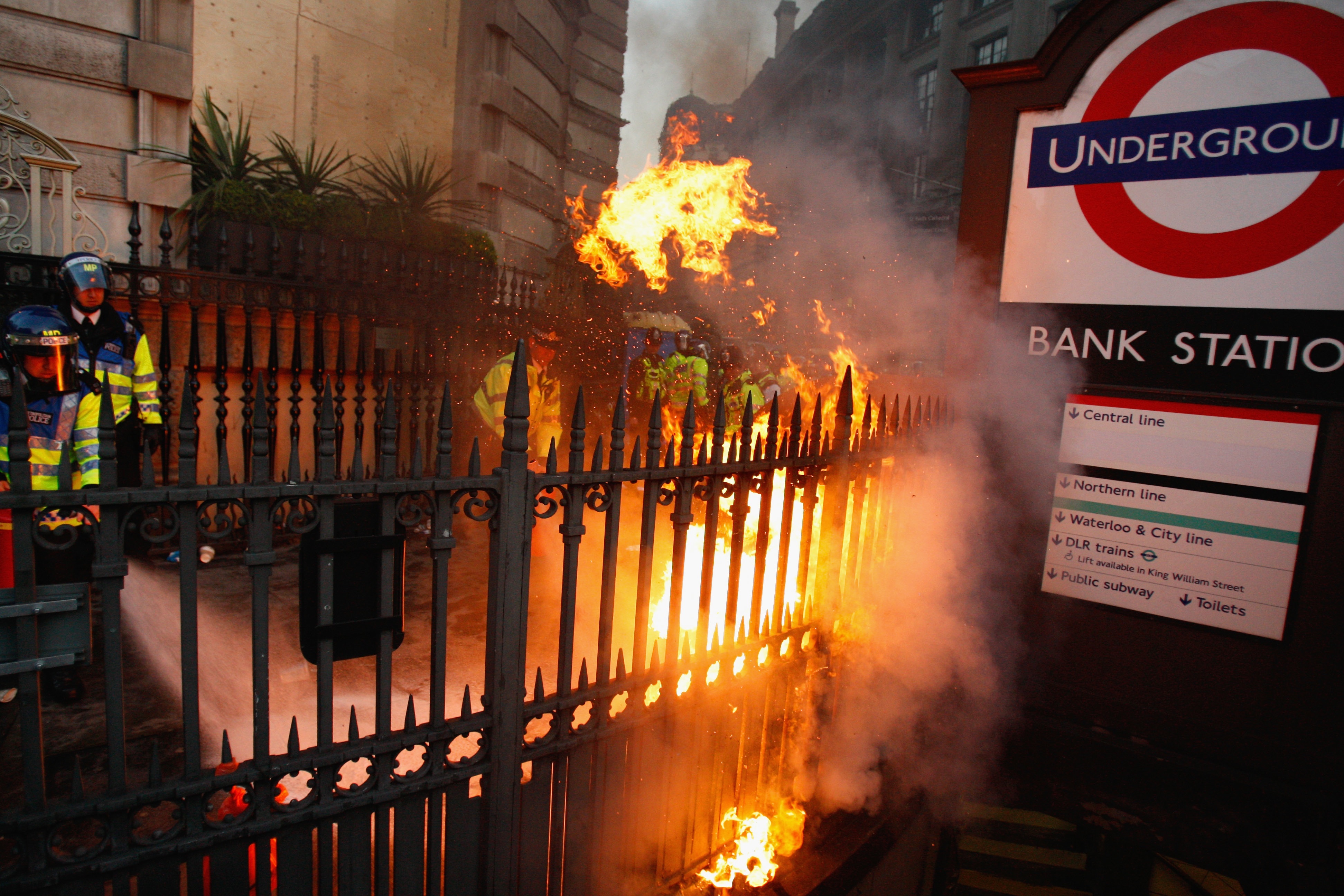
LONDONBURNINGJeffJMitchell:Getty

As London burns with angry lefties, Anatole Kaletsky fisks the OECD forecasts:

In November, the OECD believed that the GDP of its member countries would decline by a very moderate 0.4 per cent in 2009; today that has been revised to an unprecedented collapse of 4.3 per cent. In November the OECD and the IMF said that Britain would be the weakest of the leading economies; but today the OECD predicts that Britain will do better than any other major economy, apart from Canada and France. In November, the OECD believed that Japan and Germany would escape more or less unscathed from the recession, with declines of less than 1 per cent in GDP; today it predicts that Germany’s GDP will plunge by 5.6 per cent and Japan’s by 6.6 per cent.

(Photo: Jeff J Mitchell/Getty.)

Integrity Returns?

Scott Horton applauds Holder's decision on the Stevens case:

Attorney General Eric Holder has decided that the Justice Department should abandon the corruption conviction secured against former Alaska Senator Ted Stevens. The bombshell decision has nothing to do with the merits of the case against Stevens–it stems from a recognition that the Justice Department’s Public Integrity Section behaved unethically in the conduct of the case—withholding vital evidence from the defense, among other things. Holder is himself a former Public Integrity prosecutor. He made the right call in the Stevens case.