Iraq’s Unraveling?, Ctd.

Tom Ricks quotes retired Col. Pete Mansoor, Gen. Petraeus's executive officer in Iraq during the surge:

As I recall what I said was that the status of forces agreement would put U.S. forces into a position where they could not intervene to stop the government of Iraq from attacking the [Sons Of Iraq].  If the Iraqi Security Forces needed help once engaged against the SOI, U.S. forces could be drawn into the fight against the very people who helped us turn the war around. I certainly hope this doesn't come to pass, but given what we've just seen happen in Baghdad, the possibility is disturbing.

The Cannabis Closet, Ctd.

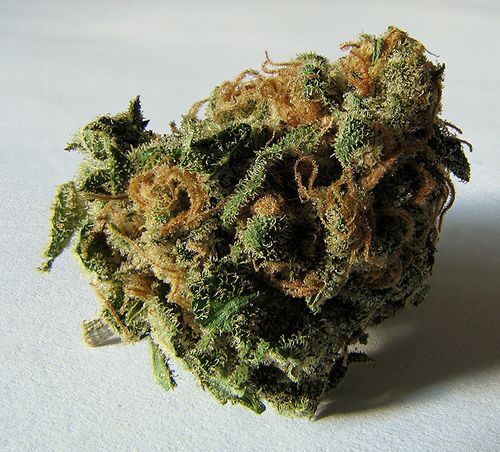
662px-Macro_cannabis_bud

A reader writes:

Count me as an in-the-closet user as well. Late-30s father of three bright, active kids. I have an MBA and work as an energy trader for an international company in Manhattan. Last Democrat I voted for was Clinton, in 1992. Six figure salary, vacations to the Caribbean, etc, etc… I also try to keep myself in good physical shape, lifting weights and running about 15 miles a week. Aside from sports I also enjoy music and am teaching myself the piano. I also consider myself an avid reader and am currently tackling some of Plato's dialogues. I'm a bit embarrassed to write the above because it makes me seem like I'm bragging about myself, but that is not my intention at all. It is only to show that someone can smoke weed almost daily while completely destroying almost all of the myths of the harm of pot (Unmotivated Loser Syndrome, Lazy Overweight Mucher Syndrome, Gateway Theory).

Another writes:

I just wanted to add to the chorus of responsible, productive and engaged voices that enjoy marijuana. My wife and I mused just last night that we know so many professionals who are not only successful in their jobs, but also active in their communities and, most importantly, active in their families/kids' lives. I personally know of a highly-ranked orthopedist, a prosthedontist, a math/science teaching consultant, 2 teachers, several attorneys, and a city district attorney, among others. In fact, my DA friend says that half the attorneys in his office have medical prescriptions…funny times in California for sure!

Another:

Several years back I served on a jury that heard a marijuana case — a classic "profile" stop on the New Jersey Turnpike.  When we got into the locked jury room to deliberate it was obvious that only two of us did not regularly use marijuana ourselves.  Even the bailiff was openly joking with us about how they had rigorously counted and weighed the "evidence" — yes, it was locked up with us while we deliberated.

We obviously had to find the guy guilty; the evidence was overwhelming and the other two people in the car with him had confessed.  But we were finding him guilty of a "crime" that almost everyone on the jury regularly committed. The whole thing was utterly absurd.

Another:

I am a 36 year old with an MBA.  I do freelance work.  Most of my friends are professionals with graduate degrees, and just about all of them smoke marijuana on occasion.  Many, including my wife, quit in/after college.  I didn't even start smoking the stuff until I was 21.  I guess I believed a lot of the hype. 

I am halfway out — in the sense that my family knows, my friends know, and most of my work/peers know.  They don't really care: no one really cares.  I have never had a conversation about marijuana with anyone who asserted it was doing me harm.  Hell, most of my family, at least Gen X and the Boomers, smoke too.  (And many of my family-members are GOP true believers!)

Another

I'm 50 year old man, full time parent to two beautiful girls, 5 and 11, and a loving husband for 16 years. We're solidly middle class in a diverse suburb on the northern edge of Cincinnati, Oh. I know many people my age who smoke weed. I've been smoking since I was 14 years old. I've never been a heroin addict or smoked meth. I drink very little. People think I'm smart. I'm in good physical and mental health and the ladies at Girl Scouts and the other parents at Catholic School have no idea about my cannabis usage.

I'm not really in the closet, as I'd freely admit to it, but I do submit to a weed smokers version of "don't ask, don't tell." I hide it from my girls, and since my wife is allergic to all kinds of smoke, I respect her wishes and smoke in the barn or the yard. Of course I don't see anything wrong with it — well, except I have to pay for the pleasure when it's easier to grow and cultivate then a tomato.

Another:

I worked as a Capitol Hill staffer for 4 years, covering legislative affairs ranging from domestic to international affairs. I am now gainfully employed at a humanitarian agency in DC. I play sports regularly, volunteer, organize fundraisers, and participate in community events.  I have friends who smoke who work as doctors and lawyers, as engineers in the army, and as special education teachers. By virtue of my having been employed by rational reasonable people, and by virtue of my socio-economic status (whereby i can afford a lawyer if something happens, and have a strong family network to support me), I am comfortable being open about my habit.

The truth is I began to be public about this with my parents who were very "anti-drug". And to be fair, the conversations with them were difficult at first, as they tried to understand why I chose to smoke, and why I was so blase about it. But over time, they have really softened their position – they now support the use of medicinal, and even make jokes about my habit.

The longer people stay in the closet, the longer the stereotype of marijuana smokers as wasted hippies will perpetuate. It seems to me that its incumbent upon all of us who can afford to be open about it, to be open about it – we need to keep opening that door wider and wider.

(Photo: Ryan Bushby/Wikipedia.)

The Hard Line

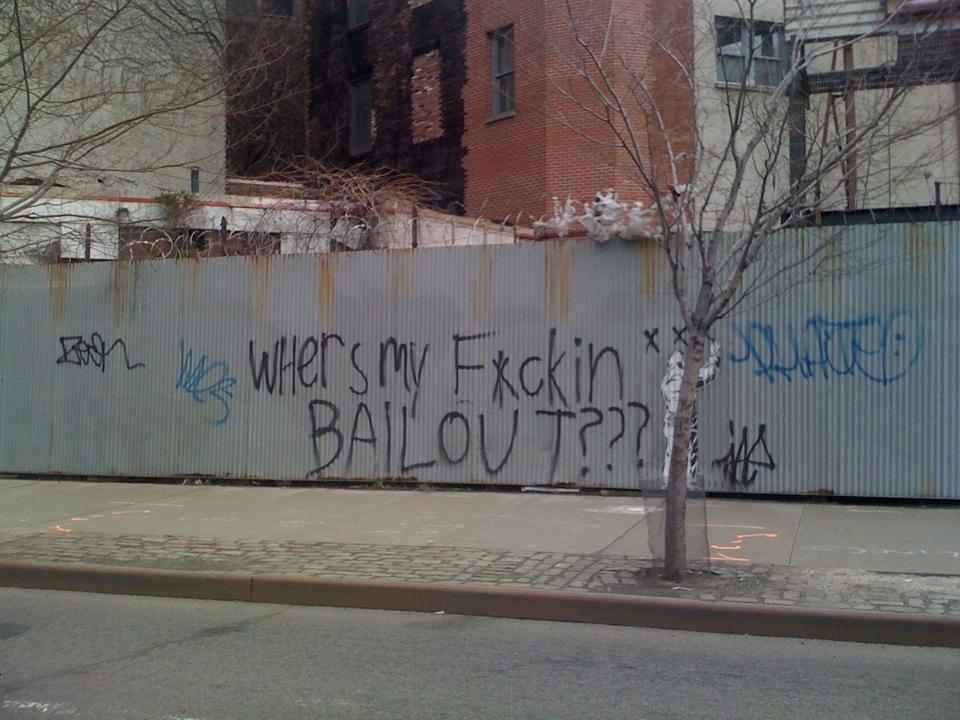
Bailout

Free Exchange helpfully summarizes the auto news:

Barack Obama has reportedly determined that a negotiated bankruptcy is the best option for General Motors and Chrysler. Chrysler could face liquidation if its deal with Fiat isn't realised, while GM's bankruptcy would be "quick and surgical" and designed to return the company to profitable operation. While GM still has 60 days to submit a more aggressive restructuring plan, leaders in Washington are beginning to call bankruptcy an inevitability.

Henry Blodget wants to know why Wall St. isn't getting the same treatment:

Why does the Obama administration refuse to hand the bill for our banking catastrophe to the folks who deserve it–bank bondholders and shareholders?  Why do taxpayers have to pay that bill, while we're spared most of the pain in Detroit?

And James Surowiecki counters.

(Photo: the approach to the Holland Tunnel this morning – from a reader.)

The Bears Divide

Free Exchange notes that Krugman and Roubini are no longer singing the same tune:

Two men who were very pessimistic for a very long time, so much so that their analysis was frequently dismissed as hyperbolic, and who were subsequently proven to be more or less right about things, are now diverging in their assessments. For perhaps the first time in my life I have to say—I hope Nouriel Roubini is right.

“Makers And Takers”

Many readers took umbrage at this shorthand in this post. Here's the context:

The new cultural divide will not be on guns, gays and God. It will be between the makers and the takers, the producers of wealth and the recipients of redistribution.

I should unpack a little (and maybe at some point, a lot). The divide I'm talking about is not a hackneyed distinction between God-fearing entrepreneurs and parasitic welfare queens. It's about those who contribute their labor to produce something of value, and those who primarily rely on government, directly and indirectly, to get them through their lives. This is not about rich and poor as such. It's clear at this point that the rich and privileged often get as much from government as anyone else. Nor is it about ending a welfare state that provides a core level of health and retirement security. Conservatives should be very comfortable in backing such a safety net – and working hard to make it more efficient and effective. It's about work vs. welfare broadly conceived. What I think conservatism has to do is recover its core sense of itself as the movement that values work over wealth, individual effort over collective action, and a system that is transparent and fair enough for ordinary folk with lives to live and families to take care of to keep tabs on.

The welfare includes mandatory entitlement benefits to the comfortable middle and upper classes, and the corporate welfare state in which wealthy businesses have the means to lobby big government to grant them tax breaks, hidden subsidies, tariffs and bailouts. It includes agricultural subsidies.

It targets big finance that has also lobbied to reduce the regulation that monitors their speculation. It's about teachers unions that protect bad teachers out of collective clout at the expense of students. It's about huge defense firms that come close to dictating what government buys and spends. You get the picture. Reduce these people's effective welfare, and reward ordinary people's hard work. It's a conservative theme that speaks to our current moment – and reflect a core element of the conservative DNA that avoids divisive moral and religious culture war issues that are best left to the states.

One reason I favor a flat tax and a full-scale 1986 style attack on deductions and loopholes is to restore a sense that those who work hard and succeed at what they do are not being scammed by powerful free-riders who can use their money to get tax lawyers to rig the system. One reason I have no problem with a modest estate tax is also because it reflects a tax code that values work over inherited wealth.

That's also why conservatives should, in my view, back a restoration of some of the pre-1999 regulation of the financial sector to prevent them from gaming rather than working the system. Too big to fail means too big, as far as I'm concerned. It's why conservatives should champion a more aggressive attempt to ratchet back the military-industrial complex as well, as Eisenhower wanted, to subject America's defense establishment to some rational assessment of real national security needs. A serious bid to means-test social security and Medicare – or otherwise ensure that only the truly needy get help – may be political poison, but it's what fiscal conservatives exist to take on.

A smaller, more transparent and simpler government is easier to keep tabs on. I should add that, unlike many fiscal conservatives, I've long favored an estate tax that taxes inherited wealth rather than earned income. What conservatism needs to do is to regain the confidence of ordinary Americans who value work, thrift and self-reliance. After this current crisis, the moment will be ripe.