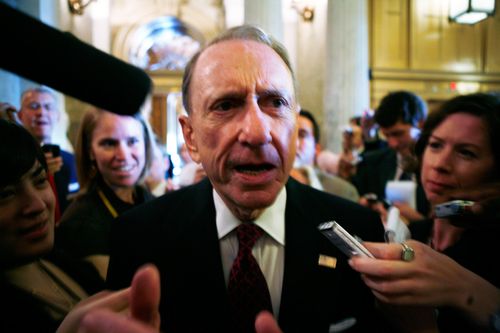
The Big Tent Shrinks Even Further

SPECTERAlexWong:Getty

A round up of reactions in the blogosphere to Specter’s party switch. Matt Welch:

Throat-clearing aside, this strikes me as no favor at all to the Democrats. By choosing to die on the hill of the stimulus package of all things, Specter reinforces whatever notion there is that stimuli and bailouts are Democratic, not Republican, pet toys. Since professional Republicans are currently scattered in the wind, trying desperately to latch onto the anti-stimulus/bailout Tea Party movement, cementing that divide may come back to haunt Democrats when those policies (inevitably, I think) become so derided that even Barack Obama’s impressive popularity can’t rescue them.

Jonathan Chait:

The broader symbolism here is that it’s another sign that Barack Obama’s first two years may not look like Bill Clinton’s. In 1993-94, Clinton’s approval ratings sagged, his party lost special elections everywhere, and conservative Democrats were switching to the GOP. Obama’s approval ratings are high and holding steady, Democrats remain far more popular than Republicans, Democrats held the first special election, and now they’ve picked up a party switch. It’s still early, but Obama is starting to build a self-sustaining psychology of success.

Jay Nordlinger:

[Specter] begins with the nonsense about how the Republican party has moved too far to the right, blah, blah, blah. That’s not to be taken seriously. That’s just rationalization, and not very smart rationalization at that.

Steve Benen:

But if reaching the 60-vote threshold doesn’t make Arlen Specter’s big switch “huge,” what makes today’s news a seismic political shift? It’s further evidence of a Republican Party in steep decline, driven by a misguided ideological rigidity. Indeed, Specter suggested as much in his statement: “Since my election in 1980, as part of the Reagan Big Tent, the Republican Party has moved far to the right.”

Kos:

Interestingly, he remains a foe of EFCA, which means that labor is free to fund and help a real Democrat in the Democratic primary. Bizarre choice. Had he decided to back EFCA, as he has always done so in the past, he’d have labor’s full support. Now, he gives the opposition an opening to take him out in the Democratic primary.

A.L.:

…from a political perspective, instead of facing serious pressure from the Right (because of Toomey’s primary challenge), he will now face serious pressure to move to the left on various issues. That’s because he’s now going to have to run in a Democratic primary, and though the party will do what it can to clear the field for him, he’ll still likely face some competition. And whoever he faces in the primary will play up his or her own Democratic bona fides while attacking Specter’s lack thereof. So Specter will have to do things to prove that he is a legitimate Democrat. And if he proves to be a major obstacle to Obama’s agenda, he’ll suffer for it; the honeymoon will be over very quickly.

Nate Silver:

This defection, coming at a time when historically low numbers of Americans are identifying themselves as Republican, would seem to be a manifestation of [the Republican] Death Spiral. These problems, indeed, were particularly acute in Pennsylvania, where many of the state’s more moderate Republicans had re-registered as Democrats to vote in the state’s extremely contentious primary between Barack Obama and Hillary Clinton. Thus, given an extremely conservative Republican electorate, Specter appeared to be an underdog against his extremely conservative primary challenger, Pat Toomey, and switched parties in order to increase his odds of survival.

Former Republican John Cole:

I’m still waiting on my Soros check and forty virgins, so don’t get too excited, Arlen. Oh, and by the way, wingnuts- how is that Republican purity treating you? Is the GOP small enough to drown in a bathtub yet? Going to love hearing how a loyal foot soldier for three decades in the GOP wasn’t “conservative enough.”

Megan:

Instant analysis:  this is probably not a good sign for the future of the Republican party, not because Arlen Specter is so crucial to its ideological or political integrity, but simply because he’s a seasoned politician from a swing state, and what does he know that other Republicans don’t?

Ed Morrissey:

 I’m in the good-riddance category here.  Normally I argue for a big tent and the need to woo moderates by focusing on core values.  Specter betrayed those values in his Porkulus vote and cloture cave.  He could have forced Obama, Pelosi, and Reid to start negotiating in good faith with his Republican colleagues, but instead allowed them to shove a bad bill down their throats.

Malkin:

Don’t let the door hit you on the way out.

(Photo: Alex Wong/Getty.)

The Conservative Fissure Widens

Arlen Specter, my kind of Republican in many ways, calls it quits:

Since my election in 1980, as part of the Reagan Big Tent, the Republican Party has moved far to the right. Last year, more than 200,000 Republicans in Pennsylvania changed their registration to become Democrats. I now find my political philosophy more in line with Democrats than Republicans. When I supported the stimulus package, I knew that it would not be popular with the Republican Party. But, I saw the stimulus as necessary to lessen the risk of a far more serious recession than we are now experiencing. Since then, I have traveled the State, talked to Republican leaders and office-holders and my supporters and I have carefully examined public opinion.

It has become clear to me that the stimulus vote caused a schism which makes our differences irreconcilable. On this state of the record, I am unwilling to have my twenty-nine year Senate record judged by the Pennsylvania Republican primary electorate. I have not represented the Republican Party. I have represented the people of Pennsylvania.

I find it interesting that a stimulus spending package in the midst of the steepest recession in memory is the sticking point. For the GOP to have remained mute under the massive increases in spending and borrowing under Bush but to make resistance to the Obama stimulus package a litmus test for conservatism reveals that the deepest principle of the Republican base is partisanship.

The Question

Ramesh Ponnuru asked last Friday:

Surely the primary question is whether laws were broken; and if there is serious reason to believe that they were, then shouldn't there be a presumption in favor of investigation? An argument against prosecution that appears to concede that laws may have been broken, or treats the question as an afterthought, seems to me to be unlikely to prevail. The people who strongly oppose investigation and prosecution would be on stronger ground, it seems to me, making the argument that it is simply outlandish and absurd to think that policymakers violated the law. Can that argument be made?

I think we know the answer.

Why Is Torture Worse Than Warfare?, Ctd.

Larison responds to Manzi:

One of the things that has kept me from saying much over the last week or so is my sheer amazement that there are people who seriously pose such questions and expect to be answered with something other than expressions of bafflement and moral horror. Something else that has kept me from writing much on this recently is the profoundly dispiriting realization (really, it is just a reminder) that it is torture and aggressive war that today’s mainstream right will go to the wall to defend, while any and every other view can be negotiated, debated, compromised or abandoned.

I have started doubting whether people who are openly pro-torture or engaged in the sophistry of Manzi’s post are part of the same moral universe as I am, and I have wondered whether there is even a point in contesting such torture apologia as if they were reasonable arguments deserving of real consideration. Such fundamental assumptions at the core of our civilization should not have to be re-stated or justified anew, and the fact that they have to be is evidence of how deeply corrupted our political life has become, but if such basic norms are not reinforced it seems clear that they will be leeched away over time.

Read it all.

Again And Again And Again And Again

The NYT revisits former CIA officer John Kiriakou's ABC interview about Abu Zubaydah's interrogation. Kiriakou claimed that Zubaydah broke after “probably 30, 35 seconds,” of waterboarding, but the recently released torture memos showed Zubaydah was waterboarded "at least 83 times." Drum responds:

Kiriakou's testimony was immensely influential at the time, but it's pretty clear now that he was wrong: unless the CIA continued waterboarding him just for sport, Zubaydah didn't break after a single session.  Or ten sessions.  Or fifty.  And if Kiriakou was wrong about that, what are the odds that he was also wrong about the "dozens of attacks"?  Or about the fact that waterboarding was responsible for any actionable information at all?

Greenwald has more. Spencer Ackerman imagines another possibility:

The final possibility is gruesome — that both things are true. Abu Zubaydah broke, but they continued to waterboard him 82 times.  What would further declassifications show? How many times was Abu Zubaydah waterboarded before the CIA was convinced they’d gotten “everything” out of him? It’s implausible to believe Abu Zubaydah said nothing after the first waterboard session, or the fifth, or the tenth, or the twentieth, or the thirtieth or the eightieth.

Was it to buttress a casus belli against Iraq? There are arguments for and against. But surely the point is that we cannot know for sure based on the shards of evidence in front of us. Worse: because torture has been introduced into the equation, we will probably never know what was true or false, what leads were valid and which were not, which questions were asked in good faith and which were not.

The torturing of these suspects ineluctably renders them pliable for whatever truth the torturers wanted to believe. This is how torture creates reality – and that reality is always for the purpose and benefit of those with the power to torture. How many torturers over the centuries have publicly acknowledged they got nothing from it? The stigma is such that they have to claim it worked – or face a double shame. And the capacity of torturers for self-deception is profound. Even Cheney wants to sleep at night. Even Cheney wants to believe he did the right thing.

But even if you trust Bush and Cheney to be torturing with the right motives (yes, I wrote those words), the act of torture itself obliterates the saliency of motive. Because the power it gives the torturer removes him from the regular to and fro of human life. Torture, when used, is like Tolkien's ring, when slipped on. It becomes its own power and its own rationale because it can coerce its own results. This is why civilized societies have placed the torture option off limits – way off limits with a wide berth in law and custom. Because it destroys the core elements of truth, freedom and fairness that are foundational for Western civilization.

Bush and Cheney removed those foundations and where they once were, a deep and dark hole lies open to the world.

It is their Ground Zero.

What If The Torturers Win?

Halfstaffdusk

Tyler Cowen is against torture prosecutions:

At many blogs (Sullivan, Yglesias, DeLong, among others) you will find ongoing arguments for prosecuting the torturers who ran our government for a while.  I am in agreement with the moral stance of these critics but I don’t agree with their practical conclusions.  I believe that a full investigation would lead the U.S. public to, ultimately, side with torture, side with the torturers, and side against the prosecutors.  That’s why we can’t proceed and Obama probably understands that.  If another attack happened this would be all the more true.

Yglesias responds:

I don’t really consider myself an enthusiast for torture prosecutions. In part for reasons related to what Cowen says, I’m less interested in seeing the guilty punished than in seeing at least some of them and their political supporters admit that they were wrong and acting unwisely under the influence of the atmosphere of panic that prevailed in the aftermath of 9/11. How exactly you achieve that isn’t totally clear to me. But I think it’s plausible that some threat of prosecution, coupled with the ready availability of clemency for people prepared to come clean, plays a role.

I find the current situation more dangerous than Tyler does. In our current world, the laws against torture, we now know, were over-ridden with impunity or, at the very least, treated as obstacles to be overcome by bad faith lawyering, Orwellian language and political brinksmanship. Absent any serious attempt to get to the bottom of this and prosecute the guilty, the US’s commitment to the Geneva Conventions and to the UN Convention on Torture is transparently insincere – and the entire international legal edifice restraining such barbarism gutted by its ostensible global leader. Bush and Cheney will not just have destroyed the integrity of America, they will have done more to advance the use of torture worldwide than anyone since the Conventions were first set up. The civilizational consequences of America’s endorsement of torture as a “no-brainer” in the words of the last vice-president are incalculable.

A conscious refusal to enforce Geneva and the UN Convention when there is no doubt at all that torture took place – and is celebrated as a “no-brainer” decision by the former vice-president – is to treat such treaties as null and void. It means this: the global power that set up the Geneva Conventions has declared them optional.

Cowen’s position is what Glenn Reynolds’ was: Americans are a bloodthirsty, lawless lot and any attempt to restrain torture on the downlow would lead to its unmitigated and enthusiastic legalization in the wide open. Better then to stay in a zone of law-free ambiguity and hypocrisy than a zone where the US is a global leader in “enhanced interrogation.” Call me naive but I do not share their view of American depravity. And I do not believe that constitutional and democratic societies should encourage and excuse leadership that is openly committed to violating the laws.

We have two honest options: to investigate the torture and prosecute the guilty or to formally withdraw from Geneva and the UN Convention on Torture. I know it would be more convenient if we could all just move on and avoid this. But we can’t. So which one?

How Bad Is The Swine Flu?

The Plank interviews a global health expert, and Obsidian Wings features a guest post by immunization, vaccine, and bioethics directors. A dispatch from Mexico City:

…as the death toll continued to rise and health officials sounded more and terrible warnings, the tangled, bustling atmosphere of this giant city descended to a surreal stillness. Movie theaters, bars, and discos are closed. Schools have been shuttered until at least May 6. Traffic is light. A Sunday soccer match in the Azteca stadium was played to empty bleachers. The occasional jogger still passes by my window, and a few brave families can be found hanging out with their unmasked kids in the nearby park. But the strange and scary swine flu is on everyone’s mind.