…obituaries aren’t interesting because of what they say about death. They’re interesting because of the funny and pathetic way they purport to deal with the unfathomable. Obituaries are little fairytales we tell ourselves, while imagining our own lives as one day complete enough to write about. An obituary, any obituary, transforms lives into stories, with interesting characters, a cohesive plot, and most importantly, a good ending. This is what we’ve got as humans — not the ability to understand or be at one with death, but the ability to generate lots of stupid crap to fill in the empty space of the unknown. Obituaries can do that as much as anything, and maybe we can think of them both in the Franklinian and Aristotelian sense: They might not complete life nor make it eternal, but they can make us feel better about living in the constant and terrifying presence of death.
David Plotz describes what he has learned about the Bible:
The overarching theme of the Bible, particularly of Genesis, is real estate. God is Trump-like, constantly making land deals (and then remaking them, on different terms). When Sarah dies, for example, there are two verses about her death, and a whole chapter about Abraham negotiating to buy a burial site for her in Hebron. It’s not just land that the Bible is obsessed with, but also portable property: gold, silver, livestock.
There’s a great book to be written—not by me—about Biblical economics, and what all these transactions indicate about the nature of Judean society. I’m not sure what it tells us about the current housing crisis, except perhaps that the Israelites were just as maniacal about land ownership as we are. None of them wanted to rent in the Promised Land. They all wanted to own (and there wasn’t even a mortgage interest deduction).
John Grohol looks at "new research [that] suggests that a person can increase their feelings of belongingness — the sense of being in a social situation — by simply watching television." He writes:
Is any of this a “good” thing? Well, it depends on how you look at it. If you’re home-bound or an older person who has lost all of their friends and family, you don’t have a lot of choices in where you can grab your social interactions. If you can get something that provides similar relief from feelings of loneliness and rejection from television or the Internet, it may be sufficient (and more than sufficient in some cases) for people faced with such a situation.
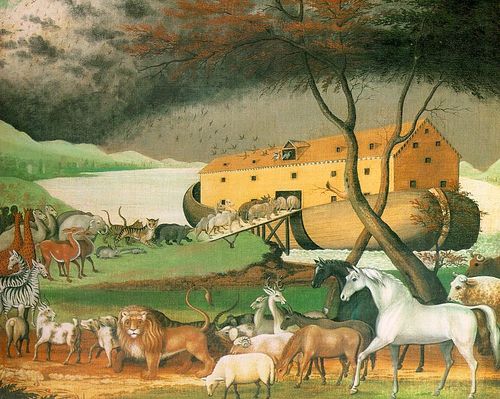
Before The FloodBy W.S. Merwin (who won a Pulitzer prize this week)
Why did he promise me that we would build ourselves an ark all by ourselves out in back of the house on New York Avenue in Union City New Jersey
to the singing of the streetcars after the story of Noah whom nobody believed about the waters that would rise over everything when I told my father I wanted us to build an ark of our own there in the back yard under the kitchen could we do that he told me that we could I want to I said and will we he promised me that we would why did he promise that I wanted us to start then nobody will believe us I said that we are building an ark because the rains are coming and that was true nobody ever believed we would build an ark there nobody would believe that the waters were coming.
I had wondered when Andrew was going to get around to explaining Catholicism to the Pope, and showing why the clear commands of Scripture against, and two millenia of plain Christian moral teaching got it wrong on gay sex. Hey, if George W. Bush can claim that "we don't torture," despite overwhelming evidence to the contrary, and still find an audience of true believers, I'm sure Andrew will be able to convince homophiles that Christianity couldn't possibly be against homosexuality, because that's not the kind of thing Christianity could possibly be against. There's enough casuistry and question-begging to go around for everybody.
Dreher has obviously never read my book on homosexuality, which deals deeply with scripture and Christian doctrine, or my many essays on homosexuality and Catholicism, or my long wrestling with natural law, or an entire body of work devoted specifically to these questions, and to resolving them as honestly as I can. I know much of this work was done a decade or more ago, but to demand that I "get around" to subjects I have spent my career exploring is a little much.
I ask Rod again: try Chapter One of Virtually Normal. It has been published in many languages and was just released in Slovenia of all places. It's my best shot.
Well, of coursehe does. But the idea that this is about vengeance is a piece of fantasy. Or as Hilzoy nicely puts it,
Who died and made David Broder Sigmund Freud?
If I had one belief in politics, it would be that the freedoms secured by the modern West are worth fighting for. Absolutely central to those freedoms is barring the executive branch from torturing people. No power is more fatal to freedom and the rule of law than torture. It is like Tolkien’s ring: no society remains free, if its rulers use it. Its power is banned because it is a solvent to the rule of law, the establishment of truth, and the limits of government. For an administration to secretly and illegally unleash this weapon – against citizens and non-citizens alike – and to demand that it not be subsequently called to account, that it be allowed to get away with it under some absurd notion that it’s too divisive to hold war criminals accountable for their crimes is and was an outrage. Punishing those responsible for war crimes is not “scapegoating”. You know what scapegoating is? It’s throwing Lynndie England in jail for following orders given by George W. Bush, while leaving him to the luxury of a Texan suburb.
The precedent of a torturing American president must be reversed. That means it cannot be allowed to stand.
There is no way the American experiment can continue while legal and historical precedent gives the president the inherent authority to torture. It is the undoing of the core idea of the founding – protection against arbitrary, lawless, cruel and despotic rule. And the impact on the entire world of America allowing this to stand would be profound. The world looks here for moral leadership. Those who endure real political oppression, imprisonment, torture and abuse at the hands of despots look to America for leadership, for guidance, for hope. If America – America – discovers that its own president has illegally tortured and decides that it simply won’t do anything about it, that it doesn’t matter, that it’s too polarizing to restore the rule of law … then what hope do those people have? To whom will they look when they fight far more pervasive tyranny, buttressed by the same absolute power to coerce the truth and break the human soul?
We don’t want vengeance. We want America back. And we are going to fight on and on until we get it back.
According to On Demand Books, there are currently five Espresso machines in the U.S. (with 10 others in locations throughout Canada and the U.K.). This, though, will soon change. Dane Neller, CEO of On Demand, said that "within a relatively short period that number will be increasing dramatically." On Demand is releasing a new model of the machine, version 2.0, which will print books faster–roughly four minutes for a 300-page book as opposed to eight minutes–and be offered at a lower price point. Neller added that the Espresso machine can now be leased as well. The 2.0 model will be on display at the London Book Fair.
Larison praises Obama's Summit of the Americas performance:
Obama’s willingness to acknowledge America’s past tendency to dismiss the views of allies and to disrespect legitimate foreign interests reflects a degree of self-confidence that has been oddly lacking in the strongest advocates of U.S. hegemony. This is especially notable for a Democratic president—who often feel must prove their hawkishness.
Instead of the almost-obsessive need to celebrate American achievements, Obama’s handling of foreign relations has shown a steady, humble confidence in the United States. This is a refreshing departure from foreign policy since the end of the Cold War, as well as from some of Obama’s own more aggressive campaign rhetoric. In contrast to that familiar Democratic “defensive crouch” on matters of national security, Obama has acted as a leader who feels no need to overcompensate for any perceived weakness and no need to apologize for giving priority to rebuilding damaged international relations with both allies and rivals. Indeed, it seems that the problem Obama’s critics have with him is not that he has been admitting American mistakes, but that he has failed to cringe and apologize to them for pursuing the course of action he thinks best for the United States.
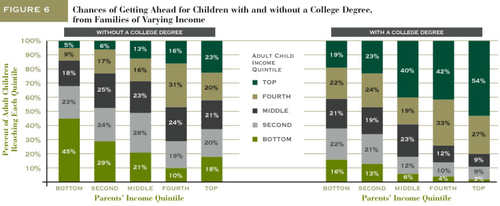
More than we might like to believe. Ryan Avent reads a study:
The truly amazing thing to me is that parental income isn't just crucial in getting to college, and getting through college — its effects linger on, basically, in perpetuity. One of the most remarkable findings from the Pew Charitable Trusts' Economic Mobility Project is that a child from a family in the top income quintile who does not get a college degree is more likely to wind up in the top income quintile himself than a child from a family in the bottom income quintile who does get a college degree…
The very notion that al Qaeda needs a secure geographic base to carry out its terrorist operations…is questionable. After all, the operational base for 9/11 was in Hamburg, Germany. Conspiracies involving small numbers of people require communication, money, and planning — but not a major protected base camp.

 The Dish