Mike Gerson’s Christian Witness

Agabuse

Few people in public life have so brazenly displayed their piety as Michael Gerson. One of the backers of "compassionate conservatism" and a constant believer that every public policy decision has to be seen at some point through the prism of religious faith went on the Hewitt show yesterday to protest any idea that officials who committed or authorized torture be subject to the rule of law. Money quote:

HH: Did you ever talk about waterboarding with anyone in the White House? MG: No, those were, in fact, those techniques and approaches that were revealed in the memo were known by a very small group of people, on a kind of need to know basis. I didn’t know about them.

I'd heard of them, hadn't you? Oh, how thick the walls are in the White House!

You can go back in this blog and see rumors of this policy well back in the first term of Bush. But Gerson? Totally in the dark. No idea. Shocked that anyone would investigate. And lying:

The fact of the matter is that this represents what was happening in the immediate aftermath of 9/11.

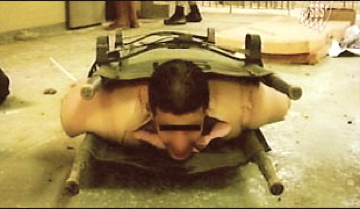
The Bradbury memos dating from 2005, long after Bush had been re-elected, setting up torture as a permanent program in the US government? Gerson is in a particularly tough spot: a public Christian who worked for, lived among and supported torture, an act of unpardonable gravity from a Christian perspective.

If one were ever to find an example of how power corrupts, a Christian who backs torture is pretty damn close. Maybe we needed a born again Christian to bring stress positions into the American government. They have a very Christian origin.

Why Won’t Obama Use The T-Word?

Marc investigates:

Justice Department officials, as well as experts outside the government, say they know the answer: given the enormous number of pending civil cases involving extraordinary renditions and Bagram/Gitmo/Guantanamo interrogations, if an officer of the executive branch acknowledges that the memos released constitute "torture," they're just provided the plaintiffs in these cases with a powerful weapon to use when the government tries to quash the cases on a variety of grounds. State Secrets Privilege? Judges are quite deferential to it. But now the government admitted to torture! 

President Obama said so. The privilege doesn't count as much if the executive branch is conceding a basic fact to their legal interlocutors.  Obama and Attorney General Eric Holder can say things like: "We won't torture." "Torture is abhorrent."  They can't say things like: "We tortured 100 detainees, and we're sorry for it."  The Obama administration has a vested interest in winning as many of the current cases as possible — even when the facts of those cases are distasteful. That's why they're avoiding the T word. Is that right? Fair? Ethical?

When The Tortured Surrender

Marc Thiessen speaks of the epiphany a torturer feels when has the body and soul of another human being finally under his total control:

[T]he memos note that, "as Abu Zubaydah himself explained with respect to enhanced techniques, 'brothers who are captured and interrogated are permitted by Allah to provide information when they believe they have reached the limit of their ability to withhold it in the face of psychological and physical hardship."

In other words, the terrorists are called by their faith to resist as far as they can — and once they have done so, they are free to tell everything they know. This is because of their belief that "Islam will ultimately dominate the world and that this victory is inevitable." The job of the interrogator is to safely help the terrorist do his duty to Allah, so he then feels liberated to speak freely.

I couldn't help recall the account of an American prisoner on the other side of the torture line:

Although the other captives had designated Denton "president of the optimist club," there were times he prayed to die. He didn't want to — couldn't — endure another minute of despair. Once, when Denton refused to tell guards how the Americans communicated with each other, he was tortured for 10 days and nights. By the 10th night, he couldn't think anymore. He couldn’t pray anymore.

Denton surrendered. Not to the guards, but to God. "It was a total surrender," he said. "If there was anymore to do, you will do it," he told God. "That instant, I felt zero pain," he said. "I felt the greatest comfort and reassurance in life that I haven’t felt since."

Torture is the moment when a human being loses everything on earth, and looks to heaven for some kind of comfort or resolve. To listen to the Cheneyites, you almost forget that human beings are still human beings, however wicked, of whatever faith, and of whichever country.

What Should We Cut?, Ctd.

A reader offers some sane points about the difficult and complex task of tackling long-term debt:

Although asking the question is not totally worthless, any suggestions must be coupled with an analysis of the implication of any proposed cuts. To do otherwise ignores the huge role government spending has on our overall economy. For example, if we cut military spending significantly, which I would support in the abstract, what happens to the people who otherwise would be employed in the military or by the military? What happens to the thousands of companies that make weapons, equipment, gear and other goods used by the military?  If we cut spending, do we just assume that the private economy will step up and create other jobs for these people?

The same question can be asked about transforming our health care system.  As Obama said when he was running for office, the health care industry constitutes 16% of our GNP.  Overhauling that segment of the economy cannot be done without other consequences.  Suppose, for example, that we suddenly adopted a single-payer, government operated program in order to hold down the outrageous administrative costs passed along  by private insurance companies.  Good idea in the long run perhaps, but what happens to all those people employed in the private insurance companies?  Do our unemployment compensation rates increase, thereby eliminating the savings realized by cutting the programs?

The problem we have today is an inability to think and act cohesively about the long term.  Virtually the only time we do so is in times of genuine crisis, and we do not yet perceive the events today as a crisis.  Obama’s message is a long-term, not a piece meal message.  Large sectors of our economy are utterly broken, health care, the banking system, and our addiction to non-renewable sources of energy to name three.  And global warming presents a problem the world as we know it has perhaps never faced before.

We have to move gradually yet forcefully in new directions to create new private markets while the government simultaneously takes on responsibilities for old private markets that have failed.  I am not at all optimistic that we have the national will power and intelligence to make the transition as it will easily take ten years to redirect the ship in a meaningful way, and our life styles during that decade will have to change.  Cutting a few programs, while perhaps one small part of the overall puzzle, does not begin to address what we need to do, and focusing on these small details is missing the forest for the trees.

The discussion should focus only on two, much broader questions.  First, are there parts of our economy that are broken and beyond repair?  Second, if so, how should the government act to fill the voids created by these failures, and help move the economy in new directions?  My belief is that if we cannot create consensus on the first issue and thereby perpetuate the old circular dialogue, we will create the crisis that will result in unimaginable government intervention in the future.  We have been living in a dream and its time to wake up.  The time has come to make big and difficult decisions.

The Nub Of It

John Schwenkler vents:

I’m sick to frigging death of people – self-identifiedly conservative or otherwise – whose reaction to the ongoing revelation of what our government and its representatives did post-9/11 is to say, Oh, well, I’m really opposed to torture, and clearly there were some cases where a few bad apples crossed the line, but we were just trying to do our best, and national security is really important, and these people are pretty awful people after all, so despite the fact that I’m really opposed to torture I’m still okay with what our government did.

NEWSFLASH: If you’re okay with all or most of what our government did, you’re not opposed to torture.

E.D. Kain and Mark Thompson respond.

The Party That Ron Paul Built?

Nate Silver reads the public opinion tea leaves:

…of the roughly four different pathways the Republicans could take in the post-Obama universe — toward Ron Paulesque libertarianism, toward Sarah Palinesque cultural populism, toward Mike Huckabeesque big-government conservatism, or toward Olympia Snowesque moderation/ good-governmentism — the libertarian side would seem to have had the best go of things in the First 100 Days.