The Dish was attacked by Typepad again this past hour. All Typepad blogs were wiped out for a while or in corporate-speak "degraded". Their new platform removed key, basic features every blog needs, and when they haven't made you spend large amounts of time manually coding features that were previously automatic, they go belly-up entirely. Be forewarned.
Month: April 2009
The Case Of Richard Wilhelm Hermann Bruns, Et Al.
Longtime Dish readers will know what I’m referring to. It is a famous war crime prosecution against Nazi officers in occupied Norway, and the trial took place in 1946. The men were accused of using “enhanced interrogation” techniques – or in the original German “verschaerfte Vernehmung” – against captives. The Dish’s first coverage of this case can be read here. The online account of the trial can be found here. Two things are worth noting. The first is the Nazi definition of the term “enhanced interrogation.” Here’s the formal description:
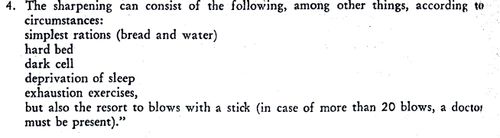
Notice how the Nazis ensured that doctors were present at all times so that they could monitor the captives’ response to torture and make sure they didn’t die or suffer visible permanent injuries that could embarrass the regime in public (see the Bradbury and Bybee memos for the Bush equivalent). Notice the careful measurement of how many times someone can be beaten (another Cheney innovation). And notice that we are not talking about waterboarding – something even the Nazis excluded from their “enhanced interrogation” methods. In the case of Bruns, et al., this translated to these charges:
On 19th December, 1942, Bruns was present at the interrogation of a sick Norwegian. Leg screws were fastened to his legs and he was beaten with various implements. Later he was thrown unconscious into a cellar, where he remained for four days before receiving medical attention.
Between 1942 and 1945, Bruns used the method of “verschärfte Vernehmung” on 11 Norwegian citizens. This method involved the use of various implements of torture, cold baths and blows and kicks in the face and all over the body. Most of the prisoners suffered for a considerable time from the injuries received during those interrogations.
Between 1942 and 1945, Schubert gave 14 Norwegian prisoners “verschärfte Vernehmung,” using various instruments of torture and hitting them in the face and over the body. Many of the prisoners suffered for a considerable time from the effects of injuries they received.
So you have the abuse of someone with a pre-existing injury (Zubaydah), neglect of prisoners (ubiquitous at Bagram, Abu Ghraib and testified to by FBI agents at Gitmo), measured beatings, sensory deprivation, sleep deprivation, and hypothermia or cold baths (also documented in the Bybee and Bradbury memos and the ICRC report). Now check out the defense against the charge of war crimes:
All three defendants appealed to the Supreme Court. Their appeal was based on the following arguments :
(a) That the acts of torture which the defendants had committed were permitted under International Law as reprisals against the illegal Military Organisation whose activities were at variance with International Law.
(b) That the acts were carried out on superior orders and that the defendants acted under duress.
(c) That the acts of torture in no case resulted in death. Most of the injuries inflicted were slight and did not result in permanent disablement.
Do these defenses sound familiar? They failed in court. And while modern Americans debate whether we can even use the word ‘torture’ with respect to these techniques, previous generations, closer to the reality of war and torture than we are, had no qualms.
The punishment for these crimes was the death penalty.
Mark Thiessen: It Was Torture
It's right there in the Washington Post – a defense of the "enhanced interrogation" techniques authorized by president Bush, illustrated at Abu Ghraib, and a cause of at least a dozen and as many as a hundred deaths, (according to the Pentagon and many human rights groups respectively). Thiessen's core defense – that the techniques worked – is at severe odds with his contention that it was not torture:
[T]he memos note that, "as Abu Zubaydah himself explained with respect to enhanced techniques, 'brothers who are captured and interrogated are permitted by Allah to provide information when they believe they have reached the limit of their ability to withhold it in the face of psychological and physical hardship." In other words, the terrorists are called by their faith to resist as far as they can — and once they have done so, they are free to tell everything they know. This is because of their belief that "Islam will ultimately dominate the world and that this victory is inevitable." The job of the interrogator is to safely help the terrorist do his duty to Allah, so he then feels liberated to speak freely.
What defines torture is not this or that specific technique. We could spend hours poring through the countless ways in which human beings have devised to torture defenseless captives over the centuries. What defines torture is applying sufficiently severe mental or physical pain or suffering to force a victim to say anything to make it stop. In terms of time, you can go from the 15 seconds of waterboarding or electrocution to the days, weeks and months of Chinese water-torture, or days and weeks of sleep deprivation. The point is to break people. Or as an Abu Ghraib interrogator conveyed the message from the commander-in-chief in an August 2003 e-mail:
"The gloves are coming off gentlemen regarding these detainees, Col. Boltz has made it clear that we want these individuals broken."
This is what Thiessen is bragging about here.
It is to subject captives to such levels of physical or mental pain or suffering that they "have reached the limit of their ability to withhold [information] in the face of psychological and physical hardship." This is, in fact, as close to a definition of torture as you are likely to find. Zubaydah understood that torture is the imposition of sufficient physical or psychological pain or suffering to cause even religious fanatics, who believe their very souls are at stake, to have no choice but to submit. And so Western torture returns to its early modern roots: as a tool to prove that the power of government is greater even than the power of religious fanaticism, if you are prepared to treat the human body and soul as objects for total coercion and control. Begin with the inquisition and end with it; only now it is designed against Islamists, not heretical Christians.
Memo to Thiessen: you cannot both argue that the pain and suffering was severe enough to force captives to have no choice but to confess and also argue that it wasn't torture. This is what you call a self-refutation.
Thiessen may not have intended it, but he just wrote an op-ed proving that his former boss, Dick Cheney, is a war criminal.
Yglesias Award Nominee
"New York has one of the highest gay populations in the nation, and they vote and pay taxes. Giuliani always did quite well (for a Republican) with gay voters. It’s hard to imagine that he, or anyone, could afford to alienate them directly and win," – Lisa Schiffren, bemoaning the thought that New York State might legislate marriage equality.
The NYT And The Blogs
Another story the MSM missed and the blogosphere found:
The new information on the number of waterboarding episodes came out over the weekend when a number of bloggers, including Marcy Wheeler of the blog emptywheel, discovered it in the May 30, 2005, memo. The sentences in the memo containing that information appear to have been redacted from some copies but are visible in others. Initial news reports about the memos in The New York Times and other publications did not include the numbers.
And I'd say that small detail has made a huge amount of difference. Anyone who has studied the history of torture or followed the Cheney program closely knows how it follows classic torture techniques, however dressed up in euphemism and veiled in secrecy. But even someone utterly and happily unversed in such matters will know – as a core fact – that waterboarding someone 183 times over and over and over again is self-evidently torture. That's why Cheney has had to come out swinging. Even Fox News cannot spin that one. And the law cannot get around it.
One statistic has finally broken through the Orwellianisms, like the Abu Ghraib photographs tore off the lid of the Cheney mode of war. Hence the shift in the argument. We don't torture. We don't torture. We don't torture. Let's move on. Look: it worked.
Zawahiri
Rattled a little?
Al Qaeda's second-in-command told Muslims not to be fooled by U.S. President Barack Obama's policies which, he said on an Islamist website on Monday, are no different to those of his predecessor, George W. Bush. "America came to us with a new face, with which it is trying to fool us. He is calling for change, but (he aims) to change us so that we abandon our religion and rights," Ayman al-Zawahri said in an audio recording on the website.
Is Cheney Panicking?
The one thing you saw most plainly in the Plame affair is how obsessed Dick Cheney is with public image, the chattering classes and spinning stories that might reflect poorly on him. The act is the elder statesman, authoritatively reviewing the world scene, soberly making judgments, calmly explaining it later to those pesky people who are required to elect you every four years. The reality is a man who lost it on 9/11, leapt immediately to apocalyptic conclusions, and then, as the dust cleared, was unable to go back on the war crimes he had authorized and so dug in ever more deeply to justify them. I don’t think anyone begrudges that kind of misjudgment at the beginning, although one would have hoped for calmer heads in a crisis, but the attempt to institutionalize the torture of first resort into an entire program of black sites, torture manuals, Orwellian euphemisms, and legal fantasy was bound, like the institutionalization of Gitmo, to collapse under any successor who actually wanted to return the US to the rule of law and the world of civilized nations.
Did Cheney believe he could hide all this for ever?
Did he believe that hundreds of randomly seized human beings could be consigned to the black hole of Gitmo for ever? And was he really going to launch this kind of appalling attacks on his successors whenever they tried to move past this stuff or be forced, by the law itself and the Geneva Conventions, to investigate and prosecute violations of core human rights?
The ratcheting up of the rhetoric – “I think you have to be very careful. The world outside there — both our friends and our foes — will be quick to take advantage of a situation if they think they’re dealing with a weak president or one who’s not going to stand up and aggressively defend America’s interests” – is particularly Weimar. He’s lashing out now, and using his surrogates to write chilling op-eds defending all of it. I see this as a sign of weakness, not strength. Obama draws these people out like moths to the flame.
That flame is the truth. Let us see it all.
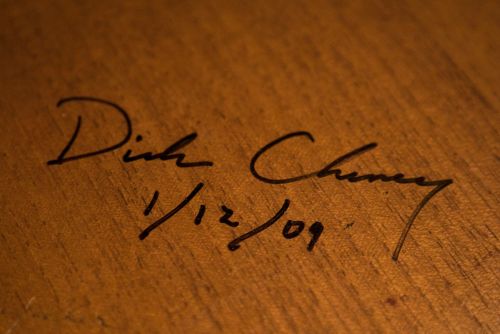
(Photo: In this handout image provided by the White House, U.S. Vice President Dick Cheney’s signature appears on the inside of the top drawer of his desk in the Vice President’s Ceremonial Office at the Eisenhower Executive Office Building January 12, 2009 in Washington, DC. The desk, constructed in 1902 and first used by President Theodore Roosevelt, has been signed by various presidents and vice presidents since the 1940s. By David Bohrer/The White House via Getty Images.)
K-Lo Asks
"Is gay marriage the new world peace in the pageant world?" Yes, it appears, it is.
“We Don’t Torture”
Three simple enough words, never spoken enough:
| The Daily Show With Jon Stewart | M – Th 11p / 10c | |||
| We Don’t Torture | ||||
|
||||
Another Memo
Spencer Ackerman reports:
…at least one other memorandum on CIA interrogations remains undisclosed: a 2007 opinion from the Justice Department’s Office of Legal Counsel on what a new interpretation of the Geneva Conventions’ Common Article 3 meant for the agency’s “enhanced interrogation program.”
A former senior intelligence official, who would not speak for the record, said that in 2007, the head of the Justice Department’s Office of Legal Counsel, Steven Bradbury, issued a still-secret memorandum authorizing an updated CIA interrogation regimen. The Justice Department issued the document after months of internal Bush administration debate, a Supreme Court decision in 2006 that extended protections from Common Article 3 of the Geneva Conventions to enemy combatants in U.S. custody, a piece of new legislation responding to the Court’s decision and a presidential executive order on interrogations.
 The Dish