Bybee’s “Good Faith,” Ctd.

A reader writes:

From an attorney's perspective, your post was right on the money. I read the memos, and my immediate reaction was: "if I had submitted this kind of analysis in law school to my first-year legal research and writing professor, I would have been given a failing grade." I couldn't believe how thin the analysis was, especially given the significance of the issues involved and the credentials of the attorneys who would have researched and drafted the memos. There were sparse citations to authority and there was little, if any, credit given to potential counterarguments or other pitfalls to the proposed conclusion. Attorneys have an obligation to point out such issues in memoranda of this type.

On a daily basis, junior litigators in big firms churn out memoranda on far more mundane issues than the torture question, which memos are far more thoroughly researched and well thought out. Also, in my current line of work, if I drafted a memo like this but failed to caution my boss about the Texas case you mentioned, I would get bawled out big time if it came back to bite him later. These guys are supposed to be among the best legal minds in the country. Besides bad faith, I don't see any potential explanation for such shoddy work quality.

Me neither. One of the great benefits of actually reading the memos is that the transparent bad faith in which they were crafted under orders from above is unmistakable. The fundamental point is that Cheney decided that torture would be his central weapon in fighting Jihadist terrorism from September 2001 onward. Why else pick Gitmo? Why else remove Geneva protections from the get-go? Why else study torture techniques immediately?

And, being a very smart operator, Cheney also knew that all this was illegal.

He does not believe that the president of the US is subject to the rule of law in conducting military operations but was canny enough to know he needed a legal paper trail to cover his tracks and provide transparently shallow rationales for war crimes. He got what he wanted from a pliant legal bureaucracy already indoctrinated in the notion that the executive can never be checked in wartime.

Once you see the entire period and all its decisions as part of a concerted, planned attempt to violate the Geneva Conventions, it all makes sense. No other rationale works. The torture was not desperately authorized when all else failed. It was planned meticulously in advance.

Facing The Meat-Eating Majority

A vegetarian tells all:

The most difficult part of being vegetarian is the misconception that we judge or, worse, want to convert meat-eaters, an assumption I blame on PETA's vitriolic ad campaigns, which suggest a mindset of herbivore heroes versus carnivorous villains.

When I tell someone about my diet, their first reaction is almost always to apologize, as if even mentioning meat to me were like telling an evangelical Christian they'd performed an abortion that morning for fun. "You know," they always tell me, "I barely eat meat, and I'm seriously considering becoming a vegetarian."

The View From His Recession

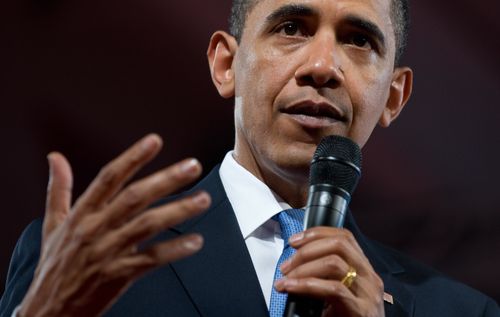
OBAMA100SaulLoeb:Getty

Leonhardt scores an interview with the President. It's interesting throughout. A snippet:

I knew even before the election that this was going to be a very difficult journey and that the economy had gone through a sufficient shock and that it wasn’t going to recover right away.

In some ways it’s liberating, though, in the sense that whether I’m a one-termer or a two-termer, the problems are big enough and fundamental enough that I can’t sort of game it out. It’s not one of these things where I can say, Oh, you know what, if I time it just right, then the market is going to be going up and unemployment will be going down right before re-election. These are much bigger, much more systemic problems. And so in some ways you just kind of set aside the politics.

The article is already bouncing around the internets. Matthew Continetti thinks Obama is setting the stage for healthcare rationing; Jonathan Cohn also focuses on the healthcare angle; Tim Fernholz wants Obama to make a better case against bank nationalization; And Reihan calls the interview "really remarkable." Reihan:

At the very least, the Leonhardt interview suggests that Obama understands the thorny landscape, and that’s saying a lot. My basic fear remains the same: I think we expect too much from government in general and from the president in particular. Still, it’s hard to argue that Obama doesn’t wear the mantle of “bearer of responsibility” fairly well.

(Photo: US President Barack Obama speaks during a town hall meeting at Fox Senior High School in Arnold, Missouri, April 29, 2009. Obama marked his 100th day in office Wednesday with a trip to the US heartland ahead of a prime-time press conference to reflect on the turbulent start of a presidency most Americans see as a success. By Saul Loeb/Getty.)

Moore Award Nominee

"Thiel is one of the co-founders of PayPal and a major investor in Facebook, and he’s a complete wackaloon and apparently a misogynist besides.  Which is to say, he’s a libertarian.  And his essay really drives home how much libertarians shouldn’t own the word “liberty”, because they are actually modern day feudalists who object to any government functions that don’t involve taxing the middle class to create an army to ransack other nations and take their wealth," – Amanda Marcotte, Pandagon.