Face Of The Day

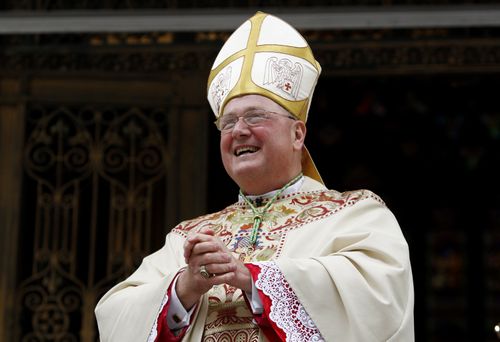
DOLANMikeSegerPool:Getty

Archbishop Timothy Dolan greets a procession of catholic clergy outside St. Patrick's Cathedral before his Installation Mass April 15, 2009 in New York City. Dolan, 59, the former Milwaukee archbishop, is taking over the nation's second-largest diocese from Cardinal Edward Egan who is retiring as New York's archbishop after nine years. He becomes the 13th Pastor of the Archdiocese of New York. By Mike Segar-Pool/Getty Images.

Pot And Scotch

A reader writes:

I wanted to correct a minor but persistent notion about cannabis, one perpetuated by your reader who says it "induces passivity." Many think that there's just one type of psychoactive cannabis. In reality there are two – Sativa and Indica – and hundreds if not thousands of hybrids between the two.

Indica-dominants increase appetite, create a pleasant body buzz, induce sleep/couch-lock, ease pain, etc. Sativa-dominants produce few or none of these effects – instead, they are stimulating, neither increase nor decrease appetite, and produce a creative head high. Most "weed" in the United States is Indica-dominant and it'll probably stay that way (if for no other reason than that Indicas grow faster).

However, what's easier to sell to a politician: a substance that makes people eat a lot and sleep on the couch or one that induces them to do a lot of creative (if odd) intellectual, productive work? Sell them on the 30 year old Scotch of the cannabis world (good Sativas) while what they stereotype is malt liquor (low quality Indicas) and what remains most common is beer (good Indicas). It's not that beer is inferior to Scotch – it's just a matter of taste – but I bet there are Senators who drink Scotch by the bottle but would never touch a Budweiser. Sell them on the Scotch, but in the process make it all legal.

Dissent Of The Day

A reader writes:

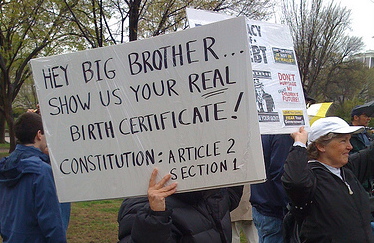
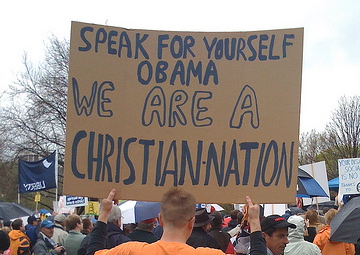
People aren't going to hold up placards detailing a fifteen point plan for deficit reduction, anymore than antiwar protesters were going to debate the relative merits of a partition of Iraq versus immediate withdrawal.  Protests are almost always infantile, incoherent, and often internally inconsistent (I'm guessing you'd actually get a pretty wide array of big-picture foreign policy viewpoints if you interviewed war protesters).  Why are you surprised that you're unable to get more than a generalized feeling of the grievances being expressed here (and why Reynolds et al, who I am guessing have things they'd actually like to see cut, can't speak for the protesters).

As for this: "[w]hen you see them holding up effigies of Bush, who was, unlike Obama, supposed to be the fiscal conservative, let me know." The trick is, Bush is gone.

He isn't President anymore, and it doesn't make any more sense to hold up an effigy of him than of LBJ or FDR for giving us the programs that are *really* bankrupting us.  Obama has governing majorities in both houses — if he really thinks the problem is the prescription drug benefit doesn't have a funding source, he should either cut the program or find a funding source.  And Obama didn't exactly run on trillion dollar deficits well after the economy recovers — as far as I can recall the promise from his advertisements was that he had a spending cut that offset every new dollar in spending he put forward. 

Personally, I'm not worried about the $2T deficit this year; it is excessive, but a large part of it is simply what needs to be done in an economic collapse.  My concern is that, using realistic numbers for growth from CBO, we're getting long-term deficits that make the Bush Administration's deficits look like kid's stuff.  And this is after the Bush tax cuts for the rich are reversed, after Obama implements a massive new energy tax with cap-and-trade, and after the wars in Iraq and Afghanistan are wound down.  And with only a down payment on what Obama would really like to do with health care reform.  That should be enough to make your hair turn white, and cause you to direct at least a little bit of your ire at the people who are actually running the show now, instead of directing ad hominem assaults on fiscal conservatives for not doing enough during the Bush years.

For the record, I voted for Bush, but mainly because the Democrats' criticism of him was that he wasn't spending nearly enough on things like NCLB and because the prescription drug benefit included too much private action.  If Democrats had nominated a Mark Warner or an Evan Bayh, it would have been a different story.
Choice, Costs, And Healthcare, Ctd.

A reader writes:

I own two businesses.  My health care costs for my employees have more than doubled in the last five years, while the benefits provided for those services have decreased. 

Mickey's post is insane.  When I purchase new computer equipment, it is better and more advanced than that which was previously available.  Not true of health care.

If the free market is better than government, let the government offer a public option and see how the private companies compete.  I think you will find their rates dropping almost magically.

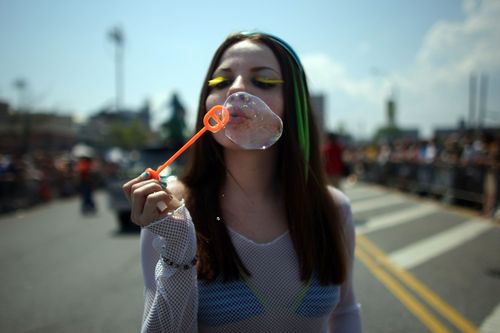
Forever Blowing Bubbles

MERMAIDMarioTama:Getty

Richard Posner on the economic crisis:

One can't expect to receive praise, or even to avoid criticism, for preventing a bad thing from happening unless people are sure the bad thing would have occurred had it not been for the preventive effort. If something unlikely to happen doesn't happen (and, by definition of "unlikely," it usually will not happen), no one is impressed. But people are impressed — unfavorably — by the costs incurred in having prevented the thing that probably wouldn't have happened anyway. And virtually all warnings are premature, because the date of a warned-against event is likely to be irreducibly uncertain.

No one — not even Roubini — could predict the day on which the housing bubble would burst, or indeed the week, month, or year. Furthermore, it is impossible to perform a cogent cost-benefit analysis of measures to prevent a contingency from materializing if the probability that it will materialize is unknown. The cost of a disaster has to be discounted (multiplied) by the probability that it will occur in order to decide how much money should be devoted to reducing that probability. No one could have calculated the probability of a financial crisis such as we are experiencing.