The Neurotic East

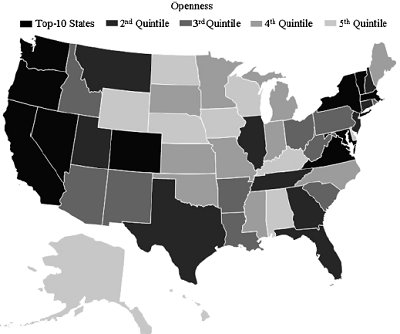
Here's a conversation-starter: a psychological geography study of the US:

We present a theoretical account of the mechanisms through which geographic variation in psychological characteristics emerge and persist within regions… Results provided preliminary support for the model, revealing clear patterns of regional variation across the U.S. and strong relationships between state-level personality and geographic indicators of crime, social capital, religiosity, political values, employment, and health.

And so we discover that New Yorkers do actually have something in common with Appallachians: they're all neurotic:

Personality map neuroticism 

The map of "openness" is after the jump:

Personality map openness

Here's the full study (pdf link) by Peter J. Rentfrow, Samuel D. Gosling, and Jeff Potter.

So We Beat A Few Pirates

So what? Doesn't the recent spat raise more questions than it answers?

Here is the problem into which the Obama team has backed itself. By saying — in Afghanistan and Pakistan — that we're not going to allow the terrorists to maintain safe havens from which they can plot and train to carry out attacks, the Obama team now has to explain why we're not pursuing the same kind of whole-of-government approach toward bringing effective governance to the Horn of Africa. And the flip side to that question is even more devastating: if we're not doing it in Somalia, why are we wasting our time and money doing in Afghanistan and Pakistan?

This, to me, is the biggest problem I see in the Obama plan for Afghanistan and Pakistan. It's not that we are establishing some terrible precedent, really, but rather that you can point to places on the map where similar problems to the ones in the Pashtun tribal belt present themselves and are not being addressed — or even discussed — in the same way. Why have we been seeking to manage the piracy problem off the Horn of Africa — and the terror problem within the Horn of Africa — yet are pursuing far more ambitious means and ends in Afghanistan and Pakistan?

Will Palin Ask Ross To Withdraw?

I've shown unusual restraint on the latest Palin fooferaw. It's her nominee to be Alaska's attorney general, Wayne Anthony Ross, who has the kind of politics you'd expect from today's ever-self-marginalizing GOP:

[H]e called homosexuals “degenerates,” hailed the “courage” of a student who lionized the Ku Klux Klan, vowed to undermine the sovereignty of Native American tribes, and allegedly defended men who rape their wives.

Here's the KKK incident, lovingly reported by Max Blumenthal:

Among them is a 1993 piece entitled, “KKK ‘art’ project gets ‘A’ for courage,” in which Ross cheered on a local college student who had offended an African-American classmate by creating a statue of a Klansman with a cross in one hand and a flag in the other. “It might have been fun to see [the African-American student] try to remove the display,” Ross wrote. “Then she could have been arrested and her future as a student of the university could have been resolved through the university disciplinary proceedings.”

And some thought Palin would disappear after the election…

Obama’s Brand Of Bipartisanship

Nate Silver defines it:

…bipartisanship, as Obama intended the term, should not necessarily be confused for "compromise". Rather, it implied behaving in good-faith — hearing out opinions from different sides of the aisle and identifying the best ideas regardless of their partisan origin. Bipartisanship, to Obama, was a process rather than an outcome. He could plausibly have been acting in a bipartisan manner, even if he hadn't gotten many Republicans to go along with his agenda.

Why Healthcare Costs So Much

Megan lists three reasons:

1)  We pay more for our medical services.  But though the pharma industry is important, the real action is in wages.  Our medical personnel cost vastly more than their counterparts abroad in almost every category.

2)  We consume more services.

Americans get shiny new facilities–my British colleagues once derisively commented that American hospitals are "like hotels".  American hospitals don't have open wards for almost anyone.  They staff at very high levels.  Doctors conduct an inordinate amount of tests.  We use an expensive machine rather than watchful waiting.  And often, those expensive machines catch conditions that never would have turned into anything, which we then treat.  Natasha Richardson probably would have lived if she'd had an accident here, because doctors would have done a cat scan, and there would have been a Medevac helicopter available.  That's tens, maybe hundreds of thousands of dollars to save a single life.

3)  There are inefficiencies.  I don't mean "compared to other systems"–every system has some screwed-up illogicality that costs it money and makes patients worse off.  But compared to what we could have.  For example, Medicare pays for procedures, not wellness, which means that there's a chronic undersupply of geriatricians, because the specialty isn't particularly well paid even though the nation's largest healthcare provider is specifically designed for old people.  This is madness.  But every real-world system that has attempted to pay physicians for wellness has ended up giving up in disgust.

The View From Your Recession

A reader writes:

As an actor in New York, I've long been accustomed to job insecurity. I've had dayjobs as a long-term temp for investment banks, as an administrator and research assistant in a cancer hospital, and many others. My most recent survival job has been more actor-stereotypical: I've been a waiter, working for a few different catering companies in the city. I've also been fortunate enough to supplement my income over the past few years with residuals earned as a commercial voiceover artist.

The recession is hitting my family where it hurts.

The residuals are drying up. My wife works part-time as a bookkeeper for a small consulting company which is increasingly in jeopardy of going under, and catering jobs are practically nonexistent nowadays. Both of us are trying to balance our work and audition schedules against each other while taking care of our two-year old son, since there's no way we can afford day care. And since my catering work was part-time, there's no chance of getting unemployment benefits. We've been living leaner and leaner, trying to keep our heads above water and failing.

For those who might say, "Why don't you give up acting and get a real job?" I can relate. Nobody forced me to take such an uncertain path, and I'm not really asking for sympathy on that score. Nor am I asking for a handout. But I have recently been blessed with agents who believe in my ability, and the right booking can literally change your life overnight. As the old poker saying goes, you have to be in it to win it. And I'm not sure what message I'd be giving my son if I gave up on the thing which gives me such creative joy, and which also led me to meet and marry his mother.

This week I caught a couple of breaks – I booked a radio spot, which helps a little, and I was hired by the US Census, which helps a lot. The work should be flexible enough to allow me to continue to audition, while paying well enough to allow us to breathe a little easier. Unfortunately the work is also temporary. But I'll take it and smile. Half a loaf is better than none. We are a rich family, even if our riches are not financial ones.