The Dish is a finalist in the Best Political Blog category this year. There's a People's Choice option for voting. If you feel like it, you can vote for the Dish (and all your other favorite blogs) here.
Month: April 2009
Bybee’s “Good Faith”

I have learned that one thing you can predict from members of the Bush-Cheney administration is a total lack of remorse. In Jay Bybee, you have an almost classic case from Hannah Arendt: a mild-mannered creature of the Republican establishment, trained into supine subservience when dealing with executive authority, and able to compartmentalize anything in his own mind to please his superiors and bask in the warm embrace of the institutional, ideological right. So even though he allegedly privately described his lawyering in matters “so awful, so terrible, so radioactive” they would never be uncovered, he gave Cheney everything he could possibly want, and more. As to his "good faith," I believe, from reading his execrable memo, that the only good faith he showed was in finding ways to give his political masters anything they wanted.
Let me give a simple small example, helpfully laid out here. Bybee was able to defend waterboarding as non-torture in a legal memo ostensibly providing objective analysis of the case history of the torture technique in the US. Among the obvious precedents for such a decision was the most recent case – when the Reagan administration Justice Department prosecuted a Texas sheriff and his deputies for waterboarding a suspect to get a confession in 1983:
At the trial of the Texas sheriff, Assistant US Attorney Scott Woodward said the prisoners who were subjected to waterboarding were not "model citizens," but they were still "victims" of torture. "We make no bones about it. The victims of these crimes are criminals," Woodward said, according to a copy of the trial transcript. One of the "victims" was Vernell Harkless, who was convicted of burglary in 1977. Gregg Magee, a deputy sheriff who testified against Sheriff Parker and three of the deputies said he witnessed Harkless being handcuffed to a chair by Parker and then getting "the water treatment."
"A towel was draped over his head," Magee said, according to court documents. "He was pulled back in the chair and water was poured over the towel." Harkless said he thought he was "going to be strangled to death," adding: "I couldn't breathe." One of the defendants, Deputy Floyd Allen Baker, said during the trial that he thought torture to be an immoral act, but he was unaware that it was illegal. His attorneys cited the "Nuremberg defense," that Baker was acting on orders from his superiors when he subjected prisoners to waterboarding.
The Reagan Justice Department – back when Republicans opposed torture – did not buy this defense and neither did a jury. They convicted the the deputy on three counts of civil rights and constitutional violations. Now: this case occurred before the UN Convention on Torture went into effect, but any good faith legal memo explaining the history of this particular torture technique would surely have cited it. It's easily findable with Google, let alone with the research resources available to the Office Of Legal Counsel.
I honestly cannot imagine how a serious legal memo with respect to a very rare torture technique would not cite the most recent domestic precedent, finding that it violated the constitution. Can you?
Unless the decision had been made to torture, and the role of these hacks was to provide a legal fig-leaf to get on with it. At some point, professionals within the Justice Department will release their own judgment of the professionalism of these memos – in a report that has been kept from the public by fierce internal fighting. But at some point, the Office Of Professional Responsibility will issue a report. And at that point, we may begin to get traction in bringing these criminals to justice.
Harman Update
The indispensable Laura Rozen elaborates on the latest.
– 6.1 Percent
GDP numbers are out and they aren't pretty. Leonhardt:
How bad have the last two quarters been? Over the last six months, the economy shrunk at its fastest rate since late 1957 and early 1958. That’s the only decline, in fact, that was worse than the current one, since the government began keeping quarterly records just after World War II.
The Obamas And The Presidency

Ta-Nehisi and I discuss the first hundred days – audio as well as transcript! – here. Money quote:
AS: What I think that they’ve done quite quickly is establish a very powerful presidential aura. It reminds me a little bit of how Reagan began to epitomize a certain kind of American President. With Obama, it’s not always predictable. He’s very young. He’s racially different, funny name, all the rest of it. It could have been that he would not have seemed like a President you could imagine, but he does seem to have become part of the furniture pretty quickly.
TC: That’s totally true. And I’ll just throw this one last thing in here. Going back to Michelle, one thing that I came across was that her job at the University of Chicago was very much about managing a very difficult relationship: the relationship between the black neighborhoods on the South Side of Chicago with the University of Chicago, and particularly with the hospital there. That is a very delicate place to be.
On the one hand the community can feel like, “Oh, you’re selling us out, you’re taking their side” and on the other hand, the University literally hired you to make their relationship better. I think going to the whole politics of it, I think that gives you invaluable experience in terms of how not to fall into a trap that people lay for you. And the South Side of Chicago is, in many ways, socially conservative. In ways that you would just never suspect because of the way black folks vote. But it’s an extremely socially conservative place.
AS: Their family, their White House is a very socially conservative unit inasmuch as Grandma is also in the house. And the kids–
TC: And the dog. [Laughter]
AS: The whole thing is also absurd, how “Leave it Beaver” it is really.
TC: That’s hilarious. [Laugher]
AS: Who would have thought that the first black couple would do this? Maybe they have to do this. The truth is: I don’t think it’s that much of an act. It is who they are.
TC: I think it is too. I think given how he came up, he’s always hungered for a kind of normalcy. And I think, given how she came up, it’s what normal for her.
(Photo: Saul Loeb/Getty.)
What Do Americans Think About Torture?
Andrew Gelman parses contradictory polling:
…how do I make sense of these polls? I guess I’ll have to step back and say that there are few absolutes in people’s opinions. In the abstract, torture is to be ruled out, but once you bring in “terrorism” (even “terrorism suspects,” which is really pretty vague), people start to change their minds.
Terror breeds terror. But the job of civilization – and of statesmen – is to stop the cycle, not accelerate it.
Garzon Moves
Undeterred by the Spanish government's overture to Obama, the inevitable international attempt to hold the United States to account for gross violation of the Geneva Conventions and the UN Convention on Torture begins in earnest:
Spain's top investigative magistrate has opened an investigation into the Bush administration over alleged torture of terror suspects at the Guantanamo prison. Baltasar Garzon's move on Wednesday is separate from a complaint by human rights lawyers that seeks charges against six specific Bush administration officials.
There are no statutes of limitations on the war crime of torture.
Lanny Davis Comes Around
Like it matters:
Here's what I think: No. 1, he has proven to me something I had doubts about—that he is a man of very strong backbone and that he is grounded in saying what he means and meaning what he says. There were times during the debates where I wasn't sure of that in the primary campaign. As much as I was really impressed with him from the first minute I met him and certainly during his convention speech in 2004, I had my doubts about whether he was ready to be president. Not only am I converted, but just completely amazed at how quickly in 100 days he has proven his political courage.
The Odd Lies Of Sarah Palin, XXVII: The Stimulus Money
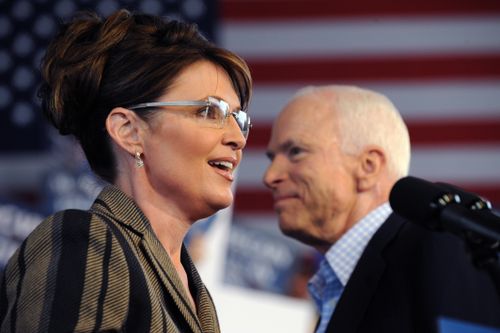
You may recall the Alaska governor's signature move last month. She declared that she would only take half the stimulus money:
Palin first told the news media that she's turning down nearly half the federal stimulus money — but later conceded that does not count the Medicaid money she is accepting. That brings down what she's refusing to 31 percent of what the state government could get… Palin said she is accepting the federal stimulus money that would go for construction projects, but not funding directed at government operations. "We are not requesting funds intended to just grow government," Palin said. "In essence we say no to operating funds for more positions in government."
Now she's changed her mind:
She earlier called the stimulus package "an unsustainable, debt-ridden package of funds." Alaska's Legislature conducted more than 20 public hearings on the federal stimulus package, and legislative leaders said they couldn't find any of the strings attached to the funds that Palin had warned about. "The Legislature then had to come in and find out through a lot of research that simply wasn't true," Gara said of Palin's argument.
But of course, having lied about how much stimulus money she would take at the start, and lied about the strings attached to the money, she is now denying she has changed her mind on this at all:
Palin spokeswoman Sharon Leighow said the message earlier this year that Palin was going to reject stimulus funds was misconstrued. "She's never said she's rejecting anything. She's been consistent we need to hear from the public, thus the legislative hearings," Leighow said.
I almost miss her. Almost.
(Photo: Robyn Beck/Getty.)
Quote For The Day
"Why Playboy? That's the only thing I didn't understand in your bio. That didn't make sense to me," – Sean Hannity to Kim Kardashian, while calling her a role model for young girls. Has he ever watched "The Soup"? Or is that the dumbest question I've yet asked on the Dish.
 The Dish