Who’s The Sucker?

Bigbear

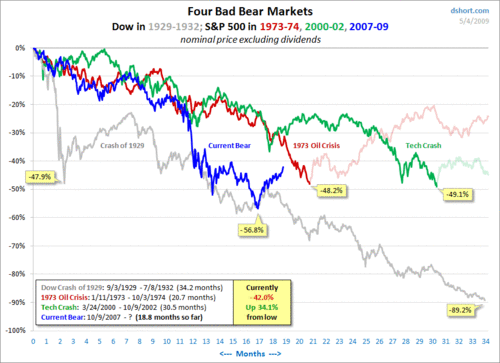
Barry Ritholtz is starting to sound less sure of his bearishness:

Over the past month, I have heard quite a few people declare this to be the start of a new bull market. The kindest thing I can say in response to that is the jury remains out, with the weight of the evidence inconclusive.

But Henry Blodget thinks unemployment "could still come around and bite us in the arse."

(Chart by Doug Short.)

The Global Warming Balancing Act

Climate

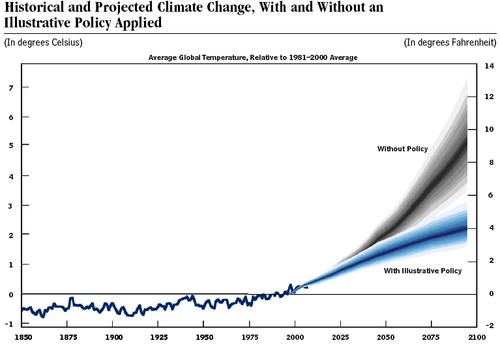
The Congressional Budget Office has released a new paper (pdf) on climate change. From the director's blog:

Given current uncertainties, crafting a policy response to climate change involves balancing two types of risks: the risks of limiting emissions to reach a temperature target and experiencing much more warming and much greater impacts than expected versus the risks of incurring costs to limit emissions when warming and its impacts would, in any event, have been less severe than anticipated.

Climate policies thus have a strong element of risk management: Depending on the costs of doing so, society may find it economically sensible to invest in reducing the risk of the most severe possible impacts from climate change even if their likelihood is relatively remote. In particular, the potential for unexpectedly severe and even catastrophic outcomes, even if unlikely, would justify more stringent policies than would result from simply balancing the costs of reducing emissions against the benefits associated with the expected or most likely resulting degree of warming. At the same time, the uncertainties in the link between emissions and climate change mean that even rigid quantitative targets are not likely to achieve a specific warming target.  Uncertainties may thus justify flexible mechanisms even though they may simultaneously justify relatively stringent policies.

Dissent Of The Day

A reader writes:

I appreciate that you ran those thoughtful rebuttals of Horgan and Florien. I also appreciate that your concluding remarks indicated your own respect for and experience with Buddhism. Yes, it's valuable to stimulate conversation.

But you never did address why you titled the piece "Up from Buddhism." As a person who is a vocal, practicing Catholic, your choice of words is troubling. Are you, in the end, Christocentric? Do you believe Christianity is an advancement over Buddhism? And so on. The fact that you would even think to use such wording suggests that at a deep level you are unclear on such issues. Please clarify.

I was using a headline to express the subjective view of the writer I was linking to (and yes, it was a little tired in its expression). I am Christocentric in the sense that I believe that Jesus was the son of God, but not in the sense that I believe that other faiths have not intuited the divine or grasped the truth beyond us in ways that Christians too can appreciate and learn from.

Truman’s Crimes, Ctd.

A reader writes:

I know you weren’t directly taking this position in your blog, but no revisionist misinterpretation of a historical topic gets me madder than this one. To refer to the dropping of atomic bombs on Hiroshima and Nagasaki as a war crime is to utterly divorce those actions from the context in which they were taken. Lawrence Frank’s Downfall is the seminal work regarding the last days of World War II in the Pacific theater, and conclusively shoots down a lot of the counter-arguments against the usage of the bombs. Consider that  the bombs killed somewhere between 200,000 and 300,000 people (high-end estimates).

The Japanese government and high command categorically refused to discuss realistic surrender terms (i.e., something akin to the unconditional surrender position that had been made public years earlier by the Allies and which was thought absolutely necessary to avoid revisiting the “stab in the back” myth that arose after WWI) until after both bombs were dropped. Even the Soviet invasion of Manchuria, which began between the two bomb drops, did not have this impact upon Japan; dropping the bombs allowed the Japanese to save face and claim that these new weapons had irrevocably changed the balance of the military equation.

To defeat Japan without dropping the bombs would have required either an amphibious invasion or a prolonged blockade of Japan. Both of these alternatives would have cost MANY more lives than the A-bombs did. Given the invasion plans that were drawn up for the initial invasion of Kyushu and the Japanese defenses against it (Japan had correctly surmised that Kyushu would be the Americans’ first target, and the bulk of their ground forces and literally thousands of kamikaze planes were lined up in response), it is almost certain that American estimates of 250,000+ US casualties were hugely optimistic, to say nothing of the millions of Japanese that would have perished. As for the blockade option, even assuming it had succeeded in breaking the will of the Japanese military and ending the war, literally millions of Japanese would have died from starvation as a result of it. The US had just concluded a survey of strategic bombing against Germany and had begun targeting transportation hubs, inter-island ferries and the like in Japan, and as soon as Japan had lost the ability to transport rice and other foodstuffs within the empire, civilians in urban areas would have begun to starve in unimaginable numbers. As it was, there was a severe famine in the winter of 1945-46, but the Japanese people were very lucky that the war ended as soon as it did.

In addition to these arguments, I would suggest that there’s a counterfactual argument to be made that if the US hadn’t used atomic weapons against Japan, someone would have eventually used them somewhere else – it’s the nature of warfare to use weaponry, not keep it bottled up in a laboratory. It’s highly likely that the A-bomb would have been used during the Korean War, or somewhere else in a situation where the power devastated by them would have been able to fight back; in that context, humanity is probably quite lucky that Hiroshima and Nagasaki were hit when and how they were hit.

I think an argument can be made that the bombing of Dresden is a war crime – I’m not sure I would agree with that either, but certainly it didn’t have a significant impact upon the course of World War II. However, that cannot be said of the A-bombs, and any modern interpretation to that effect flat-out ignores the signifcantly more ghastly alternatives to their usage. All deaths in war are tragic, but the deaths at Hiroshima and Nagasaki were by far the lesser of many evils, given the mindset of the Japanese government and the other options available to the US at the time.

Another reader counters:

As an aspiring American political history PhD candidate I like to think I know something about this topic.  Historically the description of American action as "war crime" has been one of our greatest taboos.  Any prominent figure who dares to acknowledge thist truth is immediately marginalized, and accused of being anti-American.  The reality is, the "greatest generation" is also the generation that commited the most war crimes of any American generation before or since.  That's a powerful and troubling statement, but I think a true one. 

Robert McNamara said in his interviews for The Fog of War (a remarkable film) that he thought that had the war gone the other way, and the Japanese had been victorious, he and everyone else who worked for Curtis LeMay would have been tried and he believes rightly convicted of crimes against humanity.  That was for the decision to firebomb Japanese cities, which totally devestated most of the urban areas.

The issue, I suppose, is context.  When torture advocates appeal to our fear of the "ticking time bomb scenario" they are apealing to the same fear that we beleive justifies our taking of life in Hiroshima or Nagasaki, that the very existence of the United States was at risk.  The taking of life on this massive scale was a lesser of two evils.

There are differing perspectives in Japan as well, some historians going so far as believing the dropping of the bombs was actually a good thing for Japan.  That's a radical view there, the first time I heard it voiced was at a dinner with several prominent Japanese and American scholars, and it had the effect of totally silencing the room save for the dropping of chopsticks as some of the men were so utterly shocked that a Japanese man could believe this. 

Anyways, it's an interesting topic, and I think that it's touching on something that is deeply problematic with American's understanding of their past actions.  Maybe we were on the "right side" of things in the Second World War, but our desperation led us to commit morally reprehensible actions.  Maybe we can make a case that those actions were less-bad than the alternatives, but that's a discussion America has really never had.
What Will We Buy Tomorrow?

Richard Florida imagines the future of consumption:

It's still very early in the resetting process. Transformations on this scale take time. So it's hard to fully grasp what a new consumption bundle and new lifestyle might look like. But one thing is clear:  It will be less oriented around the auto-housing industrial complex: We'll all be spending relatively less on cars and housing and energy, that is, if we're going to have money left over to create demand for the emerging, new stuff required to power a new round of growth and prosperity.

Serving Openly

The NYT's Room for Debate (a fantastic new media use for the paper's long list of sources) tackles DADT. This dispatch by Zoe Dunning was clarifying:

I am a retired Navy Commander and lesbian. I publicly “came out” in January 1993 as a political statement in support of then President-elect Bill Clinton’s campaign pledge to allow gays and lesbians to serve openly and honestly in the military. I was one of the first cases under “Don’t Ask, Don’t Tell” (DADT) and one of the very few exceptions who unanimously won my DADT discharge hearing (using a defense strategy subsequently deemed illegal by the Pentagon). This enabled me to serve the final 14 years of my military career as an open lesbian.

The units in which I served those 14 years did not suffer impaired cohesion or morale due to my mere presence. If anything, my honesty enabled closer relationships with my shipmates because I no longer needed to distance myself from them due to fear of discovery and potential loss of my career. I continued to serve, sleep, shower and perform alongside my fellow unit members without incident because I was a professional officer and conducted myself as such. Being “out” did not change that.

My open service did not unduly expose the unit to an increase in sexual harassment complaints or issues. If anything, it decreased it. In my 26 years in uniform, the only sexual assault or harassment I witnessed were cases of male on female misconduct, many of which went unreported for fear the man would turn the woman in as a suspected lesbian in retaliation (not an unfounded fear, as this happened frequently). I personally was the victim of many inappropriate verbal and physical advances from men, especially as a midshipman at the U.S. Naval Academy in the early 1980s, and knew I was powerless to report them for fear of retribution and investigation of me, not the man.

These anecdotal experiences are supported by a Palm Center study of the Canadian military, which found the percentage of military women who experienced sexual harassment dropped 46% after the ban was lifted. One factor in the decline was that women were now free to report assaults without fear that they would be accused of being a lesbian.

I think this debate needs to shift from if the law should be repealed to how repeal should best be implemented.

The Stress Tests

Are due out on Thursday (after being pushed back). The murmur from econopundits doesn't instill much confidence in the process. Krugman:

Even Brad DeLong, who has been relatively sympathetic to the administration here, is disturbed by the idea that regulators are negotiating with the banks about the test results. Now it seems as if the report’s contents may also be dictated by what, based on the response to leaks, the informed public is willing to swallow. (”Would you believe it if we say Citi is fine? OK, what if we say they need $5 billion? Not enough? How about 10?”)

I hope I’m not being too cynical here. But it would be nice if the administration would, just once, do something to dispel that cynicism.

Joe Weisenthal:

At one point, according to the report, as many as 14 banks were to have been given orders to raise money a number that's come down in recent days — a testament to how this is all a lot of art, rather than science.

The government is obviously trying extremely hard to spin both the results and the leaks, saying that stress test failure does not constitute insolvency and that the tests should give the public confidence in the banking system.

Okay.

Simon Johnson:

After long negotiations, the bank stress tests were set to show most banks are close to hav[ing] their Goldilocks level of capital (i.e., just right)  Given that we generally agree (and the President has long stressed) this is the biggest financial crisis since the Great Depression, we seemed to be on the the verge of a capital adequacy miracle.

But instead of this being seen as some combination of good luck and smart policy, ”everyone is basically fine” would look like the banks are running the show.  My Treasury friends swear up and down this is not true, but that is now beside the point.  Whatever the reality, it looks increasingly to everyone like the banks really are in charge.  It’s a nasty rule of politics that you are damaged by where perceived blame lands, rather than by what you actually do.

Noam Scheiber:

My guess is that the market doesn't want too bleak a picture, but doesn't want a whitewash either. The early leaks about stress-test results hint that we may end up in the sweet spot…

Obama’s Rally?

Nate Silver looks at how making the market a benchmark of Obama's success could play out:

There is risk here for Obama — it is now much harder to make the case that the market is undervalued and volatility remains high by historical standards; a significant retrenchment is possible, as is a continuation of the bull market conditions of the past 60 days or so. But given the choice between having a leading indicator like the stock market be regarded as his economic benchmark or a lagging indicator like employment (where the numbers are still getting worse), Obama would take the stock market every time.

But both are silly. We may not be able to judge the first calls by this administration on the banking crisis for a couple of years. And even then, the noise in the system of economic growth is deafening; and the government's role – though much more important in a crisis – is nonetheless limited.

The Daily Wrap

We had a very full Dish today; Condi backpedaled, Gonzales confounded, Palin supporters sniped, gut-wrenching news of gay violence surfaced in Iraq, another torture report inched toward the surface, Abu Ghraib photos still went missing, rumor-mongering on Sotomayor gripped the Beltway, the Dems seemed to surrender on nuclear power, and the president continued to disappoint on gay rights. But despite his dithering, my marriage became legit in DC and the fate of gay Mainers advanced one step closer to equality.

We also ruminated over how the Coulters have ruined conservatism and how the torture program has weakened a long tradition of American fortitude. Thanks to the YouTubes, we became obsessed with Keyboard Cat, witnessed the sexual power of subwoofers, and saw Susan Boyle sing at 22.

In home news, today was a huge day for The Atlantic; we won both the Webby Award and the People's Voice Award for best magazine. (And that's before Harry Shearer and 11 other correspondents started blogging for us today.) Finally, don't forget to vote for the front cover (and back cover) of the Window View book.