Torture: The Smoking Gun?

Abu-ghraib-leash

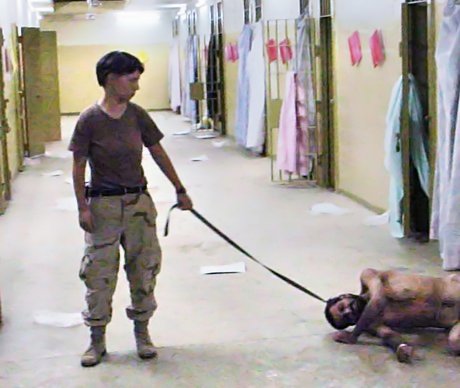
As more details trickle out, we have the possibility of a real breakthrough in accountability for the torture and abuse techniques authorized by president Bush as illustrated above. AP story here. Ambers:

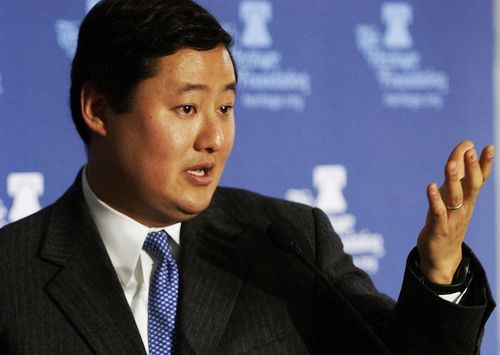
Ostensibly, Yoo, an attorney for the Office of Legal Counsel and Bybee, that section's chief, were tasked by Attorney General John Ashcroft with determining whether so-called "enhanced interrogation techniques" violated U.S. law and treaty obligations.  But a draft report, prepared by the Justice Department's Office of Professional Review,  suggests that, at the direction of the White House, the OLC worked to justify a policy that had already been determined and did not begin their inquiry from a neutral position.

It is not clear — and sources would not say — who in the White House communicated with the two lawyers about the memos, and it is not clear whether Yoo or Bybee felt unduly pressured to provide a legal framework for a decision already made by senior administration officials.

Who in the White House ordered up these memos to provide phony legal cover for a plainly illegal torture policy already decided upon? That's what we need to find out. From the leaks, this OPR report could be the next critical step in finding out the source of the criminality. In the end, it's Holder's call; and he may decide to take his time. My concern, now that we have ended the torture program, is simply that we get to the bottom of its origin, however long it takes, and that those really responsible are held to account under the rule of law and under the judgment of history.

This is not about vengeance; it's not about partisanship; it's about the integrity of the rule of law, without which we are all lost.

Extremes Of Certainty

Julian Sanchez revisits his post on bombing Japan, torture, and morality:

I find striking about both the arguments over torture and the recent revival of the old Hiroshima dispute is that it sometimes seems as though the defense of necessity is regarded as  purely empirical one: We can argue whether bombing Hiroshima or waterboarding detainees saved American lives, but if it did, then that settles any question of justification.  And we seem to end up with these awfully binary framings—”would you agree it was justified if it saved lives?”—where the options are “saved lives” or “didn’t save lives,” as opposed to “saved X lives with probability A, saved Y lives with probability B, saved no net lives with probability C, cost Z net lives with probability D.”  This tendency isn’t unique to defenders of torture, mind you: Whether the same information could’ve been obtained by other means, or whether some particular attack would have occurred in the absence of that information, can only honestly be answered in probabilistic terms.

The OPR Report Gets Closer

YOOMandelNgan:AFP:Getty

The NYT has a basic outline of what the Justice Department report into the legal quality of the memos ordered up by Bush and Cheney to provide legal cover for illegal acts of torture. But it is not exactly earth-shattering news that the report itself does not allegedly recommend criminal prosecution. The report will be studied closely for what it reveals and there are some tantalizing hints at future revelations:

The draft report is described as very detailed, tracing e-mail messages between Justice Department lawyers and officials at the White House and the Central Intelligence Agency.

If those emails can be interpreted reasonably as the stitch-up many of us suspect – in effect instructing the lawyers how to craft memos making what was illegal “legal” – then the focus will rightly go back to the White House. Anyone even without a legal training can see that the OLC Memos are, as Kinsley elegantly put it, “fatuous”. But the report is apparently damning:

The report by the Office of Professional Responsibility, an internal ethics unit within the Justice Department, is also likely to ask that state bar associations consider possible disciplinary action, including reprimands or even disbarment, for some of the lawyers involved in writing the legal opinions, the officials said.

The reason this is vital is that it gets to the core of the question of good faith in authorizing the elaborate torture program that Bush and Cheney constructed as their central weapon in the war against Jihadist terrorism. If we can see that the memos were transparent attempts not to explicate the law in good faith to guide the executive branch – but were emanations of the executive branch to provide phony and flawed legal cover for already-decided illegal acts, then we have a conspiracy to commit war crimes.

That’s what’s at stake here.

It is the motherlode. And we don’t yet know what’s in the report. But if it contains a judgment that the legal analysis is so shoddy that it should lead to professional disbarment for its authors, then the critical question becomes even more pressing: was this deliberate shoddiness to give the Decider what he had already decided to authorize?

I know, given the full extent of the torture program, its systematic nature, its plain illegality, and its obvious contempt for the spirit and intent of the prohibition on torture, what I suspect. And if this report finds gross misconduct by the government lawyers doing the president’s bidding, then the case is not closed. Far from it, it has just begun. And the real war criminals – Bush and Cheney – are getting closer and closer to justice.

(Photo: John Yoo/Mandel Ngan/Getty.)
The Rosen-Greenwald Spat

Since I know both men, like and respect both, and know next to nothing about Judge Sotomayor, the wise thing is to shut the fuck up. But, er, this is a blog, and one is required not to shut the fuck up most of the time. So I will merely note how interesting it is as a media phenomenon. Washington's old journalistic guard is not yet fully aware that the pool they operate in now is much larger than it was, and the cozy familiarity of it all – the sustenance of reputation, the quiet hierarchy of the Northwest quadrant – is now history. What might have been sent into the ether as a small provocation, summing up a coterie's assumptions, will no longer be given credence because of its provenance. It will have to make its case in a brutally frank environment. Or fail to.

Buddhisms

A reader writes:

Like you, I mainly side with the comments of your readers.  But I can understand those who turn away from Buddhism (at best, I could call myself a philosophical Zen Buddhist today, so I guess I've turned away from it in some respects).
 
Yes, there is much more to Buddhism than living a monastic life among chanting monks, just as there is so much more to Catholicism than the desire to become a priest or Cardinal.  But it doesn't serve anyone well to pretend that many of the things associated with Buddhism aren't caricatures — the reader who thinks searching for true enlightenment is a sham conveniently forgets those who choose the Theravada path toward achieving the status of arhat.  Zen may have gotten the biggest foothold here in the West as being more of a philosophy than a religion, but in its home continent, Buddhism has all the same trappings and dogma as any other faith (for instance, abstaining from alcohol is more like a guideline for lay followers, but it's much closer to a Commandment/rule for a monk in a monastery).

As long as the strict monastic life exists in Buddhism — especially in its birthplace, with the oldest branch practicing it — people will associate some of the more remote religious aspects with the whole (like living as a devout monk practicing abstinence, or the concept of a "self" not existing as it is understood in other faiths).  It works that way with every religion.  Many Catholics are pro-choice and think birth control isn't something to be frowned upon, even if the infallible Pope says otherwise.  Some stay with the religion in spite of disagreements.  Others leave.
 
Steve Hagen was my introduction to Buddhism, and a central point in one of his books is that Buddhism is like a raft.  It gets you somewhere, but when you get to the shore, you don't carry your boat across a continent.  That's a non-dogmatic view within Zen (that at some point, you may even move on from Buddhism itself), which certainly isn't as well-publicized to non-Buddhists as some of Horgan's critiques are.  But there is dogma elsewhere in other noteworthy branches that can turn people away from the Buddha Dharma.  If no quarrels were to be had with any faith, we'd only have one to follow.

Born Godless

Andrew Stuttaford, a non-believer, describes why so many children of the non-religious turn into theists:

Belief in a deity (or deities), and the desire to worship it or them, is an almost universal aspect of human nature. This not something that can be wished or indoctrinated away, and it’s pointless and maybe even destructive to try. It’s far better, surely, to channel that impulse by giving children some sort of gentle religious grounding, preferably in a well-established, undemanding, culturally useful (understanding all that art and so on) and mildly (small c) conservative denomination that doesn’t dwell too much on the supernatural and keeps both ritual and philosophical speculation in their proper place. Better the vicar than Wicca, say I.

Crimes That Go Unpunished

Larison:

…ironically, some of the defenders of the torture regime are making the best argument for the prosecution of past administration officials by their own invocations of past government illegalities. They are unwittingly reminding us that crimes unpunished today can easily become tomorrow’s conventionally accepted “correct” decisions.

He also tackles Truman:

Because the prevailing view of Harry Truman and his decisions at the present time happens to be favorable, we are all supposed to believe that the “judgment of history” has “vindicated” Truman. This is a nice way of saying that propaganda and hero worship have overcome moral reasoning, and time has caused the moral horror of even a significant part of the American right in the 1940s to fade from memory. This favorable view of Truman is inextricably tied up with the cult of the presidency, our depressing but all too human habit of praising bad wartime leaders at the expense of better peacetime executives, the mythologizing of WWII (and therefore the minimizing or justifying of any wrongdoing on the Allied side) and the implicit devaluing of Japanese civilian lives every defense of both fire-bombing and nuclear strikes includes. None of this seems to occur to the people who continue to glorify Truman and to use Truman as an example of how tainted, bad Presidents may yet be viewed as great successes by posterity. What Truman’s posthumous rehabilitation should tell us is that half-truths and falsehoods, if repeated often enough, can become widely accepted, and that virtually no American political leader, no matter how many blunders he made and no matter what criminal acts he ordered, is beyond redemption at the hands of later sympathetic people who find that leader’s decisions to be useful precedents for their own preferred course of action. The “judgment of history” has, for the time being, ruled in favor of Truman, and therefore challenging this judgment is something to be mocked.

Obama Asleep At The Wheel On HIV?

Peter Staley wonders why some very basic moves that would have established the president's bona fides early on in HIV policy have simply languished undone. Like, ahem, removing the HIV travel ban. It was backed by Bush, overwhelmingly passed by the last Congress, passed last summer …  and yet the Obama administration has barely moved on it. Yes, there has been a very welcome boost to HIV research funding and one leading gay appointee, John Berry. But the rest is an awkward, inactive silence.

Their apparent resistance to anything pro-gay – delaying repeal of DADT indefinitely, freezing with fear on anything to do with civil unions or marriage – is beginning to make the Clintonites in the primaries seem prescient; and those of us in the gay movement who backed Obama seem like fools. Someone needs to get things moving in the right direction. Soon.