Thinking About Sarah

A reader writes:

First things first. I do not like this woman – politically. As most, I thought she was a joke of a choice for McCain who clearly decided he was going to be bought and sold by the Rovians.

When I first started watching this video my very negative feelings about this woman started rising up all over again.

There is something quite disturbing about her (although Michelle Bachmann makes Sarah seem oh-so normal) and I have such a deep seated distrust of whatever comes out of her mouth. It's all such bullshit.

BUT –

The more this clip went on, the more I found myself believing her. I must admit that I did find convincing – and touching – her thoughts of aborting the fetus upon learning that the child would have Down's Syndrome. In fact, I found it to be the most sincere thing that I ever heard come out of her mouth since she hit the national forum. I still cannot stomach the woman's policies, the way she tries to bring her intolerant religious beliefs into the public square, etc. But for the first time it appeared to me that she actually kept it real.

I'd be curious to know your opinion.

That's why I felt I should post it, even though it's now old news and got swallowed up by the other news at the time. It is the first time she's spoken about this that seemed real to me (however politically convenient) – and I felt it important for the readers of this blog to see that. It has stayed with me since I saw it.

On the issue of abortion, I'm struck by how powerful and transformative the pro-choice-pro-life position is, if you see what I mean. To choose to have a child when society and convenience would allow you another option without stigma is a powerful, beautiful statement. In that sense, it is the most pro-life stance imaginable.

But if abortion were criminalized, who would ever really have the choice to take it?

Crisis To Crisis

Damon Linker thinks that the current media is wearing us out:

I like the free-flowing, rough-and-tumble, demotic character of Internet-driven media as much as the next blogger. Information can be addictive, just as sharp-edged opinions can induce an adrenaline-driven thrill. But what about historical perspective? And philosophical reflection? And level-headed analysis? The 24-hour news cycle and instant Internet updates don't foster those habits and may even be incompatible with them. And I'm afraid our culture is beginning to pay the emotional and intellectual price.

Has a week passed in the last nine months when we haven't been confronting a "crisis"?

“Huddled Masses Yearning To Breathe Free”

Will Wilkinson wants New York to learn a lesson from Toronto:

The United States, this fabled land of immigrants, has fallen dismally far behind countries like Australia and Canada in openness to immigration. The Statue of Liberty may as well be moved to Vancouver's English Bay where the "huddled masses yearning to breathe free" are now rather more welcome than in New York Harbor. Many Americans, convinced by arguments like Samuel Huntington's, have come to believe that the institutions we so rightly cherish are too dependent on a feeble, endangered cultural inheritance to survive the bustling presence of strange languages, exotic gods, and pungent foods. That cultural fragility argument is false, and it deserves to die.

A Sign Of A Shifting Climate

What does it tell you that the NYT suddenly manages to find sources telling us that Condi Rice came around to strongly resisting and opposing the torture program once John Bellinger did some – drum roll, please – research on the efficacy and history of torture in other democracies? I think it tells you that Rice's non-coercive interrogation by Stanford students had an impact. Bellinger, in particular, seems to be trying to walk back his own role significantly. But this is, at least, a fascinating nugget:

The proclamation that President George W. Bush issued on June 26, 2003, to mark the United Nations International Day in Support of Victims of Torture seemed innocuous, one of dozens of high-minded statements published and duly ignored each year. The United States is “committed to the worldwide elimination of torture and we are leading this fight by example,” Mr. Bush declared, vowing to prosecute torture and to prevent “other cruel and unusual punishment.”But inside the Central Intelligence Agency, the statement set off alarms. The agency’s top lawyer, Scott W. Muller, called the White House to complain.

Then there's the pushback from Porter Goss, as emptywheel explains:

It's also rather nice, don't you think, that Goss doesn't mention his role in not preventing the destruction of the torture tapes right in the middle of the debate on the McCain amendment? I guess that–like Condi's "by definition" statement–isn't relevant to this story. Yet it suggests a number of other possible motives behind Goss' refusal to continue torturing–particularly as Congress continued to look more closely at the CIA's torture program. Of course, if Goss admitted that, then it would ruin his whole narrative about how Congress never complained, wouldn't it? But perhaps he's moving on from that narrative to one that claims that "Dick made me do it."

If you read between the lines some more, Steven Bradbury is sweating. Or should be.

Where Are The Uninsured?

Uninsured_2005-thumb

Jim Gimpel finds a map:

The geographic concentration of the uninsured seems a bit ironic, given that the South and Southwest are not known for being Democratic strongholds agitating for a universal-coverage-single-payer system. But most of the uninsured fall heavily among the ranks of non-voters. The Republican congressional delegations from these states have little political incentive to work on this issue with President Obama. But the President doesn’t look like he needs them, either.

Sarah Palin’s “Revelation”

This is unfinished business – a news event that got swallowed up by the release of the ICRC report, the OLC Memos and the Senate Armed Services report. But given this blog's coverage of governor Palin's various strange stories about Trig, and her continued refusal to provide any medical records to confirm her account, her speech to the Kansas Right To Life organization – her first public explanation for her unusual behavior, since the MSM decided it was a question that could not be asked – is worth entering into the public record. 

She explains above what she describes as her "fleeting moment" of temptation to abort Trig when she found out she was pregnant at an out of state energy conference, and her decision to keep the pregnancy secret for seven months (an endeavor made easier by the fact that no one seeing her had any idea up to the very day she announced). I tend to assume that everything Palin says is untrue until proven otherwise, and in this case, have no basis to confirm or deny anything. But it is also only fair to give her own explanation for her secrecy an airing.

For the record, she says that she kept her pregnancy secret for seven months because there were "neanderthals" out there who would have refused to believe that a pregnant woman could handle her public duties as governor, and because of her own conflicted feelings about having a Down Syndrome child at the age of 44. She does not explain the bizarre circumstances of the day-long labor on various airplanes. But, hey, maybe at some point, she will. When she does, I will do my best to bring it to you. Maybe one day – who knows? – a journalist might even ask.

Obama’s Stealth Green Revolution

Part 1 is already legislated. And it was a bigger deal than some of us realized:

With all the billions and trillions Washington is allotting to this or that ailing bank or insurance company these days, it's important to have some perspective on how big a figure $38 billion really is when you're talking about energy. According to a recent study by the consulting firm Management Information Services, between 1950 and 2006, the government disbursed about $725 billion in federal energy incentives, mostly to oil, coal and gas. Renewables like wind and solar received only $45 billion. Give or take a few billion, Obama had matched that by Day 29 of his administration.

Taming The Prince, Ctd.

A reader writes:

One small point that I think is worth noting, and that I think can be used against some of the conservative defenders of both unlimited executive power and torture, is the following. Isn't it the case that, say, Locke's understanding of prerogative is such that by definition we cannot restrict its ADDINGTONMelissaGolden:Getty use ahead of time, but that after the fact there will be a judgment of sorts, a post-hoc reckoning with what happened?

I fully admit that in Locke — and, I would argue, The Federalist and Lincoln — there's a fairly robust notion that action sometimes will need to be taken with great dispatch, or where the law is silent, or even, at times, against the law. Because such situations will not be regular or normal, they necessarily fall within the realm of prudence and prerogative. They are exceptions to the rule and thus, in a way, extra-legal. Locke writes that such actions can be undertaken for "the common good;" Lincoln believes they can be undertaken to defend the Constitution itself (violating some facet of the Constitution to preserve the continued use of the document itself).

But all these theories include the idea that because such actions cannot really be limited beforehand, they can be judged, and punished, afterwards (thus Locke's famous "appeal to the heavens"). And isn't that what we are doing now?

We are sorting out what happened, seeing what information was gained by the use of torture (or techniques close to it), and ultimately determining to what extent, if any, it was "worth it." The admission that prerogative power can be quite expansive, almost unlimited, prospectively means nothing in excusing the use of such power retrospectively. According to the conservative political theorists who reminded us of the nature of executive power, we are doing precisely what their own theories said we could and must do! My suspicion is that after they lose the arguments about the more technical legal aspects of torture, which your own work has done so much to expose, they will move on to more broad, theoretical arguments about prudence, prerogative, and the executive branch. They should lose that argument too.

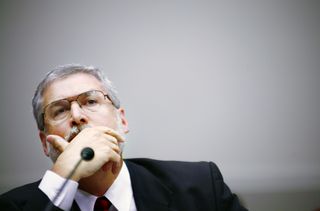
(Photo: David Addington, Cheney's consigliere, by Melissa Golden/Getty.)