Scott Adams seems to be enjoying the swine flu scare.
Month: May 2009
Animals, Language, And Free Will
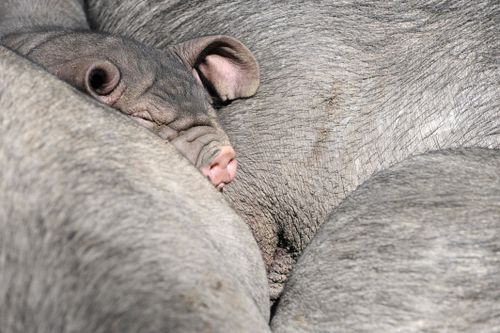
Mark Vernon thinks about the difference between us and animals:
An essay by Herbert McCabe, called Animals and Us, is particularly interesting. He affirms that animals clearly have emotions – they grieve, rejoice, even fall in love. The main difference between their ‘sensitive life’ and ours (‘sensitive’ meaning the life that comes from having senses) is not, then, of kind but of intensity – and intensity meant in a certain kind of way, not along an axis of pleasure/pain, but rather in that we can transcend our sensitive life, to some degree, in language.
(Photo: Barbara Sax/Getty.)
Mental Health Break
A music video made with chalk, a bunch of blackboards, and 1900 drawings. It took six months to produce:
Firekites – AUTUMN STORY – chalk animation from Lucinda Schreiber on Vimeo.
Why To Pass Cap And Trade During A Heat Wave
Brad Plumer reads through a new study showing that views on climate change correlate with local weather. The study finds that:
"For each three degrees that local temperature rises above normal, Americans become one percentage point more likely to agree that there is 'solid evidence' that the earth is getting warmer."
Plumer speculates:
Maybe this explains why national surveys that ask people whether they believe in global warming tend to fluctuate fairly significantly, even over a few short months' time.
Bonus finding: This local-weather effect is strongest on people who aren't particularly partisan, and it's pretty much non-existent for people who identify strongly with one party or the other. Committed Republicans tuning into Rush aren't likely to believe in man-made climate change no matter how sweaty it gets, while ardent Democrats won't stop listening to Al Gore just because there's a cold snap the day he's testifying before Congress. But for many people, however irrational, this stuff appears to have a fair-sized impact.
The View From Your Window

Brooklyn, New York, 9.52 am
The Wisdom Of Old Guys
Ian Frazier, not without self-regard, praises aged adventurers:
Old guys tend to have better connections, more influence, and—how to put this?—more money. Their credit cards work. Their cars don’t fall apart five miles after they turn off pavement. They have better gear, and they take better care of it. Old guys spend more time sitting up late after the family’s asleep, and in these hours your old guy will plan and replan his upcoming expedition, put new laces on his wading shoes, tie flies, dress in all his Arctic gear in order to see what it’s like to move around in, call another insomniac old guy and check out up-to-the-minute river conditions, and so on.
Old guys adventure more in their minds beforehand, and that makes them more prepared in the field. Old guys in some cases (not including mine) can do a bit less physically, so they have to use their brains more. You are taken more seriously by people who rent canoes and cabins if you’re accompanied by a sober and thoughtful and knowledgeable-looking old guy. On any adventure, it’s always an advantage to bring an old guy along as a check and corrective on the more impetuous young.
Face Of The Day

Tattoo artist Scott Campbell creates reliefs by laser cutting stacks of one dollar bills. More here.
The North Repopulates
Martin Walker's article on worldwide demographics may make Mark Steyn's brain hurt:
Something dramatic has happened to the world’s birthrates. Defying predictions of demographic decline, northern Europeans have started having more babies. Britain and France are now projecting steady population growth through the middle of the century. In North America, the trends are similar. In 2050, according to United Nations projections, it is possible that nearly as many babies will be born in the United States as in China. Indeed, the population of the world’s current demographic colossus will be shrinking. And China is but one particularly sharp example of a widespread fall in birthrates that is occurring across most of the developing world, including much of Asia, Latin America, and the Middle East. The one glaring exception to this trend is sub-Saharan Africa, which by the end of this century may be home to one- third of the human race.
Plotting Sin
Geographers from Kansas State University 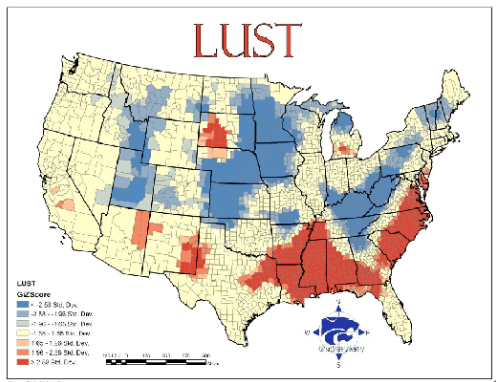
The Baby Brain
Jonah Lehrer explores it:
…scientists have begun to dramatically revise their concept of a baby's mind. By using new research techniques and tools, they've revealed that the baby brain is abuzz with activity, capable of learning astonishing amounts of information in a relatively short time. Unlike the adult mind, which restricts itself to a narrow slice of reality, babies can take in a much wider spectrum of sensation – they are, in an important sense, more aware of the world than we are.
 The Dish