The Most Important Speech Of Obama’s Presidency, Thus Far

Marc Lynch catches a big story in the Arab media this morning, Obama's announcement that he will visit Saudi Arabia before his Egypt speech:

The key question for Obama's trip the region, his speech, and his strategic approach both to Iran and the Israeli-Arab tracks is this: will he reinforce or challenge the "moderates vs resistance" frame which he inherited from the Bush administration?  The Arab leaders he has been meeting, like the Israelis, are perfectly comfortable with that approach, dividing the region between Israel and Arab "moderates" vs Iran and Arab "resistance" groups like Hamas and Hezbollah.  That's the easy path.  If followed it is likely to fail badly, destroy the hopes for change which his engagement policy has raised, and leave the region right back where Bush left it. But I think — and hope — that Obama will not fall into that trap. 

He has an opportunity over the next few weeks — with the unveiling of his approach to Israel and the Palestinians, the response to the Lebanese and Iranian elections, and his Cairo speech –  to break down those tired, dangerous, and unpopular lines of division. And if he chooses to do that, to really challenge the unsustainable status quo, then Riyadh and Cairo are the right place to start. 
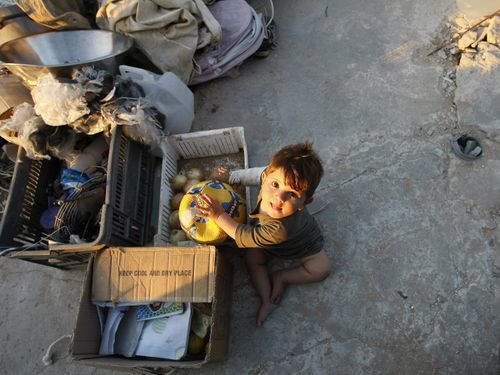
Face Of The Day

GAZAONIONSMohammedAbed:AFP:Getty

A Palestinian boy plays near the rubble of his family house, which was destroyed during the December-January Israeli offensive, in the northern Gaza Strip refugee camp of Jabalia on 28 May, 2009. Israel's recent war on Gaza brought the enclave to the brink of a catastrophe, Amnesty International said on May 28, also lambasting the two main Palestinian factions for human rights violations. By Mohammed Abed/AFP/Getty.

Universal Coverage And Competition, Ctd

Sean Safford confronts Greg Mankiw:

…a national system would likely impose a burden on many larger employers while improving the lot of smaller ones.  To the extent that one sees America’s competitive advantage as having to do with the relative ease with which this country produces small, entrepreneurial companies that might grow to become tomorrow’s Google or Microsoft, a national health care system should be a net positive.

A second dimension: impact among large companies is not equal either. Older industries and older companies with older workers are currently our least ‘competitive’. Think: legacy airlines.  Because the current system charges employers based on the risk pool of their employees, and also because the longer employees’ tenure, the better their benefits are likely to be, national health care would end up improving the competitiveness of some of our least competitive industries.

Sotomayor On Executive Power

Scott Horton takes a stab:

In the tough way she approaches prosecutors who appear before her, I see a judge who believes that those who wield executive power have to be held to account for it. That should add to her appeal to civil libertarians, who are generally disappointed with many of Obama’s recent calls on national security issues.

Well, we'll see. After Alito and Roberts, who see the court's role as getting out of the way of all executive claims, we need some kind of balance.

Misreading Obama?

A reader writes:

You may not be a Democrat, but you’ve got the manufactured outrage down pat. I wasn’t there, but it seems to me that the plain implication of Obama’s joke is that he has failed to keep so many promises that he’s not sure which promise is at issue. In other words, it’s self-deprecation. He’s mocking himself, not the protestors.

Another writes:

Obama’s joke at his Beverly Hilton fundraiser seems, to me, to be a reference to how many different agendas were motivating the small protests outside.

The LA Times has one article about the gay rights protest, another about a general protest against the wars and a reader comment in one article suggests there was also an Armenian protest. Unless you’re drawing your understanding from something other than the NY Times piece, I don’t think it’s at all clear that Obama was referring to a specific gay protest and joking about the nature of his gay-issue promises. He seemed to be poking fun at how many different groups, representing different interests, were outside.

He may be a serious disappointment in his lackadaisical approach to gay issues, but he doesn’t seem callous.

The video doesn’t make it seem so bad, and the referent is clearly broader than just gay rights. Maybe I jumped too soon.

Dissent Of The Day: Newt Was Right

A reader writes:

What Sotomayor's speech reveals is that she believes (as many people on both sides of the ideological spectrum do) that issues in this country concerning ethnicity, gender, sexual orientation etc. cannot be appreciated or understood by people who do not identify with the group in question.
 
This dangerous and very prevalent mode of thinking means that any judge who does not have a background in one of these areas is less capable of making judgements concerning a civil liberties case than someone who can identify with the affected group. It automatically calls into question the decision making process of any judge by suggesting that their ability to make correct decisions is not based on an objective analysis of the law but on past personal experiences. 

I reject her argument that white male judges are not as capable simply because they don't care or because they are unwilling to take the time or effort to fully appreciate or understand the problem. Her own statements prove that this is not the case, and her criticisms of past courts are full of her own bias. For example, she states that the Supreme Court had never upheld a claim by a woman of gender discrimination until 1972, but she fails to add that the decision was made by a Supreme Court that was entirely male and almost all white. 
 
Finally, like it or not, Newt has a point, and one that resonates strongly with white Americans. Would a white judge have been able to get away with saying that a wise white male can more often than not make better decisions than a minority? Of course not, it would be immediately branded as racism, and I highly doubt anyone would be taking the time to try and qualify the statement. So was what she said racist or not?
 
You can argue all day long about whether waterboarding is torture, but you've said more than once that it is hypocritical for the NY Times to called it torture if one country does it for one reason and to call it enhanced interrogation if America does it for another reason. I'm seeing a little hypocrisy in not calling her statement racist.

I agree with much of what my reader writes. I find the term "racist" too crude and offensive for her belief that ethnic, cultural and personal experience can be an advantage in being a judge in a multicultural society; combined with her stated view that a judge must resist the temptation to reduce the law to her own perspective.

Strange But True

Bradford Plumer defends Energy Secretary Steven Chu for suggesting that we paint our roofs white to slow climate change:

[J]ust refitting the 30 billion or so square feet of commercial roof space in the United States would be the equivalent of taking roughly 75 million cars off the road for a year. And, as a bonus, buildings with white roofs tend to stay 30 percent cooler than their black-topped counterparts during the summer, which curtails energy use. Obviously this wouldn't stop global warming, but on the list of pain-free measures that would make a fair bit of inroads on the problem, this has to rank very high up there.

Talk Radio Piñatas

Matthew Schmitz calls for a cease-fire:

By going after these talk radio personas, they are merely raising their profiles as the embattled defenders of “authentic” conservatism. Having Rush’s face on the cover of Newsweek, especially for a very negative article, only increases his reputation among his supporters and his legend among media types. It does much, much less to help the Republican Party, conservatism, or anyone else other than David Frum, who can build a reputation as the anti-Rush.  If Frum and Friedersdorf do want a conservatism that can win again, I think they would be well-advised to find enemies who do not have everything to gain by being attacked.

E.D. Kain counters:

If Rush and Levin (et al) didn’t already have extremely high profiles then I might agree with this analysis.  As it stands, the much less well known figures like Conor, Frum, and Dreher are hardly likely to raise their profiles as “the embattled defenders of ‘authentic’ conservatism.”  Indeed, such dust-ups are more likely to raise the profiles of Conor, Frum and Dreher. Either way, it can’t hurt to try.

I'm with Kain. We may have to heighten the conservative contradictions before we defuse them.