A Kindle survey shows that the majority of readers are over fifty:
The comments themselves are as illuminating as the numbers. So many users said they like Kindle because they suffer from some form of arthritis that multiple posters indicate that they do or do not have arthritis as a matter of course. A variety of other impairments, from weakening eyes and carpal-tunnel-like syndromes to more exotic disabilities dominate the purchase rationales of these posters. Which in turn explains Amazon's pseudo-statistical case that e-book purchases are incremental/additive, rather than cannibalistic of their print sales. Countless people report being able to read much more with Kindle because it overcomes physical obstacles or limitations that had made reading difficult for them previously.
Julian Sanchez brilliantly dismantles the sadistic partisanship of Michael Goldfarb:
I realize it’s probably not a position taken often at the offices of the Weekly Standard, but the suggestion that the bombings of Hiroshima and Nagasaki were war crimes is not, in fact, crazy or rare. A Japanese legal review concluded as much two decades after the fact, Albert Einstein claimed before the fact (in a letter to Roosevelt) that the use of an atomic bomb would be a war crime, and indeed, the Wikipedia article devoted to the debate serious people have been having for 60 years contains a lengthy section titled “the bombings as war crimes.” To the extent it’s a controversial claim, it’s controversial because we don’t like calling U.S. presidents war criminals, not because it’s a difficult question whether obliterating entire areas inhabited by large civilian populations with the flimsiest of military targets as a pretext should now be regarded as a war crime.
Reporters, of course, were not allowed to visit Hiroshima and Nagasaki in the wake of the atomic drop.
The grainy mushroom cloud pictures – abstract black and white photos akin to snapshots of volcanic ash – showed nothing of the violence below; these pictures were taken by the military and released to the press. Unflattering stories on the bombings were censored. The true horror of the atomic blasts wasn't recognized until much later and never made it into the American public's imagination the way Abu Ghraib did. Will vents:
Aside from how little Goldbfarb’s “Truman was a war criminal, too!” argument makes sense, I’m totally baffled by people who defer to past atrocities for some sort of ethical guidance. Shouldn’t a just and decent society seek to improve its moral record? Shouldn’t we want to reevaluate past mistakes? Shouldn’t we be trying to make better moral judgments than our predecessors? One might assume that Americans would be interested in at least some introspection…
Brooklyn artist Katie Sokoler made cutouts of various characters and taped them around her neighborhood. "I then waited for people to walk by and took a picture at the exact moment they matched up with their silly shadow."
It's worth recalling the original American Taliban, John Walker Lindh, the test-case for what was to come. Tom Junod from 2006:
The first American to get Abu-Ghraibed, long before Americans knew they were capable of such an exotic verb. The first to inspire Donald Rumsfeld to issue the order "Take the gloves off," and the first to be on the order's receiving end. The first to be denied medical treatment, the first photographed naked and bound, the first taunted while blindfolded, the first–certainly the first–to have SHITHEAD scrawled on his blindfold, the first whose digital photos made their way round the world as souvenirs, the first denied access to the Red Cross, the first to be ushered into a legal limbo created ex nihilo by the administration's notions of executive power…
John Walker Lindh was blindfolded and duct-taped naked to a stretcher in Afghanistan. He was being held in a shipping container, and he had a bullet in his thigh, and by the time an FBI agent interrogated him, the bullet had been in his thigh for nearly two weeks and the wound was starting to stink. "Of course, there are no lawyers here," the agent told him, and two days after he gave his statement, he was moved to a ship in the Arabian Sea and the bullet was finally extracted.
But it is equally clear that the kind of claims that Bush and Cheney made about executive power in the context of the current conflict, especially when allied with the power to seize individuals and torture them on the basis of executive judgment alone, goes far beyond such exigencies. It goes beyond because the emergency that usually justifies this kind of exceptional action is now permanent insofar as the Jihadist threat stretches indefinitely into the future; because the remit of the power is universal in so far as it has no geographical limits, and can extend, as Jose Padilla discovered, to citizens as well as non-citizens; and it is secret, in so far as we knew nothing about the torture policies of Bush and Cheney until long after they had tortured and abused people in their captivity.
Permanent, universal and secret powers to detain and torture people using the full force of state power strike me as inimical to the Western experiment in human history, or indeed to any society that prizes freedom. The fact that arguably the leading conservative intellectual in Washington, Charles Krauthammer, has openly supported the power of the president to torture solely on his own discretion and minimally if it could save one single life reveals how much contempt the current right has for individual liberty. This argument, mind you, is not even made retroactively; it is being made proactively – and the Bradbury memo outlines an ongoing permanent torture apparatus at a president's disposal.
There comes a point, in other words, when the executive's legitimate power to act in an emergency to save lives morphs into a de facto re-making of the constitution to grant the presidency the powers of a pre-modern monarch – subject solely to the voters' four year "moment of accountability."
To my mind, this is an elected tyranny. And the first Americans would gladly have lost a few cities – and countless lives – to resist it.
Oh, lord love you, Stephen. How I admire your arrogance and rage and misery. How pure and righteous they are and how passionately storm-drenched was your adolescence. How filled with true feeling, fury, despair, joy, anxiety, shame, pride and above all, supremely above all, how overpowered it was by love. My eyes fill with tears just to think of you. Of me. Tears splash on to my keyboard now. I am perhaps happier now than I have ever been and yet I cannot but recognise that I would trade all that I am to be you, the eternally unhappy, nervous, wild, wondering and despairing 16-year-old Stephen: angry, angst-ridden and awkward but alive. Because you know how to feel, and knowing how to feel is more important than how you feel. Deadness of soul is the only unpardonable crime, and if there is one thing happiness can do it is mask deadness of soul.
My own less mawkish take on the History Boys – almost a carbon copy of my own, often miserable, gay youth – is here:
A line it from the lonely gay schoolboy was almost too much to hear: "I'm Jewish. I'm homosexual. And I'm in Sheffield … I'm fucked." Somewhere in my mind in those teenage years was a similar refrain: "I'm Catholic. I'm homosexual. And I'm in East Grinstead … I'm fucked."
But I wasn't fucked, of course. And not-to-be-fucked, not to turn into the tragic homosexual figure, memorizing "Brief Encounter," constantly chasing unrequited love, seeking refuge in the great worlds of Hardy or Larkin or Auden as a substitute for life: that was my goal.

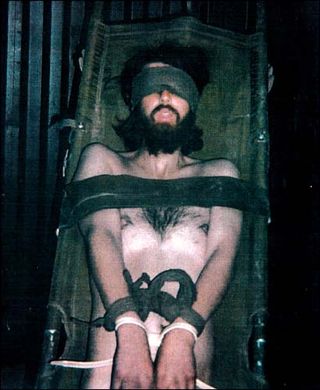 exotic verb. The first to inspire Donald Rumsfeld to issue the order "Take the gloves off," and the first to be on the order's receiving end. The first to be denied medical treatment, the first photographed naked and bound, the first taunted while blindfolded, the first–certainly the first–to have SHITHEAD scrawled on his blindfold, the first whose digital photos made their way round the world as souvenirs, the first denied access to the Red Cross, the first to be ushered into a legal limbo created ex nihilo by the administration's notions of executive power…
 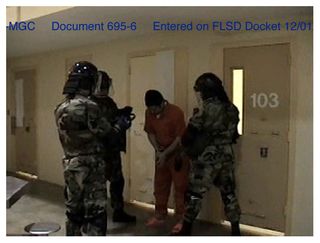 his knowledge.
 The Dish