The Case Of Matthew Shepard

Visit msnbc.com for Breaking News, World News, and News about the Economy

Many are understandably aghast that some opportunistic and homophobic characters are disputing the idea that the brutal Matthew Shepard killing was purely a hate crime: a young man singled out and beaten to a bloody pulp by strangers solely because he was gay. A pure hate crime was certainly how I first thought of the case, but the notion that the story is a lot murkier is not crazy or bigoted. (How Rachel Maddow could have a segment on this and not raise any of the salient questions I don't know.) I don't doubt that homophobia fueled the disgusting murder. But I am unconvinced it was the sole motive. ABC's 20/20 report brought some serious facts to the table – most specifically the crystal meth binge that the killers had been on, and the original motive being possibly robbery of someone McKinney knew casually:

As a heavy user and a dealer, McKinney was well-known

with the methamphetamine crowd, according to Ryan Bopp, who was one of McKinney's friends and drug associates at the time. By the fall of 1998, McKinney had blown through his inheritance and was now the parent of a new baby with his girlfriend, Kristen Price.

"I think he was really torn because it is the desperation of getting your fix or taking care of your family," Price said. In the days leading up to the attack on Shepard, she said, McKinney was using methamphetamine every day…

"Everybody knew Matt Shepard was a partier just like Aaron, just like the rest of us," said Bopp.

In fact, Bopp said he had seen Shepard and McKinney together at parties. "Aaron was selling [drugs] and him and Matt would go off to the side and they'd come back. And Matt would be doing some meth then," he said.

Though they frequented the same party scene, McKinney maintains he had never met Shepard before the night of the crime and wonders why people might say he had. "I've never met him. … Maybe they seen us somewhere in the same spot or something. I don't know," McKinney said.

A bartender familiar with the local drug scene, who asked to be identified only as "Jean," says she was friendly with Shepard. She also says McKinney and Shepard knew each other.

When she learned of the beating, she said, she recalls thinking, "It's either money or dope, yeah. He'd be the perfect target especially because Aaron knew him."

Another Laramie resident, Elaine Baker, says she also saw McKinney and Shepard together in a social situation. Several weeks before the murder, she spent a night on the town in Doc O'Connor's limousine with a group that included both McKinney and Shepard.

"In the back of the limo, there was me, Stephanie, Doc, Aaron, Matthew Shepard," she said.

As word spread of the attack on Shepard, other people who knew him also suspected the drug scene might somehow be involved.

In fact, former Laramie police Cmdr. Dave O'Malley got a call from a friend of Shepard suggesting that. Nevertheless, O'Malley doesn't believe drug use motivated the attackers.

My own view, for what it's worth, is that this was multi-determined. I do not doubt that one of the motives for the brutality of the killing, perhaps the primary one, was homophobia. Equally, I don't doubt that it was much, much murkier than the p.c. mythology would have you believe. Shepard's mother's statement is telling, and true, I think:

"There were a lot of things going on that night, and hate was one of them, and they murdered my son ultimately. Anything else we find out just doesn't, just doesn't change that fact," she said.

Souter’s Farewell

The big news of the morning is Supreme Court Justice Souter announcing his retirement. A mini-round up of commentary worth pondering. Josh Marshall:

I've heard a few people mention that this represents a political opportunity for the Republicans. But for the life of me I cannot see that. Supreme Court nominations are extremely high stakes battles for partisans on both sides and each party wants to hit a nomination struggle with the most political muscle possible. President Obama has extraordinarily high personal popularity at the moment. His approval rating, while down a bit off the inaugural high, has stabilized and even tracked up a bit at a strong 60%. His party is nearing 60 seats in the senate. And the Specter party-switch, while perhaps not that significant in numerical terms, has left the senate Republican caucus deeply split and demoralized — with one faction savoring an emasculated, tea-bag-driven ideological purity and another disgusted with the party's ultras and anxious to reenter the actual national political conversation. In other words, it's about the worst footing imaginable for senate Republicans to try to defeat or stand united against whomever Obama chooses.

Tom Goldstein:

The president will be personally invested and involved. I think it will come down to interviews between Wood, Kagan, Sotomayor, and two more out-of-the-box candidates, perhaps one with significant political experience and another who is a progressive visionary.

And the president will decide personally based on his own very individual view of how he wants to shape the Court. There is no rush to make an announcement. The term will conclude at the very end of June, and it makes no sense–and there is no pressure–to announce a choice for a successor before the justice has completed this term's work. That leaves two months, which is plenty of time, and the president can reasonably be expected in very early July to name his nominee. Hearings would be held in early or mid-August (the administration and Senate Democrats will want them sooner rather than later, in order to not leave the nominee hanging), when the rest of Washington hoped to be on vacation away from the heat.

Ilya Somin:

Today, the average Supreme Court justice serves for over 26 years. Over such a lengthy tenure, there is likely to be turnover among the other justices, and the current appointee's ideology may have a major impact on the balance of power over the long run even if its immediate effect is insignificant.

Was The London Cage Policy?

That's the question that is at issue in the debate about Britain in the Second World War and torture. We don't have documentation that authorizes the torture, and no evidence that Churchill knew of or approved of it. We do know that the central institution for interrogating captured Nazi spies – Camp 020 – used no torture at all. In the absence of definitive proof of authorization, how are we to put this incident into perspective? I asked Darius Rejali, the world's expert on torture in democratic nations, and author of Torture and Democracy, the definitive account. Here's his interesting reply, which has a bottom line of confirming that this looks, pace Jonah Goldberg, very much like an aberration, as often happens in wartime, and not policy, along the lines of the Bush-Cheney top-down program. So the point stands.

But here's Rejali's explanation in full:

You can prove something is policy in two ways. The top down approach is to find the document that authorizes the abuse, torture or genocide. This is often hard to find. They are often classified, destroyed, or demolished by war. The second way the bottom up approach, and its axiom is the Nuremburg Rule which is foundational to all human rights work done today.

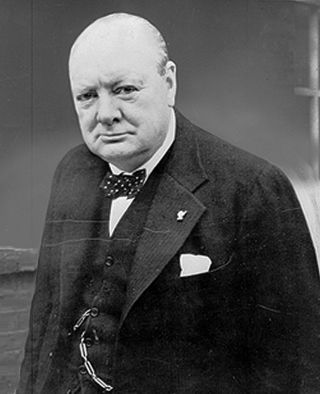
Churchill_portrait_NYP_45063 The Nuremburg Rule is: Uniformity of practice indicates uniformity of intent. When the same practices appear in different places and times within a given country, or among a series of prisons around the world, in cases of individuals who are unknown to each other, it is hard not to conclude that there is a deliberate state policy to torture. Applying the Nuremburg rule works quite well in – for example – documenting the American torture regime – strong similarities between Afghanistan, Iraq, Gitmo – everyone could see that –  and now we have the documents that confirm the bottom up with the top down.
Conversely, while the French and Russian prosecutors at Nuremberg tried to persuade the judges that torture was a Nazi policy, the judges brought down only one verdict affirming torture, this against Kaltenbrunner, for torture in the concentration camps. Outside the camps, the worst Gestapo tortures, they held, were only semiofficial. And this seems to be born out historically, even in the absence of documents. Gestapo torture techniques are widely varied, and reflect the countries in which they appeared. The only place where they were dramatically similar were the camps (again that took three years to make the spread sheet).

So the bottom up approach requires a survey of all the POW camps under Allied supervision, looking for patterns of torture. And this I did in Torture And Democracy as a necessary step, long before I knew about the London Cage. I looked for as many allied POW camp histories as I could looking for patterns of abuse and torture. I looked at histories of camps in Europe, Asia, North Africa and Ethiopia/Somalia.  I also read Italian and Japanese POW diaries I could find at the library of congress. It seems clear that sometimes Americans and British camp leaders were either indifferent or helpless in the face of violence between prisoners, but none that they initiated themselves. The only place I found some accounts of torture was in a single memoir by an Japanese POW,  Iitoyo Shogo, who in a British POW camps in Indonesia.   Torture did exist in Soviet POW camps and it also did exist in French POW camps in the Sahara, which even the OSS knew about.

Thus, Torture and Democracy shows that the bottom up approach fails to establish that what happened at the London Cage was policy.

What we know about the treatment of prisoners in POW camps under Allied supervision is that the London Cage does not fit the general pattern of British and American POW camps in Europe, Asia, North Africa, or Ethiopia/Somalia, whereas torture in Dachau had striking similarities to tortures in Auschwitz  and Ravensbruck.  And what is more it does not appear that the prisoners in the London Cage were qualitatively any different than prisoners held in any other POW camp.  SO the London Cage was policy claim fails to meet the Nuremburg rule, proving that this was a policy for typical allied POW camps.

This does not mean the top down approach (what you're asking me about; is there a document proving the war cabinet knew) may not show up a secret authorized program. Why this set of prisoners were special is beyond my abilities to guess; they seem pretty common. I suppose there must be a Red Cross report of Scotland refusing inspection; one wonders if they protested, and if so to who, but if Scotland refused the RC, it would have been an issue, given how much the British had insisted on this regarding Japanese POW camps.  Likewise, even if Scotland did not have clear approval of MI19, his superiors certainly knew of the allegations of torture and then quietly overlooked them. This is one of the classic post-war amnesia problems I cover in chapter 24 of the book. Being a winner was all about being morally pure. The MI5 investigation never charged Scotland, and presumably once declassified, that should show who had authorization.  That presumably should be at the National archives.

But I found the 2005 report of the London cage out of scale with the rest of the Allied POW histories and I thought I knew everything there was to know about it. It does fit a certain pattern of torture practice that continues pretty solidly through British colonial practice. And the conclusion I drew is that this is a case of an officer who was tolerated by mid-tier officers, much like Lt. Calley's behavior was tolerated and much torture that happened by American forces by Vietnam. And this is a way in which torture transmission happens, often by mid-tier officers. The same way in which torture entered the French a few fringe colonial officers after the war passed torture to their underlings to live on another day in Algeria and Vietnam. Maybe one day we will find the document authorizing Scotland, in which case everything changes.  THe Nuremburg rule can't prove it didn't happen, only that it seems quite unlikely that it is policy.

Dissent Of The Day

A reader writes:

You seem to think that Clive's exposition of existing torture laws is an attempt to outline a legal argument he personally believes in. I don't read his posts that way. Rather, I think he's offering up a version of the argument Yoo or Bybee's defense team might make, and then is saying, "These laws are vague enough that this argument might sway some people. Consequently, pursuing prosecutions could have unintended, negative consequences. It's best to move forward."

This resonates with me. I think people in our country (and around the world) are quickly migrating to the view that the Bush administration was an anomoly and is not representative of American ideals or values. A jury conviction of Yoo for war crimes would help reinforce that viewpoint, but a jury acquittal would upend it completely.

The bitter irony of the Bush administration is that his take-the-gloves-off approach to ensuring the safety of the American people had the effect of making us significantly less safe. How much more bitter would the irony be if prosecutions we pursued for his administration's torture crimes had the effect of undermining the very laws they had broken?

Rather than pushing for prosecutions right now, I think we should be pushing for transparency and light. Make FOIA requests, hold Congressional hearings, have a public debate. Let's continue to argue this out in the court of public opinion. When it comes to prosecutions, what's the rush?

I've long said I'd like a lengthy Truth Commission that takes plenty of time to assemble all the necessary facts. Then we can decide on the prudence of prosecution, or not. But my reading of the US's treaty obligations and domestic laws make such a prosecution unavoidable.

The Curtain Lifts, Ctd.

Byron York plays defense:

I wrote that citing Obama's "sky-high ratings among African-Americans make some of his positions appear a bit more popular overall than they actually are." I thought the word "overall" conveyed the idea that there was a difference between the total job-approval number and the complexities of opinion of Obama on various issues.  Maybe "across-the-board" would have been better than "overall," but I doubt that would have kept a left-wing activist like Matthew Yglesias, or Andrew Sullivan, who has himself been accused of racism and, quite recently, anti-Semitism, from branding me a racist.  The numbers inside the Times poll are newsworthy, if the critics would take the time to read and analyze them.

Thanks for the kind words! But York gives no context for these numbers. Of course African Americans are going to be more favorable to Obama: they are overwhelmingly Democrats. Here's Ta-Nehisi:

The essential Dave Weigel displays more patience than I can muster and calmly notes what any decent political observer already knows–Obama's support among blacks isn't exactly aberrational, when compared to other Democrats. That point needed to be made, but it's so obvious that I'm at a lost to explain how York could miss it.

Which leaves me with this: I know that certain black public figures had made a game of name-calling out of racism. I also know that white people, like all people, want the benefit of the doubt–and, like all people, they deserve it. I try to give it as much as possible. In this instance, it has to be withheld.

Churchill vs Cheney, Ctd.

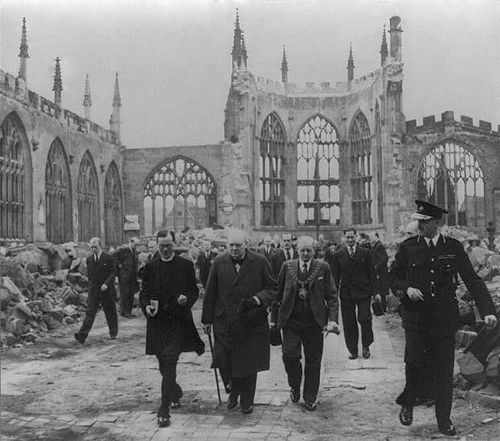
Winston_Churchill_walks_through_the_ruins_of_Coventry_Cathedral

The Guardian story on the "London Cage" has troubled me greatly and I have tried to find out as much as possible about it since yesterday. The best account of the history of democracies and torture can be found in Darius Rejali's book, "Torture and Democracy," which provides very important context for this long obscure nugget in British history, and helps illuminate a critical distinction. Rejali writes:

I’ve been following the debate re your Churchill-Cheney blog, the Obama aftermath, and now the London Cage. I just wanted to mention a few things that might be pertinent.

There is a significant difference between the German prisoners in the cage and the German spies captured by the British during World War II. The Germans in the cage were accused of war crimes, and the techniques was used to coerce confessions of guilt. It didn’t matter if what they said was true, and even then the success rate of the cage was terrible.

The Cage held 3573 prisoners. They were accused of war crimes. The techniques were designed to coerce confessions of guilt. But only about 1000 confessions, false or true, were coerced – either by torture or “not torture”. That is 70% refused to confess anything. These are, as I say in the book, surprisingly dismal results but pretty much in line with other dismal results for false confessions including Korean and Chinese torture during the Korean War and French ancien regime torture (which was even poorer). And these are cases where people don’t care if the information is true or false. They just want the confession.

By contrast, the German spies during the war were captured with standard British policing techniques and interrogated using “soft skills”. British counterespionage managed to identify almost every German spy without using torture—not just the 100 who hid among the seven thousand to nine thousand refugees coming to England each year, not just the 120 who arrived from friendly countries, but also the seventy sleeper cells that were in place before 1940. Only 3 agents eluded detection; 5 others refused to confess. The British then offered each agent a choice: Talk or be tried and shot.

Many Germans chose to talk and became double agents. They radioed incorrect coordinates for German V missiles, directing them to land harmlessly in fields. But for this misdirection, the distinguished war historian John Keegan concludes, in October 1944 alone the Germans would have killed about 1,300 people and injured 10,000 others.

My first post was in reference to the capture and interrogation of German spies for intelligence. I was unaware of the Cage – and if I'd read Rejali's book (one of those on my long list), I would have. But in a way, the full facts merely deepen the core point. The point of torture is always torture. If you do not care about the accuracy of intelligence, and want forced confessions, it can work (even if not very well). Ask John McCain. There is no gainsaying the use of abhorrent tactics by some, even though it remains unclear what clearance it had, and whether it was authorized, unlike the Bush-Cheney program, by anyone in any real authority. (We do know that the head of MI5 was protesting what he heard had gone on and that one Nazi who cmplained of mistreatment there went on to work as a double-agent for the Allies.) What is clear is that the core British apparatus for interrogating Nazi spies and captives suspected of having actionable intelligence during the war used no coercion of any kind; and that the clear and stated policy of the British in interrogation during the war banned all forms of torture.

If you really want to save lives, you need accurate information. If you really want accurate information, you do not torture. And no crisis in contemporary America in the last decade approximated the trauma of the Blitz.

I stand by my first post, and am grateful for the additional information it flushed out. You can buy Rejali's book here.

Your Newest “Democrat Senator”


The RNC put out an anti-Specter robo-call (above). Chris Orr is befuddled:

Even leaving aside the fact that the 2010 election is a year and a half away, I’m unclear on what this robo-call is intended to accomplish. Does the GOP think that if it reminds Democrats that Specter is a former Republican who is opposed to EFCA, it will persuade them to vote for a more conservative, still-Republican who likely opposes EFCA still more? Do they imagine they’ll inspire Dems to vote against him in the primary, possibly giving them a more-liberal, less-well-known Democratic candidate to run against in the general? Or are they just so ticked off they want to insult him, and associating him with Bush is the best they can come up with?

The ad is clearly designed to help another Democratic contender knock out Specter in the primary and therefore give the Republican on the ballot a better shot at winning against a wet behind the ears no-name Democrat. Planting story lines early makes them go over smoother later on. That said, if the NRSC manages to gin up enough Democratic angst that Specter faces a legitimate challenge from the left, it could simply make Specter take more liberal policy positions in the present. That’s not a very good outcome for the GOP when Obama is front-loading his domestic agenda. 

As The Tide Turns

A reader writes:

I got home today with a "Benefit Update Rider" from Oxford Health Plans waiting in my mailbox. This sort of thing usually fills me with dread, and it the only time such a notice put a smile on my face. Verbatim, as follows:

SECTION XIII. Definitions has been updated to include the following definition of Spouse:

Spouse: A person's partner (husband or wife) in a legal marriage.  For purposes of Dependent eligibility under this Certificate, spouse includes same sex partners who are married in jurisdictions that recognize same sex marriages.