Clive Crook writes that Obama owes Bush an apology over national security issues and his supporters an apology for misleading us. He then declares that: "The Democratic party’s civil libertarians seem to believe that several medium-sized US cities would be a reasonable price to pay for insisting on ordinary criminal trials for terrorist suspects." That's a real stretch, but Clive's points are mostly well-taken, although I think he's wrong in believing that Obama's plans for military commissions are not a big change. They are. Bush's military commissions were riddled with bad faith, had next to no due process and were effectively show trials. The new rules Obama proposes are much, much fairer.
 As for apologizing to his supporters, I hope I don't come off as a sap for saying I don't feel I need apologizing to. Obama always declared that he supported a war on Jihadism – just not a dumb one in pursuit of non-existent weapons in Iraq. He never held the purist civil liberties position Clive implies he did; and never argued in the campaign that we should simply return to a pre-9/11 posture. He backed rendition, for example – just not the extraordinary rendition to torturing regimes that Cheney set up. He backed an increase in troops in Afghanistan – and has followed through. He has nominated a very hard-ass commander to target al Qaeda in Af-Pak. He has continued to use drone attacks (unwisely in my view). He has barely removed a soldier from Iraq. He backed military commissions in the past – just not the kangaroo courts engineered by Cheney.
The two fundamental issues many of us (by no means all on the "left") were concerned with – and it's hard to get more fundamental – were a) the use of torture, coercion and abuse against prisoners in violation of Geneva and the UN Convention and domestic law; and b) the claim that the power to detain indefinitely and torture – beyond all law and treaty – was vested solely in the executive branch, with no accountability or checks outside of elections.
These were, in my view, fundamental attacks on America – much more fundamental than the mass murder of 9/11. They were attacks on the core meaning of America, on American decency and values, and on the rule of law and constitutional balance. They gave the executive branch the power to coerce evidence and to avoid all accountability for such evidence. They allowed the president to torture an American citizen, Jose Padilla, into madness before he was allowed to stand trial (on charges that bore no relation to the original claims). This regime and its claims are now over, even as Cheney threatens to revive them in the future. For this shift, we should be glad. And Obama fulfilled that fundamental promise. He ended torture and he ended tyranny. That is no small change. Yes, the Bush administration, prodded by the courts and Congress and its own saner, calmer members, walked back some of this from 2004 onwards. But the clarity of Obama's decency and constitutionalism remains. It's what the last election was about for some of us.
Now to the caveat. Preventive detention in this terror war is a very hard issue – and it is an Obama backtrack. Every fiber of my being resists it. But I am not ready to regard the war on Jihadism as over or as anything but a war at its sharpest end.
How to conduct this global war outside of traditional armies and beyond traditional sovereignty is an immensely difficult task, made much more difficult by Cheney's arrogant, extreme and indecent beginning. It may take years of trial and error to figure it out – and the war will change constantly in pace and location and tactics. But in previous wars, prisoners caught behind enemy lines or planning serious attacks on civilian targets have long been detained as prisoners of war. If we had done that from the start, and stuck with Geneva, long term detention might be more palatable and defensible. The trouble, of course, is that there is no end-point to this war and no formal enemy to surrender. And so long-term detention under Article 3 becomes a kind of perpetual supermax – as damaging to our global image as Gitmo.
Given my druthers, I'd let all prisoners who cannot be charged with any offense that would stand up in a military commission go. Some would no doubt go back to plotting. But we cannot arrest people for nefarious and vague plots without the kind of evidence we procured in the Newburgh case. My one exception would be for those suspected of finding or seeking or using or knowing about weapons of mass destruction. That seems to me a pretty solid line that takes the conflict into a clear zone of global war and immense danger. It's where crime ends and war begins.
Without torture, and with constant review of the detention, WMD cases – and only with respect to non-citizens – could justify this kind of imprisonment. But I'm deeply queasy about any other more extensive option. I concede that this is an entirely pragmatic judgment, and, of course, I'm open to persuasion to a more purist position. But 9/11 did change the calculus – the question is: to what extent? And does success in neutralizing parts of al Qaeda mean we can return to previous precedents? How do we judge that? How can we as civic participants have a voice in areas understandably sealed off by secrecy?
This is a moving target in a fast-changing world. It requires pragmatism from above and vigilance from us. And a conversation that can get past the fear-mongering of Cheneyism.
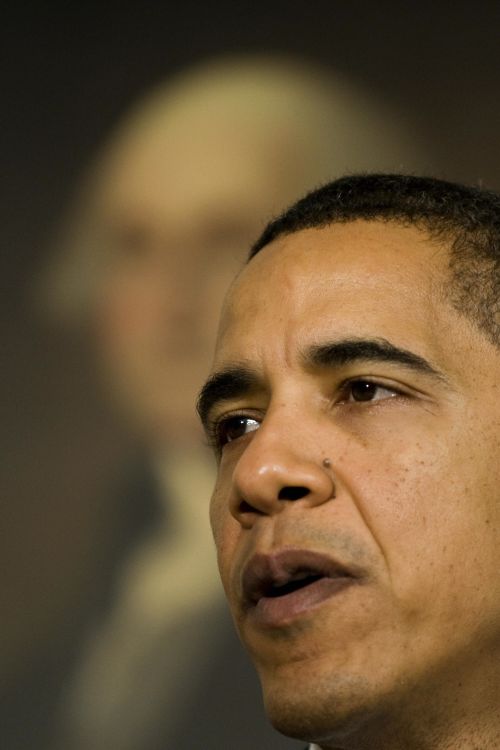
(Photo: Jim Watson/Getty.)
 The Dish