Cheney’s Core Contradiction

Dogs2

Perhaps the most remarkable passage in his speech to AEI last week was the following:

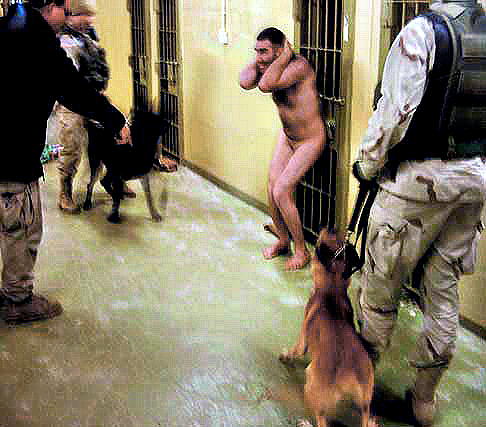
In public discussion of these matters, there has been a strange and sometimes willful attempt to conflate what happened at Abu Ghraib prison with the top secret program of enhanced interrogations. At Abu Ghraib, a few sadistic prison guards abused inmates in violation of American law, military regulations, and simple decency. For the harm they did, to Iraqi prisoners and to America's cause, they deserved and received Army justice. And it takes a deeply unfair cast of mind to equate the disgraces of Abu Ghraib with the lawful, skillful, and entirely honorable work of CIA personnel trained to deal with a few malevolent men.

There are two options in trying to understand this passage: a) It reveals a profound and disturbing level of denial about his own record; or b) It is one of the Biggest of Big Lies ever told by a vice-president of the United States. Perhaps the easiest way to show this is to cite the final and definitive "Conclusion 19" of the Senate Armed Services Committee Report:

The abuse of detainees at Abu Ghraib in late 2003 was not simply the result of a

few soldiers acting on their own. Interrogation techniques such as stripping detainees of their clothes, placing them in stress positions, and using military working dogs to intimidate them appeared in Iraq only after they had been approved for use in Afghanistan and at GTMO. Secretary of Defense Donald Rumsfeld’s December 2, 2002 authorization of aggressive interrogation techniques and subsequent interrogation policies and plans approved by senior military and civilian officials conveyed the message that physical pressures and degradation were appropriate treatment for detainees in U.S. military custody. What followed was an erosion in standards dictating that detainees be treated humanely.

There is no factual dispute as to the real origin of what Cheney calls the "disgraces" of Abu Ghraib: Dick Cheney via Don Rumsfeld. Cheney himself has boasted of the most dramatic of the torture and abuse techniques, waterboarding. He also pioneered and now defends a program in the CIA and at Gitmo that, in what it does to human beings suspected of being terrorists, is identical to the photos of Abu Ghraib. Look at the photos again.

Forced nudity: approved by Cheney. Hooding: approved by Cheney. Stress positions: approved by Cheney. Use of dogs: approved by Cheney. It is not just me arguing that Abu Ghraib was a function of a Capt5 policy dictated and approved at the highest levels. It's the entire Republican Senate leadership of the Armed Services Committee. It's every objective journalist's conclusion. It's in several Pentagon reports. It's demonstrable in the photos themselves. So who are you going to believe: Cheney or your lying eyes?

It was obviously not meant to be photographed and displayed as happened at Abu Ghraib. Some of the sexual excesses were clearly not authorized (but at Gitmo, recall, we know that lesser sexual abuse was authorized). It was meant to be conducted by more professional personnel than at Abu Ghraib. It was not supposed to murder anyone – as happened at Abu Ghraib and many other torture sites in the Cheney war. But the methods were exactly the same. We know where they came from. Call them what you will. There they are. Cheney knew them all, pushed for them all, and yet cannot own them when they are in front of his eyes. In fact, he has to push them into a corner called "disgraces." That's a strong word for a policy you created and enforced, against much of the military and intelligence and diplomatic agencies in government.

So why does Cheney tell such a big lie? Why does he do what he specifically says he would never do – blame a few underlings for policies he devised, pushed through against the law, and still champions as "honorable"? The only salient defense of the techniques of the CIA program as kosher and the Abu Ghraib photos as horrific is that these identical techniques are okay when used by some in the CIA but not okay when used by a low-ranking grunt on the night shift following orders. This is the core contradiction. You can't scapegoat Lynndie England while championing the methods she was told to use.

If Cheney wants to defend his program of torture and abuse then he owes it to us to own it as well. You either support what we saw at Abu Ghraib as the policy of the United States or you don't.  So which is it, Mr Cheney? A disgrace? Or an achievement? On that there is no middle ground, as someone might say.
A Liberal Alito?

Orin Kerr:

I don’t know a ton about Sotomayor, but her resume hints at someone who is sort of like a liberal mirror image of Samuel Alito: the humble kid who goes to Princeton and Yale Law, becomes a prosecutor, and then gets appointed at a young age to the federal bench and puts in 15 years as a respected (if not particularly high profile) federal judge. In some ways, that makes Sotomayor a pretty conservative pick.

One of his conservative readers is relieved:

As a conservative lawyer, I’m fine with this pick. As far as appellate judges go, Sotomayor is generally undistinguished. She’s a political pick designed to appeal to an interest group. Obama has 59, practically 60 seats in the Senate, and he could have named a strong, dynamic liberal who would have been a game-changer (even if only taking Souter’s seat). He didn’t.

Sotomayor was the safe choice: Hispanic, female, compelling life story, and few controversial decisions. She’s a reliably liberal vote who doesn’t move the ball in any significant way. There could have been much stronger picks (Kathleen Sullivan, Pam Karlan, even Diane Wood), but Obama, ever the politican, made a political decision.


And she’s not a lesbian. So we lose the gay seat (just kidding).

The Incoherence Of American Conservatism

It is becoming even clearer to me since the last election, as some of the clutter has been swept away. Conservatism has to mean resistance to expansive government power if it is to endure as anything vaguely coherent as a governing philosophy. Believing in limited government does not mean loathing all government; in fact, it means making a smaller government more effective, in part by limiting its ambitions to what it can effectively do that no other body can. The resilience of the anti-government thread – even in its least articulate "tea-partying" variety – and the cogency of this critique in the long-term of Obama's pragmatic liberalism make a small government Republicanism hard to kill, however much some would like it.

The problem, however, for such a limited government conservatism, is foreign policy. It is extremely hard to fit a multi-continent, Iraq and Afghanistan-occupying war on terror into this rubric. It's just too utopian, expensive and open-ended. Gary Becker makes this point well:

The current Republican Party is trying to incorporate two inconsistent sets of beliefs: one is the support of competition and generally freer markets, and the other is the advocacy of interventionist policies on various social issues, such as gays in military, stem cell research, or in international affairs. Both these positions are often linked together as "conservative", but they involve contradictory views of government. I argued for a consistent conservative position that supports individual choices, and opposes big government.

If you cannot cut taxes, and you will not make a dent on entitlements, then the next big ticket item is defense. My view is that a successful future Republicanism will begin to urge a dismantling of the empire and a limiting of the war on terror just as it will do in the war on drugs. This doesn't mean isolationism; it means a much more sober view of what a bankrupt America can do effectively to advance its real interests in the world:

Conservatives are not isolationists on international affairs since they recognize that the interests of a country like the US are affected by what happens in other countries. This is clear in Reagan's successful efforts to wear down the Soviet Union during the Cold War, or in more contemporary efforts to anticipate terrorist attacks planned in other countries. However, just as with the use of government powers on purely domestic issues, conservatives would recognize that governmental foreign actions are usually very inefficient (as in conducting wars), and are often driven by special interests. A conservative philosophy would limit governmental international interventions to cases where the risks from not taking actions are very large, and the interventions reasonably straightforward.

Check And Mate?

Stu Taylor ponders the shrewd politics of Obama’s choice:

The Republican dilemma is underscored by the fact that the Sotomayor actions they might be most eager to attack are themselves especially likely to engage the sympathies of Hispanic voters. In a 2001 speech that I have criticized, for example, Judge Sotomayor suggested that “a wise Latina woman with the richness of her experiences would more often than not reach a better conclusion [as a judge] than a white male who hasn’t lived that life.” This will strike many Republicans as the essence of the ethnic and gender stereotyping that liberals once properly abhorred. But with Republicans already in danger of being seen as the white-male party, rushing to the defense of white males may not be a winning argument politically.

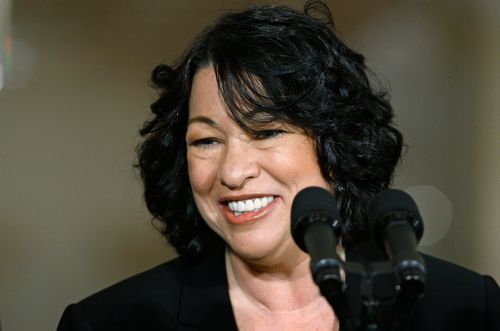
This president is more cunning than he might seem. Today’s news photos of Sotomayor are also strikingly attractive and charismatic. You can imagine how this pick plays in the West and Southwest. As shrewdly as the Huntsman pick for China, this is both a defensible policy pick and a brilliant piece of domestic politics. The visuals of Jeff Sessions laying into her will not help the GOP in exactly those places it desperately needs. Advantage: Obama.

Sotomayor Reax

SOTOMAYORChipSomodevilla:Getty

Tom Goldstein (his whole post is well worth reading):

Opponents’ first claim – likely stated obliquely and only on background – will be that Judge Sotomayor is not smart enough for the job.  This is a critical ground for the White House to capture.  The public expects Supreme Court Justices to be brilliant.  Harriet Miers was painted (frequently, by conservatives) as not up to the job.  The same claim (absurd to anyone who has talked with him) is still made by the left about Clarence Thomas.  By contrast, John Roberts was described as brilliant and Sam Alito as exceptionally smart. The objective evidence is that Sotomayor is in fact extremely intelligent.  Graduating at the top of the class at Princeton is a signal accomplishment.  Her opinions are thorough, well-reasoned, and clearly written.  Nothing suggests she isn’t the match of the other Justices.

Ilya Somin:

I am not yet sure what position to take on President Obama's selection of Sonia Sotomayor. My general sense is that she is very liberal, and thus likely to take what I consider to be mistaken positions on many major constitutional law issues. I am also not favorably impressed with her notorious statement that "a wise Latina woman with the richness of her experiences would more often than not reach a better conclusion than a white male who hasn't lived that life." Not only is it objectionable in and of itself, it also suggests that Sotomayor is a committed believer in the identity politics school of left-wing thought. Worse, it implies that she believes that it is legitimate for judges to base decisions in part based on their ethnic or racial origins.

Scott Lemieux:

If the GOP wants to make a big stand on affirmative action in the context of the first Hispanic-American nominee — and hence continue its demographic death spiral — I say bring it on.

Greg Sargent makes the same point:

How do Republicans oppose the first potential Hispanic Supreme Court justice, given their much-vaunted outreach to Latinos in 2006 and 2008, the losses the GOP has suffered with this group given the party’s immigration stands, and the party’s desperate need to expand racially and demographically among such groups? The optics of GOP opposition here likely would look awful.

So does Alex Massie:

Identity politics and treating entire swathes of the population as client groups is not an especially bonny aspect of American politics. But it is what it is. While it's not obviously the case that just putting the first hspanic justice on the bench necessarily advances or even much solidifies Democratic support amongst latino voters, one can easily imagine a situation in which a raucous, energetic, strident Republican attempt to derail the nomination could further alienate hispanic voters from the GOP. That might be unfair, but I wager it's how it would be perceived by latino voters. So this would seem, at first blush, to be the trap Obama has set for the Republicans: accept the nomination (assuming there's no scandal) and like it or fight it and lose and do more damage to your own interests than you would if you'd simply seethed in silence and accepted your inevitable defeat. It's one they do not need to fall into…

And Ben Smith looks at the specifics of GOP opposition:

Obama has signaled that he plans a much more populist appeal, stressing the common touch, than the usual intellectual, legal and Beltway-centric defenses of Supreme Court nominees. And my view is that this nomination, barring surprises, carries far more risk for the Republican Party than for the White House. As I reported last week, the RNC commissioned a post-election review late last year and found that among the most urgent priorities was that the party not come across as anti-Hispanic during an immigration debate. Senate Republicans, led by Jeff Sessions, are likely to be painfully careful not even to be hinting at anything other than consuming respect for Sotomayor and her pioneering status. Talk radio is likely to be less careful and to be gleefully reposted by Media Matters and widely circulated in the Spanish-language media. Fierce opposition from the right could push Florida and the West out of reach. (Watch for what Charlie Crist says about her.) Less fierce opposition doesn't do the GOP much good either.

Wendy Long:

She has an extremely high rate of her decisions being reversed, indicating that she is far more of a liberal activist than even the current liberal activist Supreme Court.

Given that we were certain to get a liberal justice out of Obama, I suppose one has to take comfort in knowing that Obama made a quota pick too, and did not choose a liberal justice who can match intellects with Roberts and Scalia.

Jim Lindgren:

Compared to recent nominees, Sotomayor is a far more distinguished choice than was Harriet Miers (whom I opposed), but a less distinguished choice than John Roberts — and probably Samuel Alito as well. I expect Sotomayor to be confirmed, but without too much enthusuasm, except in a few pockets of the Democratic coalition.

Greenwald:

It is very encouraging that Obama ignored the ugly, vindictive, and anonymous smear campaign led by The New Republic's Jeffrey Rosen and his secret cast of cowardly Eminent Liberal Legal Scholars of the Respectable Intellectual Center.  People like that, engaging in tactics of that sort, have exerted far too much influence on our political culture for far too long, and Obama's selection of one of their most recent targets both reflects and advances the erosion of their odious influence.  And Obama's choice is also a repudiation of the Jeffrey-Rosen/Ben-Wittes/Stuart-Taylor grievance on behalf of white males that, as Dahlia Lithwick put it, "a diverse bench must inevitably be a second-rate bench."

Kristol:

"Where policy is made." That's how, in 2005, reported Supreme Court pick Sonia Sotomayor characterized the Court of Appeals, where she now serves. It's undoubtedly even truer, in her eyes, about the Supreme Court. The debate over her confirmation could be an interesting "teaching moment"–a politically important teaching moment–for constitutionalists who would beg to differ from Sotomayor's vision of the appropriate role of the federal judiciary.

DiA:

Long before the SCOTUS storm, in 1992 the New York Times profiled Justice Sotomayor and it remains one of the more informative pieces written about her. After growing up in a Bronx housing project, she graduated summa cum laude from Princeton, became an editor of the Yale Law Journal at Yale Law School, and spent five years working in the Manhattan district attorney's office. She then became a high-earning commercial litigator before being appointed by Mr Bush. Justice Sotomayor is obviously qualified, but Mr Obama recently said he was looking for something more in his nominee. "I want somebody who has the intellectual firepower but also a little bit of a common touch and has a practical sense of how the world works," he said over the weekend.

Rick Garnett:

Six (!) Catholics on the Court? So, it sounds like President Obama will nominate Judge Sonia Sotomayor to replace Justice Souter.  Could it be that we will soon have a Supreme Court that is two-thirds Catholic (and 1/9th "White Anglo-Saxon Protestant")?  Poor Chris Hitchens!

I suspect her Catholicism may come in for a theocon inquisition. I don't like her affirmative action views, but I've always taken the view that a president gets wide lee-way in this kind of appointment. I see no good reason to oppose her – and some real perils for the GOP if they beat up on a brilliant and self-made Latina on SCOTUS. They must know the country they purport to want to govern.

(Photo: Chip Somodevilla/Getty.)

Fleshing Out The Cap & Trade Bill

Tyler Cowen makes a list and judges Waxman-Markey. Number eight:

Waxman-Markey defenders argue "we must do something," "this is a first step and a framework," "the people who oppose the bill are fraudsters," etc. but all that non-marginal analysis does little to address the key problem.  Those arguments may make you feel better about affiliating with Waxman-Markey, and opposing its critics, but they are not geared toward solving the problem.  Beware when non-marginal moralizing becomes so prevalent in the case for a piece of legislation.

The Economist had a good take here as well. It looks as if the price for doing anything about carbon is largely giving away the permits for free to special interests. Maybe it's a start. But it makes the fiscal future even worse – since the cap and trade revenues were about the only reliable revenue producer in Obama's future.

Selling Sotomayor To The Center-Right

It's becoming a theme of the Obama presidency – coopt moderate GHWB Republicans in favor of centrist policies. Here are the three talking points from the White House that stood out to me:

* Before she was promoted to the Second Circuit by President Clinton in 1998, she was appointed to the District Court for the Southern District of New York by President George H.W. Bush – a show of bipartisan support that proves good judging transcends political party.

* Known as a moderate on the court, Sotomayor often forges consensus and agreeing with her more conservative nominees far more frequently than she disagrees with them. In cases where Sotomayor and at least one judge appointed by a Republican president were on the three-judge panel, Sotomayor and the Republican appointee(s) agreed on the outcome 95% of the time.

* Judge Richard C. Wesley, a George W. Bush appointee to the Second Circuit, said "Sonia is an outstanding colleague with a keen legal mind. She brings a wealth of knowledge and hard work to all her endeavors on our court. It is both a pleasure and an honor to serve with her. "

Specter's on board.