A reader writes:
It was a startling revelation, wasn't it? Three comments:
1) Kudos to Mancow for having the balls to do it, and even more for telling the truth afterwards.
2) But, as many are noting, this was friendly waterboarding experimental extra-lite, with Mancow in almost complete control. Let's see him–or anyone else–take the real thing, even once, tied up with a rag stuffed in his mouth, administered by unfriendly pros, with no way to end it, preceded by several days of stress positions and followed by a little walling and a few weeks of sleep deprivation. Then let's talk about "torture".
3) Watch Mancow's reaction afterwards closely; look for the micro-emotions and body language: this guy has been deeply traumatized–I mean psychically, in the original Greek sense of the word: in the soul. Some of it may be attributable to the early experience he mentions of almost drowning 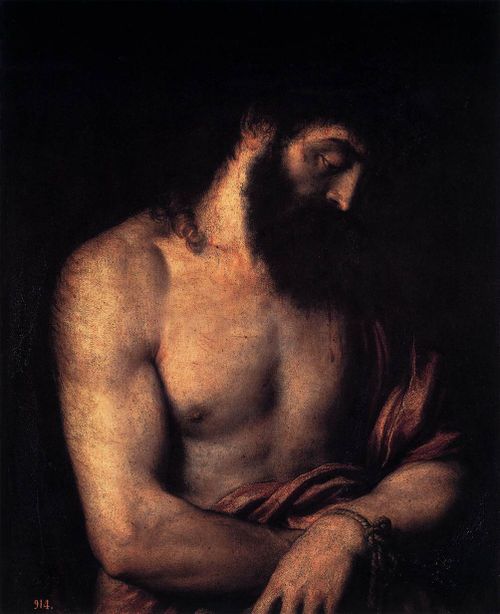 as a child, but deeper even than that, Mancow has glimpsed the real evil of torture: every act of torture–even "play" torture like this–betrays the deepest core of human trust: the trust in God.
Why? Because every man, created in the image of God, the imago dei, must–whether he wishes to or not, whether he knows it or not–stand and act in the place of God, with every decision, with every action, in every human relationship. The torturer therefore does not simply betray the laws of war, he betrays the imago dei: he betrays God, he betrays the other, he betrays himself, he betrays Trust itself.
The inarticulate terror you see flash for a moment across Mancow's face is the existential terror of a child–and we are all children–who sees that: a child faced with a world in which God cannot be trusted, in which God may indeed be actively evil: capricious, all-powerful, hateful, inexorable, inescapable. This is the deepest betrayal of all. This is the utter failure of human love.
"Power is not a means; it is an end. One does not establish a dictatorship in order to safeguard a revolution; one makes the revolution in order to establish the dictatorship. The object of persecution is persecution. The object of torture is torture. The object of power is power… But always—do not forget this, Winston—always there will be the intoxication of power, constantly increasing and constantly growing subtler. Always, at every moment, there will be the thrill of victory, the sensation of trampling on an enemy who is helpless. If you want a picture of the future, imagine a boot stamping on a human face—forever."
I am not a Christian. I prefer my Jesus neat. But if this understanding–the understanding of love–was not the point of his Passion, of the failure of love that brought about his torture and his death by torture, of his triumph over and utter repudiation of Orwell's nightmare–then it had no point, and has no point today.
And neither you nor I, though we hold our Jesus in different ways, believe that. We know different–and we know by trial.
"It's better for someone to have a heavy stone tied around his neck, and be thrown into the sea, than for that person to offend one of these little children."
We are all little children. Even the worst of us–perhaps especially the worst of us. Even the terrorist. Even the mass murderer. We would love to throw those sinners away, and we've tried to do just that for millennia–but it has never worked, and it never will work, because that is simply not the way reality works. There is no 'other'. There is only us. So to offend the worst among us–no matter how angry we are, no matter how much we feel they deserve it, no matter how much they do deserve it–is to offend the worst in us; it is simply to compound and perpetuate the original sin. It is an act of self-hatred, of spiritual suicide.
Let us be clear: 'offense' is not death itself–Jesus proved that–it is the betrayal of the imago dei, the betrayal of ourselves, the betrayal of God, the betrayal of our fellow men and women, no matter how lost they may appear to be. Offense is, simply, the failure of love; the failure of courage; the failure of the heart.
This entire debate about torture is nothing more–and nothing less–than the debate between fear and courage, between fear and love, between fear and strength. Watching Mancow stare into the depths–if only for a moment–we saw a man begin, perhaps, to understand that.
(Painting: Ecce Homo, by Titian.)

 The Dish