Contradictions of Reaganism

by Richard Florida

In an intriguing post, Stirling Newberry suggests that Reaganism set in motion basic economic and geographic forces that have led to a "self-inflicted recession" and shaped the demise of the conservative movement.

[T]he epicenters of that "Reagan Democrat" revolt are now the areas that are hardest hit by the present depression: California, the Upper Midwest, and the Sunbelt South. This is not an accident …

The only places that are doing well in the Republican universe are those strongly associated with mining, plus Republican metro centers such as Phoenix and Salt Lake City, which are the recipients of the labor draining from the rest of the Republican heartland. Resource extraction is the only bright spot in the Republican world …

The Bush boom produced a moment where it seemed like the producers of Residential Real Estate, the back bone of the Republican donating and agitating base, were finally at their pinnacle. Truck Dealers, Home Builders, Real Estate Agents, and the Small Business class that catered to the people who lived in the "boomburgs" saw rapid increases in employment, wages, and social power. They had the money and the confidence to try to press their social agenda on the rest of the country. It was, of course, doomed to failure; since none of these people made anything that could be exported; or if they did, it came at the costs of increased imports that counter-balanced them.

The Cannabis Closet: Safe Havens

Cannabis

by Chris Bodenner

A reader writes:

I think living in Manhattan has warped my view of how others view pot. I can get it anytime I want. They deliver the stuff here (granted, at a HUGE markup, but still). You can also smoke on the street with relative impunity. Often I will be walking around and have the sweet, musty smell of pot enter my nose. I always look around to see if I can identify the culprit, but I never can. Ironically, smoking weed in a crowded public place is probably the safest place to do it. In fact, wondering the streets of Manhattan or Brooklyn with a spliff in my hand is one of my favorite activities and I have almost zero worries about getting caught (being middle class and white doesn't hurt).

Another writes:

I am a late 20s casual user, college and law school graduate, working as an attorney, in a healthy relationship, stay fit, run a small business, etc. I live in Portland, Oregon, so pot use is pretty much accepted here. Once someone gets past the level of a casual acquaintance, it's usually okay to tell them about it, and more often than not they indulge, or have in the past.

Another:

A few years ago, some friends and I were passing a joint in an alley behind a bar in downtown Vancouver, BC, when we were suddenly caught by surprise by the police. The officers gave us a stern lecture, confiscated our pot and let us go.

Another:

I have, but I don't. Doesn't really agree with me. It doesn't bother me as long as the smell isn't imposed upon me; although I'd like it if the laws here were tweaked enough so that driving while smoking a joint was reason enough for a cop to pull you over and write you a ticket, which it doesn't seem to be in Vancouver. Impairment is impairment.

Another:

Ann Arbor has some of the laxest laws regarding marijuana in the country; 25 dollar first offense, then 50, then 100 for all subsequent offenses. An the city police don't even really try to enforce these laws. But because the annual Hash Bash is on campus and thus on state property, anyone exercising their right to civil disobedience can be fined thousands of dollars and face jail time.

This is fucked up. Excuse my language but this really does make me angry, especially after the story of Derek Copps. The fact that by moving over some invisible line I go from being a mellow kid just looking to relax to a criminal worth prosecuting is beyond ridiculous. I smoke weed. I enjoy smoking weed. It's one of God's plants. I smoke weed while attending college and still get very good grades. These laws need to be changed. They need to be changed now.

Another:

There are now marijuana dispensaries all over LA. Every day I pass on my way to the gym that has a big neon marijuana leaf in the window. Another just opened behind my apartment building. It faces La Brea Blvd, across the street from Pink’s Hot Dog stand where it’s clearly visible to the huge crowd standing in line 24/7. It’s the sheer normalcy of these shops that forces the issue.

Another:

I live in Boulder, CO and there is no closet here. People just assume that you smoke pot. And the police don't care about it unless you are a big time grower. Possession of an ounce or under is $15 fine, and they'll plead down to that if you have less than a quarter pound. We smoke joints openly in public, and the cops usually won't even ask us to put it out if the see us doing it. I've smoked pot with a cop. In public.

So here's my favorite story: I was contracting for a computer company based in Texas. After two months, my client came to me and said that the corporate headquarters were demanding that all contractors take a drug test. And he said: "But you can't pass a drug test, can you?" "Certainly not," I replied. And he came back with "Okay, I'll take care of it." He hired someone to take the test for me so I could continue to work there. But he screwed up. Turns out, I was pregnant. Which is pretty funny because I'm a man. But strangely, the corporate headquarters didn't notice that issue, and everything was fine.

Welcome to Boulder. I guess it is I that live on another planet. But it's a good one, trust me.

Another:

While attending a private college in northwestern Massachusetts, my classmates and I smoked frequently and, for the most part, freely. Don't know if the percentage of smokers is higher now than it was then, but the notion that the school or community law enforcement would pursue pot offenses on campus was unheard of. My biggest surprise was when my girlfriend and I were ejected from a campus concert (R.E.M. as a matter of fact) because we lit up a joint. We refused even to believe it, but the security guard said he was serious, and kicked us out. We later snuck back in. In our dorms we had massive bong-a-thons. Again, I don't know about the prevalence of pot-smoking in schools then versus now, but the relative laxity toward it in those days (ironically, the early Reagan years) is undeniable.

The Rise Of Anti-Urbanism, Ctd

by Patrick Appel

A reader writes:

Richard Florida's post notes the history of anti-urbanism in conservatism, but the history extends longer than that into the industrialization of Europe during the 1700s and 1800s. Goethe depicted the city not just as the realm of the intellectual, but of the debaucher. Mephistopheles corrupts Faust, the intellectual, in the city. William Wordsworth and Samuel Coleridge rebelled against the artificiality and inhumanity of the city. Joseph Conrad coupled the city with the immoral impulse of business to colonize and dominate. Wheras Karl Marx, and other like him, viewed the city as a savior for the unintelligent farmer. At the core of all critiques of urban areas, from these first author's to Florida's neoconservatives, is the fear of disenchantment.

The city always represents the loss of enchantment, the increase of impractical knowledge, the dissolution of man's special nature. Krugman says this is an aesthetic problem conservatives have with the city, but it goes much further than image. Conservatives disdain the city not just because it threatens the image of the burly American, but also because it threatens them. Small towns are dying and cities are growing; a single city hold great political power equaled only by a multitude of suburban neighborhoods. No matter how one looks at the issue, the paragon of the conservative way of life is no longer the paragon of the American way of life. It realy is an ontological problem for conservatives: How do they exist in a country that no longer holds their values as essential to life? How do they live with the disenchantment of the way of life they hold dear? Then answer for some is the path chosen by Wordsworth and Coleridge. They rebel, decrying the city and its inhabitants for any number of supposed ills. If history of thought has taught us anything on this subject, it's that no amount of rebellion can stop the city.

Bubble Cities

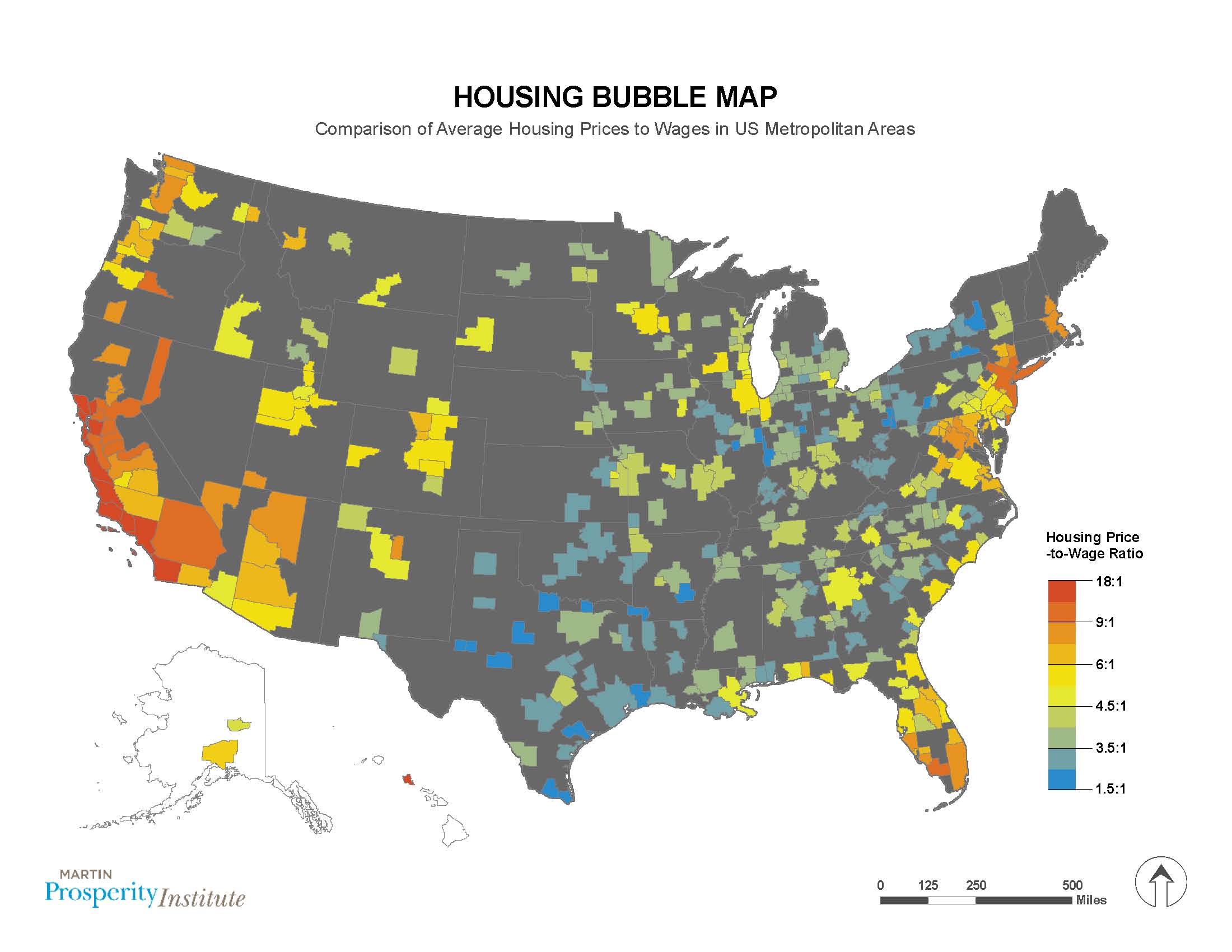
Map by Scott Pennington, Martin Prosperity Institute

In a compelling analysis, Richard Posner exposes the Fed`s complacency as a key source of the nation`s housing bubble and ultimately as a major – if not the major – cause of the ongoing financial mess and economic crisis. The fallout has effected all of us, and as Posner notes will continue to do so for some time.

But the housing bubble has varied widely by region. Some places in effect became bubble cities their econoimies premised upon and defined by the housing bubble.

This map charts the housing-to-wage ratios for U.S. metropolitan areas in 2006, the height of the bubble. It differs from the more commonly used housing price-to-income ratio. Historically, housing prices have been about three times income, but by 2006 housing prices had soared to a high more than five times incomes. In Irvine, California, the housing price-to-income ratio soared to 8.6 by 2006.

The housing price-to-wage ratio may provide a better gauge of housing bubbles. Income is a broad measure that includes wealth from stocks and bonds, interests, rents, and government transfers and other sources. Wages constitute a more appropriate gauge of a region's underlying productivity, accounting for remuneration for work actually performed.

Forget ratios like four or even eight. Six regions – all in California – posted ratios of 15 of greater: Salinas, Santa Cruz, Santa Barbara, Oxnard-Thousand Oaks, Napa, and San Luis Obispo. Another 12 metros had ratios above 10 – L.A., San Francisco, San Jose, San Diego, and Riverside, California, as well as Honolulu, Hawaii, and Naples, Florida.

The housing-to-wage ratio also generates a number of surprises. Greater New York's ratio (9.4) was slightly higher than Las Vegas (9), and Greater DC..'s (8.7) slightly bested Miami (8.4). Boston (8.1) and Seattle (7.6) topped Phoenix (7.2). Chicago's (5.9) was higher than Tampa (5.6) or Myrtle Beach (5.5).

What regions seem to have avoided the bubble? The cream of the crop on the housing-to-wage ratio are Dallas (3.5), Houston (3.2), Pittsburgh (3), and Buffalo (2.8).

Panic For The Good Of Humanity

By Patrick Appel

That's Fareed Zakaria's advice:

We're living in a dangerous world. But we are also living in a world in which deep, structural forces create stability. We have learned from history and built some reasonably effective mechanisms to handle crises. Does that mean we shouldn't panic? Yes, except that it is the sense of urgency that makes people act—even overreact—and ensures that a crisis doesn't mutate into a disaster. Here's the paradox: if policymakers hadn't been scared of another Great Depression, there might well have been one.

Drezner isn't buying it entirely.

State of Denial

by Richard Florida

Real estate got just about everyone into trouble in Phoenix, and the thinking seems to be that real estate is going to get everyone out.

A real estate "frenzy" is apparently developing there, the NYT reports, as bottom feeders gobble up mass foreclosures.

It`s not just Phoenix I fear, it's our national mind-set writ large.

In Praise of Silence

by Lane Wallace

At the height of the initial swine flu scare at the end of April, NPR posted an opinion piece on its website arguing that Twitter had exacerbated panic about the outbreak. The gist of the piece was that a limit of 140 characters gives no room for context or solid information. All it allows is the venting of fear, which creates even more–and usually more misinformed–anxiety and panic.

All that is probably true. And an important and valid concern. But what concerns me as much or more about incessant connection through Twitter, texting, Facebook, Crackberrys, and yes, even 24/7 instant news … is that all those technologies enhance an already bad inclination humans (and especially Americans) have. And that is: an overweening desire to be distracted from being alone in silence … or having to come to terms with whatever we might find there, if we slowed down enough to let it catch us.

Twitter, Facebook and cell phones didn't create this desire or problem. I've known people all my life who turned the television on as soon as they woke up in the morning and left it on until they went to bed at night, just to insure there was never complete silence in the house. All that the new connectivity, on-line virtual game options, and instant messaging do is make it easier to avoid the awful specter of silent, alone time. And yet … just try to imagine Henry David Thoreau writing his masterpiece about Walden Pond while twittering, texting, and watching CNN.

We have a far more instantaneous culture, these days. "Downtime eliminators," as a friend of mine calls internet-capable cell phones, and all the communication sites and methods they enable, mean that even on weekends, instant replies are expected. And it's not just replies. Less than three minutes after an event, we expect a world of talking heads to pronounce judgement on the meaning of what's transpired. Patience has become not only a virtue, but an endangered species.

I can't change any of that. But among the many things that life has taught me over the years is that my first thought isn't always my best thought. And that truly understanding anything … an issue, an event, or even the emotions swirling around within myself … requires not just time, but enough space, solitude, and silence to allow some clear tones to emerge from the noise.

On one level, people have understood the power and importance of silence for a long time. It's why we go to the woods, or the ocean, or up on mountainsides to renew ourselves. And why we take up meditation, or spend time in quiet cathedrals. But even the most majestic mountainside loses a large piece of its power to inspire if it has to compete with a cell phone, text reply, or other efforts to stay connected elsewhere at the same time. Or even to record the moment, instead of simply being in it.

At home or in the course of daily life, the challenge is even greater. Once, all it took to get a little silence and space was turning off the radio. A decade or two later, it took turning off the TV and phonograph, as well. Today, our distractions are much more mobile, and we have more devices to turn off. We also have an ingrained habit of constant connection that makes disconnecting more difficult. And potentially more painful.

Where there's a will there's a way, of course. Which is what makes me suspect that at least part of the constant connectivity movement and technology stems from an inherent desire, within many of us, to have all that distraction. We are not, as a species, hard-wired for solitude. We're social animals, made to exist in tribes and packs.

And yet … there's a unique kind of strength that comes from simply sitting in companionship with yourself and listening for what your heart or the world might tell you. Or allowing thoughts or events to percolate slowly against counter-thoughts, opinions, or trends. My best ideas don't occur to me when I'm feverishly involved in churning out words. They come when I give my mind permission to listen instead of talk. To just be for a while. Undistracted. Undisturbed. And sometimes not even consciously focused on the problem at hand.

That kind of space and silence may be a challenge to find in today's world. But below is something that helps. Not just the view out my window, but my favorite place to sit and think. Where thoughts, questions, answers, perspective … and even the occasional hummingbird … have a way of finding me, once I turn off all the gadgets and the noise.

IMG_0227.JPG

Palo Alto, CA 2:00 pm

Math of Global Cities

by Richard Florida

Earlier this week, Cornell mathematician Steven Strogatz reprised George Zipf's famous power law for the size distribution of cities where "the population of a city is, to a good approximation, inversely proportional to its rank."

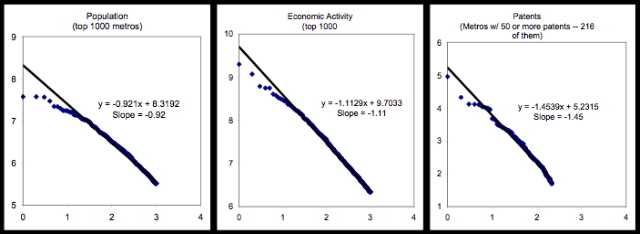
Tim Gulden of George Mason University has used data based on satellite images of the world at night to provide a Zipfian analysis for the 1000 largest urban agglomerations globally, based on several different measures of city size comparing rankings for population, economic activity, and patented innovations.

Gulden's research provides what is perhaps the first systematic depiction of the size distribution of global cities, and generates important insights into geographic organization of economic activity and innovation across the world.


While the population of cities tends to follow the Zipf law that Strogatz describes within a nation, this scaling does not hold for the whole collection of world cities. The distribution ends up being somewhat flatter – particularly among the largest cities. This may result from barriers to migration between countries.

The distribution of economic activity – which Gulden estimates using the light emissions from night-time satellite images – is more Zipf-like..

Innovation, however, appears to have a different scaling rule. The slope of -1.45 indicates that the distribution of patent activity is much more skew.

Gulden's work again reminds us that cities and urban agglomerations remain a key facet of globalization. As barriers come down and global forces continue to act on cities, the world's cities are likely to eventually conform to the basic rank-size pattern Zipf identified – already evident in the global distribution of economic activity and the even more skewed pattern of global innovation.The world's largest urban agglomerations are likely to become even bigger, while second and third tier cities face ever harsher competition.

The Ethanol Scam

by Patrick Appel

Ed Wallace sighs:

More than one major transportation-based industry in America besides Detroit is on the ropes. For the fourth time in our history the ethanol industry has come undone and is quickly failing nationally. Of course it’s one thing when Detroit collapsed with the economy; after all, that is a truly free-market enterprise and the economy hasn’t been good. But the fact that the ethanol industry is going bankrupt, when the only reason we use this additive is a massive government mandate, is outrageous at best.

(Hat tip: Silverstein)