Face Of The Day

ChildDoll
by Patrick Appel

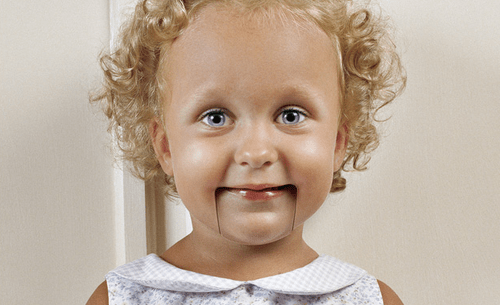
This is some of the creepiest portraiture I've seen in some time. The website says that, "children we ask to much of, to be perfect, like dolls." A description of the work:

'[T]he puppet show' is a new photographic work by Italian studio Winkler+Noah. 30 portraits of children aged between two to eight years old were taken and transformed into dolls by subtle retouching. the studios' statement was 'the best present we can give to children is to let them be children'.

Hipster History

by Richard Florida

Brian Frank writes:

Richard Florida points to a familiar article about "blipsters" — "black  hipsters." Which is funny, now that I think of it, because the  original hipsters were known as "white negroes".

Well, almost. Norman Mailer's infamous "The White Negro: Superficial Reflections on the Hipster" was originally published in 1957 in Dissent. 

Nearly a decade earlier, in 1948, Anatole Broyard, published "A Portrait of the Hipster" in Partisan Review. I can't find an online version, but here's how one writer describes it:

Broyard attempted an analysis and a definition of a new type then appearing around Greenwich Village who had, in his view, been welcomed by intellectuals who "ransacking everything for meaning, admiring insurgence… .attributed every heroism to the hipster.,,."

But Broyard was less enthusiastic about these supposed new rebels … In Broyard's words: "The hipster promptly became in his own eyes, a poet, a seer, a hero." And he added that the hipster life-style "grew more rigid than the Institutions it had set out to defy. It became a boring routine. The hipster – once an unregenerate Individualist, an underground poet, a guerrilla – had become a pretentious poet laureate."

Of course, what Broyard was doing, as well as attacking the hipsters, was criticising his fellow-intellectuals for failing to accept that the hipster rebellion was a sham.

Hmmmmmm …

What to Do with All Those Empty Car Dealerships?

by Richard Florida

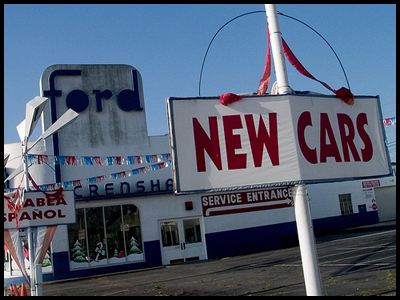
More than 2,000 car dealerships across the country will be closing their doors in coming months. Planetizen – my favorite urbanist site – recently asked its readers what should be done with all that space. Here are the top five vote-getters as of May 21:

  • Ask the local residents about what the community needs (222 votes)
  • Urban gardens (200 votes)
  • Create walkable, vibrant places and improve current communities (138 votes)
  • Farmers' markets and local events (126 votes)
  • Solar and wind energy park/vehicle charging stations (102 votes)

Ask The Audience: Mental Health, Ctd

A reader writes:

As someone who has lived with serious mental health problems, I can relate to the sister your reader writes in about. It's important to understand that every one of us has the innate desire to not be different. Many mental illnesses don't begin to manifest until early adulthood – so you've spent your life as a normal human being and now you're crazy. Right, who's going to accept that? Even if you've always had a mental illness, you just want to be normal. This is why almost every individual with mental illness goes through a period of abandoning medication – it's just much easier to think "I don't need this because the hard times which caused it are over" or "Now I'm cured". In my experience it takes a "bottom" so to speak to realize that you do need to be medicated and arrive at acceptance.

This relates directly to the earlier post regarding patient rights and how often people with mental illness are treated or institutionalized against their will. When I was unmedicated, every thought – no matter how innocuous – twisted into something dark and disturbing. I would begin by thinking how nice it is to hear children playing outside, and then find myself dwelling on all the horrible things that could happen to them. I would look at green grass, and end up thinking about how someday I'll be buried under a patch of it. When I looked at my gas range, the telephone cord, or the beam across my roof, I started to think about how it could be used to kill myself. My thinking was different and dangerous, and I was in no position to make rational decisions about my healthcare. Patient rights really don't apply in the same way under these conditions. I was institutionalized against my will on several occasions, and if I hadn't been I would probably be dead today.
Books After Digital

Thomasallen2

by Patrick Appel

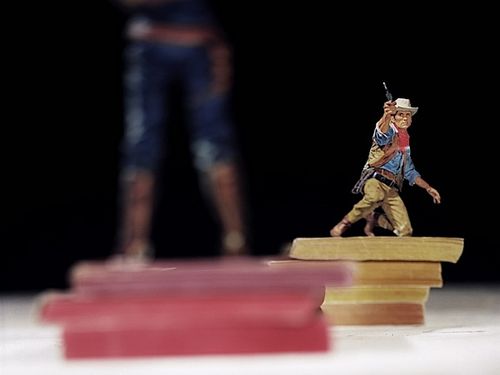
Thomas Allen's work has bounced around the tubes before, but it's worth a second look. A description:

American photographer Thomas Allen constructs witty and clever dioramas using figures cut from the covers of old pulp paperbacks. Using salacious pulp art drawing’s of the ’40s and ’50s that covered books such as ” I Married a Dead Man” and ” Marihuana Girl’, Allen constructs one set of pictures up close while obscuring another, and in the process creates a different context. Each piece is given a brand new storyline, though never quite strays from their cheeky origins.

(hat tip: Jacobs)