Breaking a Violent Habit

by Lane Wallace

Eve Ensler, the author of The Vagina Monologues, gave impassioned testimony last week to the Senate Foreign Relations Subcommittee on African Affairs about the violent war against women being waged, still, in eastern Congo. Testimony reinforced yesterday by Nicholas Kristof of the NY Times, in a column titled, simply, "After Wars, Mass Rapes Persist." 

No sane person in the world would argue against the notion that a terrible travesty is being conducted against women in not only the Congo, but Liberia, Sudan, and other African conflict areas. Eastern Congo has the highest rate of violence against women in the world, at the moment. As many as 70% of the women and girls there have been sexually assaulted or mutilated, according to some estimates. The numbers boggle the mind. 

We should do something, Ensler says. I agree. Wholeheartedly.

Hear one woman's tale of brutal mutilation, and you want to throw up. Realize that behind the eyes of most of the women you encounter lies a similar, horrifying tale, and something inside you twists, screams, and goes strangely numb. There's simply no way to even absorb it. But having spent a little time in conflict areas in Africa, I also agree with Kristof that the problems are so complex that solutions are difficult to see, or even imagine, clearly. Especially by people on the outside. 

In 2001, I spent a little time flying relief supplies into Sudan, in the 18th year of civil war there. The airlift into Sudan involved a bizarre mix of missionaries and mercenaries, and both authorized and unauthorized flight missions. The U.N. planes could only fly into areas authorized by the Sudanese government. But seeing as the conflict was a civil war, there were whole areas the government didn't want aid to reach. Hence the unauthorized flights by non-U.N. aid organizations … like the one I was flying with. 

On one flight, we dodged a couple of Northern-occupied towns and did a "quick turn" at a little dirt airstrip in the village of Akot, Southern Sudan, where there was a hospital and a school. We were on the ground less than 10 minutes because that's when we were at our most vulnerable. Not long before that, a Red Cross plane had been bombed by the Northern Sudanese on that very strip. Such are the hazards of war, of course. 

Six years later, I went back to Southern Sudan … in large part because I wanted to see what had changed since the 2005 Peace Accord had been signed. Unquestionably, progress had been made. Villages that had been decimated were being rebuilt, and people were returning home after years in refugee camps. Mine fields had been cleared and turned into outdoor markets. 

But all was not idyllic. Southern Sudan's charismatic leader, John Garang, had died in a helicopter accident right after the peace accord had been signed, leaving behind feuding tribal factions and corrupt officials. In village after village, men told me that if the North didn't agree to independence for Southern Sudan, they would simply get their guns and return to their rebel hiding places. In one village, when I asked a group of teenage boys what they wanted, now that the war was over, one wordlessly took my pen, wrote the word "independent" on his hand, and held it out for me to see. There was no smile on his face, or in his eyes.
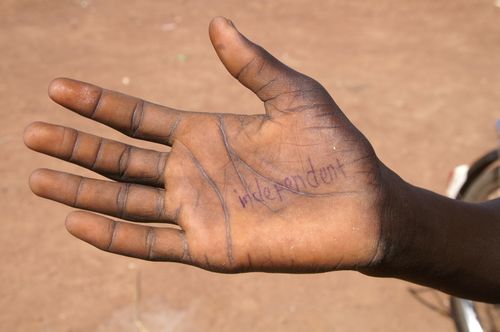
Independent

Two days later, I was flying with the same pilot I'd flown with six years earlier, when we got a radio distress call. There'd been an uprising at a local hospital, and hostages had been taken. The Sudanese People's Liberation Army (SPLA) had moved in, captured the kidnappers, and freed the hostages. But the conflict involved tribal rivalry, people were armed, and tensions in the area were running high. Could we fly in and take the hostages to safety? 

We got security updates every 10 minutes on the way there, stayed high, and did a maximum performance descent to the dirt airstrip, to keep our exposure to any potential ground fire to a minimum. We taxied to the end of the strip, where our human cargo awaited us, and shut down the engine only long enough to load up. Four minutes later, we were airborne again, in a steep climb. As we reached a safe altitude, and my heart rate returned to something closer to normal, I realized with a sad shock that I'd been to that strip before. Six years earlier. And then, too, we'd had to do a quick turn to avoid violence on the ground. Because then, the nation had been at war. 

All of that is to say … the sobering truth of Africa–or, perhaps, anywhere–is that an absence of war does not equate to peace. And violence is a very hard habit to break. 

Is there any hope? A little. Kristof points to progress being made in Liberia, where the Carter Center is working to prosecute rapists and President Ellen Johnson Sirleaf has sent strong signals that rape will not be tolerated. He also quotes a young girl there who, despite being brutally raped and mutilated, has determined that when she grows up, she wants to build shelters for abused girls … and become President of Liberia. 

Farfetched? Well, consider: in 1994 Rwanda suffered one of the most brutal, genocidal civil wars in memory. But in the vacuum that the chaos left, the surviving women had to start taking on roles they never had before. (At one point, 70% of the country's population was female.) In 2003, a country that only nine years earlier had nurtured a highly repressive culture toward women; a culture in which women were not allowed to inherit property or own their own businesses … elected a parliament in which a full 49% of the representatives were women. Which gave Rwanda a greater percentage of women in its national government than any other country in the world.   

How did that happen? In part because of international efforts to help Rwanda draft a new national constitution and electoral process. And in part because of the Rwandan women themselves. Can that happen in Congo? I don't know. But Ensler's right about Congolese women being resilient. In September 2007, as UN tanks rolled down the streets of Goma to try to repel an attack by rebel leader Laurent Nkunda a few kilometers to the southwest, I watched women in town continuing with their standard Saturday morning town clean-up. They were singing as they worked. 
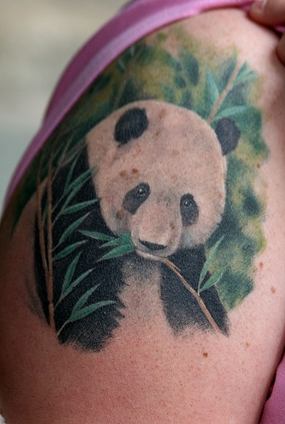
Panda Junkies

by Chris Bodenner

Panda-tattoo

In the wake of news that Mei, the National Zoo's female panda, is not pregnant after all, FishBowlDC's Matt Dornic points to a series of condolences posted by superfans:

"To sweet, beautiful Mei: I'm so sorry that you didn't have another cubbie. I don't know what you're feeling or what you've been going through but we love you Precious Mei."

"I so wanted her to be a mother again – FOR HER SAKE, NOT MINE – so that she could express her natural, wonderful mothering instincts she showed with Tai, so she could cuddle a little cubbie in her arms and express her emotions of caring, warmth and love."

"Tai sorry you won't be getting a baby bruder or sister dis year. Boy you sure are one miracle widdle baby cubbie growed up to be almost four years old."

"Fanks fow bwekfass, Auntie Teweetza (whymes wif Peetza)! Happy Wenzday, UB and Tai, and all his aunties!"

(Photo by Flickr user hammy15)

The Geography of Unemployment

By Richard Florida

The U.S. unemployment rate is nearly nine percent but varies widely by gender, race, and also by state and metropolitan region. The unemployment rate is up in 44 of 50 states, according to new BLS estimates released yesterday. Last month, 106 U.S. metros reported jobless rates of 10 percent or more, while 90 had rates below seven percent, according to data from the U.S. Bureau of Labor Statistics.

Greater Detroit posted the highest rate for large regions (those with a million or more people), 14 percent. Ten other regions posted rates in excess of 10 percent. The lowest levels of unemployment were found in greater New Orleans, 3.3 percent and Oklahoma City, 5.6 percent. Greater Portland, Oregon saw the largest jump in its unemployment rate (+6.5 percentage points), followed by greater Charlotte (+6.2 points) and greater Detroit (+6.0 points).

Writing over at Economix, Ed Glaeser previously identified the effects of manufacturing economies and human capital (the share of people with a bachelor's degree or above).on the unemployment rate. But how do these factors and others effect the change in the unemployment rate? So, Charlotta Mellander and I decided to take a look the effects of human capital and the occupational or classstructure on the change in the unemployment rate over the past year or so.

Large increases in regional unemployment are heavily concentrated in regions with a large percentage of working class jobs – that is, jobs in industrial production, transportation, and construction. Working class jobs are significantly correlated with change in the unemployment rate (0.35)

1Unemployment and Working Class

Regions with higher levels of human capital and higher percentages of the creative class have fared considerably better. Both are negatively and significant correlated with increases in the unemployment rate (the correlation for each being roughly -0.3),

2Unemployment and Creative Class-thumb-600x375-8384

3Unemployment Human Capital-thumb-650x377-8385

Interestingly enough, regions with large concentrations of low-end, standardized service jobs (like food prep, building maintenance, and personal care services) also fare better than those with large working class concentrations. (The correlation between the change in the unemployment rate and the share of service class jobs is -0.26).

Many service jobs, by their very nature, are less amenable to global competition or to off-shoring. It's hard to out-source the person who cuts your hair, mows your lawn, or takes care of your children or an ailing parent. But these jobs are typically lower-paying and less secure than manufacturing jobs.

Here's a thought: Instead of bemoaning the loss of what were once high-pay, family-supporting manufacturing jobs, why not consider ways to upgrade these jobs that we seem to be retaining and in some cases retaining even during this downturn.

4Unemployment and Service Class


The View From Your Recession

by Chris Bodenner

A reader writes:

I work as a designer and painter for 2D/3D animated television for a major network. The series I currently work on is a huge property, with a to-die-for Nielson rating. Two weeks ago, our staff was informed that after three years, they are canceling our show. The very next week, our show hit #1 for all of pre-school programming, and we were also rated as "Hot Pick" by TV guide.

The animation industry is in dire straits when you are canceling #1 shows, and leaving so many of us with hardly any chance to find other employment. The recession has clobbered my industry, leaving many artists looking outside the animation world for some "real" work. Working as welders, t-shirt designers, a good friend of mine is even designing graphics for a crappy slot-machine company in Reno, at the same time taking a pay-cut of over 25%.

So add another 70+ people to the unemployment rolls here in the debt and deficit ridden state of California. We. Are. Screwed.

Projecting Much?

by Chris Bodenner

"The problem that we have with this president is that we don’t know [Obama]. He was not vetted, folks. … He was not vetted, because the press fell in love with the black man running for the office. 'Oh gee, wouldn’t it be neat to do that? Gee, wouldn’t it make all of our liberal guilt just go away? We can continue to ride around in our limousines and feel so lucky to live in an America with a black president.' Okay that’s wonderful, great scenario, nice backdrop. But what does he stand for? What does he believe? … We just don’t know," Michael Steele.

Nearly 70 million Americans of all races and backgrounds elected Obama. Then 91 Republican insiders elected Steele. Total coincidence.

Adapting to “The New Plenty”

by Lane Wallace

A few weeks ago, I spoke with a man who makes his living selling new and used business jets. Which is to say, a man with the economic prospects of someone selling flood insurance in a drought. Business jets are not exactly a booming business at the moment. I asked how bad things were. "Bad," he admitted. "But you know how 50 is the new 40 and pink is the new black? Well, I think 'enough' is the new 'plenty.' And I'm just thrilled to be doing 'enough.'"

It's a thought that would resonate with quite a few people, these days. But there's good as well as bad news on that front. The bad news is, many of us are having to adapt to a new standard of plenty. The good news is … we're far better at adapting, and adapting to less, than we often fear. 

There's no lack of academic research on this topic. Adaptation is central to a species' survival, after all. And anyone who's lived with an unfinished house project knows all too well how easy it is to adapt to everything from a missing stair railing or unfinished shower to huge holes in the walls or ceilings. After a while, you hardly even see them anymore. (Your guests, of course, are another matter.)

We adapt remarkably well, when we have to. Or, perhaps more accurately, when there truly isn't any other choice. A couple of years ago, I spent a month flying relief supplies into Sudan, Chad, and the eastern region of the (DRC) Congo. All kinds of things we take for granted here, from fresh coffee, hot water, and electricity to infrastructure, social order and an absence of AK-47-toting soldiers everywhere, disappeared abruptly from my daily routine. And yet, I adapted almost disturbingly well to the "new normal"–including the presence of AK-47s and military weaponry everywhere. If things simply aren't available, or are an inescapable part of daily life, we quickly learn to adjust our expectations accordingly. 

The challenge comes from trying to scale back or deny yourself while all those comforts and niceties are still right there in front of you. If all the restaurants in the country suddenly disappeared, we'd soon learn to live without them. But trying to cut back on how many times we eat at restaurants that are all still appealingly and tantalizingly nearby and open … that feels painful. 

Counterintuitive as it sounds, we actually cope better with drastic changes than incremental adjustments. (For more evidence on this, check out Alan Deutschman's fascinating book Change or Die.)  Not that I'm suggesting moving to Africa just to make coping with the recession easier. 

But during my time in Africa,  I spent some time in a couple of Darfur refugee camps, in the eastern region of Chad. When the refugees first arrived in the camps, said a Norwegian aid worker who'd also worked in Rwanda, Bosnia and the Congo, the Darfur refugees were the most emotionally and physically decimated group of humans he'd ever encountered. But three and four years later, the women I talked to there … dressed in colorful fabrics, open to a visitor's questions, smiling, and playing with new babies … were clearly going on with the daily business of living. Did they miss their destroyed villages? I asked. Of course, they answered. They dreamed of them day and night. Did they want to return home? A pause. Evidently a complex question. Well, yes. But not if it wasn't safe. Here, they said, we're safe. We have food. We have … a shrug of the shoulders … 

Enough. 

Disturbing, on one level, how little can constitute "enough" for a human being. On the other hand… it's a powerful truth to learn, the concept of "enough." Wherever you are. 

Hipster Marketing

Scion

by Richard Florida

Toyota's Scion brand is turning to hipster culture in its attempts to lure Gen Y (h/t: Ian Swain).

The company sponsors art shows nationwide — its Scion Space in Culver City has shown countless A-list L.A. artists — and it works with hip-hop heavyweights like Ghostface, DJ Premier and Jazzy Jeff. And, recently, it's started recruiting rising stars of the L.A. music scene to help sell cars. DJ duo L.A. Riots and IHeartComix impresario Franki Chan have both contributed to the Scion CD Sampler series, which has previously featured Flosstradamus and Spank Rock's Ronnie Darko, among others.
Money quote:

"You're not gonna see my music anywhere near an Ed Hardy commercial," laughs L.A. Riots' Daniel LeDisko on the phone from New York. "There are certain things that would take away our street cred."

Photo courtesy of www.ridelust.com