by Chris Bodenner
FOX has it. My favorite entry:
POS – Parent Over Shoulder or Piece of Sh**
So how do I decipher "Sh**"?
by Chris Bodenner
FOX has it. My favorite entry:
POS – Parent Over Shoulder or Piece of Sh**
So how do I decipher "Sh**"?
by Patrick Appel
Hilzoy liked most of Obama's speech, except for one detail:
The power to detain people without filing criminal charges against them is a dictatorial power. It is inherently arbitrary. What is it that they are supposed to have done? If it is not a crime, why on earth not make it one? If it is a crime, and we have evidence that this person committed it, but that evidence was extracted under torture, then perhaps we need to remind ourselves of the fact that torture is unreliable. If we just don't have enough evidence, that's a problem, but it's also a problem with detaining them in the first place.
This is a very basic law. It is not negotiable. Greenwald sorts through myths and facts about "preventive detention":
Bush supporters have long claimed — and many Obama supporters are now insisting as well — that there are hard-core terrorists who cannot be convicted in our civilian courts. For anyone making that claim, what is the basis for believing that? In the Bush era, the Government has repeatedly been able to convict alleged Al Qaeda and Taliban members in civilian courts, including several (Ali al-Marri, Jose Padilla, John Walker Lindh) who were tortured and others (Zacharais Moussaoui, Padilla) where evidence against them was obtained by extreme coercion. What convinced you to believe that genuine terrorists can't be convicted in our justice system?
For those asserting that there are dangerous people who have not yet been given any trial and who Obama can't possibly release, how do you know they are "dangerous" if they haven't been tried? Is the Government's accusation enough for you to assume it's true?
Above all: for those justifying Obama's use of military commissions by arguing that some terrorists can't be convicted in civilian courts because the evidence against them is "tainted" because it was obtained by Bush's torture, Obama himself claimed just yesterday that his military commissions also won't allow such evidence ("We will no longer permit the use of evidence — as evidence statements that have been obtained using cruel, inhuman, or degrading interrogation methods"). How does our civilian court's refusal to consider evidence obtained by torture demonstrate the need for Obama's military commissions if, as Obama himself claims, Obama's military commissions also won't consider evidence obtained by torture?
If there are indeed cases were we don't have enough evidence to convict someone, but there are Very Good Reasons to hold them indefinitely, shouldn't we, at the very least, be given the details of these cases? Why wouldn't Obama want to release case files and give specific reasons why these individuals need to be locked away? If the detainees in question are obviously dangerous –enough so to justify violating the law of the land– wouldn't these facts vindicate his actions? Otherwise, the government is allowed to imprison people without trial without stating a reason besides, "trust us."
After eight years of Bush, that is not an acceptable answer.
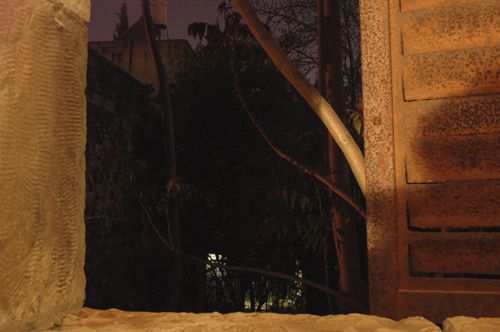
Jerusalem, Israel, 6.04 am
by Patrick Appel
DiA, which has been on the top of its game –especially since Julian Sanchez and Dave Weigel started writing there– summarizes a very early 2012 presidential poll:
by Patrick Appel
A reader writes:
How do we decongest our overcrowded and dangerous emergency departments?
I am a pediatric emergency room physician. The vast majority (statistics say about 75%) of our patients do not need to be in the emergency room. Ask anyone who does the job–we routinely see children for colds, for diaper rashes, even for pimples. I once treated a 6 year old girl for gum stuck in her hair, and last week I treated a teenager with a sore throat who had an appointment in 30 minutes with her doctor but couldn't wait that long.
The law (known as EMTALA) states that we must see everyone who presents to the department, regardless of the frivolousness of the complaint. We can declare them "medically stable" and discharge them without treatment, but then we have unhappy patients and even more unhappy hospital administrators (who have to deal with patient/parent complaints and who make more money if we order expensive tests and treatments even for people who don't need them), and we are more likely to have complaints and lawsuits filed against us. Patients come to us because we are more convenient than their regular physicians (open 24 hours, no appointment needed)–and, despite the prevailing myths most of our patients DO have primary care physicians (thanks to SCHIP)–and we accept patients regardless of their insurance status or ability to pay. EMTALA was created for a good reason– to prevent the "dumping" of uninsured patients on other facilities– but it seems that some incentive to go to a primary care physician rather than the emergency department is needed.
The problem is easily identified, but the solution is not. If we stop accepting everyone, chances increase that someone with a real emergency will be turned away by a secretary, a nurse, or by EMS personnel. As it stands, chances are increased that someone with a real emergency will be forced to wait too long to be seen as their condition worsens or that mistakes will be made because of the increasingly chaotic environment. Despite President Bush's statement 2 years ago that “people have access to health care in America, after all, you just go to an emergency room,” the system is completely overwhelmed.
by Chris Bodenner
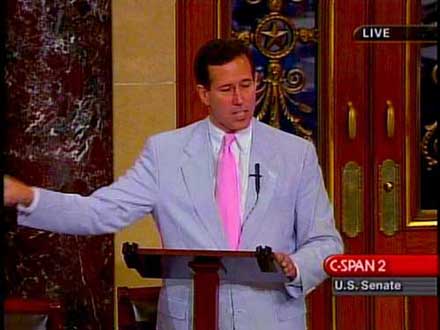
"The other thing we have to do is we have to stand up and say, look, America — Conservatives believe in the stewardship of patrimony. In other words, there are things in America that are really good, that work, have worked for 200 years. And we have a guy named Barack Obama who’s trying to fundamentally rewrite everything, change our economy, change our social structure, change our foreign policy, to something new, something fashionable, something cool. Well, we're not cool, we're not fashionable," – Rick Santorum, clearly speaking for himself:
by Richard A. Posner
In judging the severity of an economic downturn, one ought to include the costs of fighting it, as well as the costs in lost output and employment that are incurred during the depression. The costs of fighting a depression have two components: the costs of fighting it that are incurred during the depression itself, and the costs incurred after the depression ends–what I call the "aftershock." The difficulty of predicting the form and severity of the aftershock is one of the sources of the uncertainty that I emphasized in blog entries VI and VII in this series.
I want to set aside, as utterly unpredictable, the possible political consequences of the depression and their costs, and focus just on economic losses, and indeed just on the economic losses flowing from (1) the expansion of the money supply by the Federal Reserve and (2) the increase in the annual budget deficit and therefore in the national debt as a result of (a) the fall in tax revenues during the depression, as a consequence of the decline in taxable income of both individuals and corporations, and (b) borrowing by the Treasury Department to finance the government's debt.
The Federal Reserve's balance sheet has risen in the past year (May 2008-May 2009) from $1.3 trillion to $2.2 trillion, an increase in $900 billion in cash plus accounts in federal reserve banks on which banks can draw to make loans or other investments. In other words, the Fed has increased the amount of money by that amount, and it is planning on further increases. But the amount of money in circulation is not rising yet, or at least not rising much. For much of the newly created money is being hoarded by banks (remember how "excess reserves" have grown), other businesses, and individuals. As long as newly created money is not in circulation, that is, is not being used to buy goods and services, it does not create inflation, which is an increase in the ratio of money to output, i.e., in prices. (Imagine getting a dollar from the Fed and putting it under your mattress.)
But suppose that the economy turns up, and the hoarded money is put into circulation, and thus is spent, and in fact is spent faster than the increase in the output of the recovering economy; then prices will rise. The Fed can check this tendency by selling Treasury securities, thus reducing the amount of cash in the economy (because it is selling the securities for cash). But by doing that, it will push up interest rates, because there will be less lendable money. Maybe it will be afraid to do that, because high interest rates slow economic activity. In that event there will be inflation, which can get out of hand, leading ultimately to a Paul Volcker type induced recession: sharp reduction in the money supply between 1979 and 1982, engineered by the Federal Reserve under Volcker's leadership, generated very high interest rates that crushed the inflation that had been rising throughout the 1970s.
At the same time that the Fed in the aftermath of the current depression will be raising interest rates by selling Treasury securities in large quantities to sop up excess cash from the economy, the Treasury may be doing the same thing by selling Treasury securities in great quantity to finance the ballooning federal budget deficits. They will be ballooning not only because of the stimulus package ($787 in Keynesian deficit spending), and bailouts that are not recovered, but also because of the fall in tax revenues during the depression and the increased spending that the Obama Administration plans for health care and other social programs.
Alternatively, the government might raise tax rates to reduce the deficit, rather than borrowing to finance it. That would have a contractionary effect on the economy, just as high interest rates have. The higher interest rates on the public debt would increase the budget deficit, and much of the interest would be paid to foreigners, who currently finance about a quarter of the federal government's debt.
The dependence of the government on foreign lending is not as dangerous as it might seem. The dollar is the international reserve currency, meaning that a great deal of international trade is transacted in dollars. This gives foreign firms and governments an incentive to hold large dollar reserves, which in turn keeps up the demand for dollars even when, by running a negative trade balance, we spend more dollars on imports than we earn on exports. Still, the world's appetite for dollars is limited, which is why the more we borrow, the higher the interest rate we are likely to be charged: we borrow more, and pay higher interest on what we borrow, and this compounds the expense of financing our debt.
When, as it were, the bill is presented for the costs incurred in fighting the depression, it may be too large to pay either by raising taxes or by continued borrowing. At that point the only alternatives will be drastic reductions in government spending, which are likely to be politically infeasible, or inflation. Inflation is a classic method of reducing a debt in real terms, or even wiping it out completely. We may also experience unintended inflation, if the Federal Reserve's efforts to "unwind" its money-creating activities by selling Treasury securities in order to suck cash out of the economy does not succeed for technical reasons. And if as in the 1970s inflation gets out of hand (it peaked at 15 percent before Volcker went to work to break it), a sharp, induced recession may become inevitable. Fear of inflation led to the even sharper recession of 1937-1938, brought on by a reduction in federal expenditures and in the money supply. It could happen again.
by Chris Bodenner
A reader writes:
I always went back and forth about writing to you regarding my self-medication of Asperger’s Syndrome, but the reader posted earlier convinced me. I, too, am diagnosed with Asperger’s Syndrome; people tell me I’m intense, committed, hard-nosed, highly principled (on a borderline-pathological level), honest/blunt to a fault, overly formal/polite, etc.
I was entirely against substance use – from caffeine to alcohol to illegal drugs – until a close friend of mine unexpectedly passed away when I was 21. I had smoked periodically starting that year (maybe 5-10 times ever), but after he died, my use/abuse really took off. In short, I stopped giving a damn about what I put in my body.
At that time, I also became friends with a group of people that, had I not started smoking cannabis on a regular basis, I would have never been friends with. I started going to parties (something I had never, ever done before), speaking out about issues that moved me, and just generally interacting with people in a manner I had never been comfortable with. That is not to say that I’m a shy person; I have never been a shy individual, I’ve never hesitated to “tell it like it is” or to speak up if I feel wronged. But something about cannabis made me socially “normal” (a word I don’t agree with; I support neurodiversity as a concept).
Cutting through the haze of daily cannabis use (and there is a haze; take it from someone who’s been smoking daily for 7+ years now) can be difficult. But for me at least, that haze is a moot point, and sometimes even a bonus. Ask my girlfriend; about a year ago, I told her I was going to stop using cannabis. After two weeks she was ready to kill me. She told me that our relationship was in jeopardy if I didn’t get back on the cannabis. It sounds extreme, but she said it in one of those half-kidding/I’m-really-being-serious kind of ways.
When I’m not using cannabis regularly, I become an incredibly manic over-achiever who does not let petty obstacles like peers, social stigmas, or friends get in his way. When I’m not on cannabis, it is nothing for me to end a years-long friendship because I perceive it as getting in the way of my achievement (and this has happened before; it took a lot of work to bring it back). Not only that, but my “routines” (AS term) aren’t nearly as important to me if I’m regularly smoking.
Example: my morning routine is to wake up early, put on a pot of coffee, let the dog out, pour my cup of coffee, let the dog back in, stir in my cream, then sit on the couch and read or listen to my iPod until my coffee is done. If I haven’t been smoking regularly, and my girlfriend comes down and lets out the dog BEFORE I put on the pot of coffee, that will completely ruin my day if not my entire week. I’ll be irritable by the time I get to work, and liable to snap at the smallest provocation.
On the other hand, if I had smoked the night before, I will notice that my routine has been jockeyed, but it just won’t bother me that much. The same goes for my social connections; when I smoke, I reflect upon, and come to value a social connection, but it’s a cognitive process for me… It’s not something I do naturally, and it’s not something I’m inclined to do if I’m sober (my mind says, “THERES NO TIME, THERES NO TIME”)
I guess you could say my overal point is this: All people are different. All people choose to use substances for reasons that you may not understand, or care to understand. But one thing is consistent with every single person I have ever met in my entire life: Everyone has vices in which they indulge, whether it’s ducking outside of work to smoke a cigarette, ordering an appetizer and dessert with dinner, making your partner wear handcuffs to bed, laying around and playing video games, snorting coke in the bathroom at the bar or club, skipping religious service, blazing up after a hard day’s work, or having a nightcap… And everyone has reasons for doing these things. And until they decide that those reasons are no longer worth doing whatever it is they’re doing, societal stigmas, oppressive laws, and shaming will only alienate people.
by Patrick Appel
Jeff Tietz returns to the story of teenage detainee Omar Khadr, who he profiled for Rolling Stone back in 2006:
MPs uncuffed Omar’s arms, pulled them behind his back, and recuffed them to his legs, straining them badly at their sockets. At the junction of his arms and legs he was again bolted to the floor and left alone. The degree of pain a human body experiences in this from of “stress positioning” can quickly lead to delirium, and ultimately to unconsciousness. Before that happened, the MPs returned, forced Omar onto his knees, and cuffed his wrists and ankles together behind his back. This made his body into a kind of bow, his torso convex and rigid, right at the limit of its flexibility. The force of his cuffed wrists straining upward against his cuffed ankles drove his kneecaps into the concrete floor. The guards left.
An hour or two later they came back, checked the tautness of the chains between his hands and feet, and pushed him over onto his stomach. Transfixed in his bonds, Omar toppled like a figurine. Again they left. Many hours had passed since Omar had been taken from his cell. He urinated on himself and onto the floor. The MPs returned, mocked him for a while, and then poured pine oil solvent all over his body. Without altering his chains, they began dragging him by his feet through the mixture of urine and pine oil. Because his body had been so tightened, the new motion racked it. The MPs swung him around and around, the piss and solvent washing up into his face. The idea was to use him as a human mop. When the MPs felt they had sucessfully pretended to soak up the liquid with his body, they uncuffed him and carried him back to his cell. He was not allowed a change of clothes for two days.
 The Dish