Bob Wright and I blur the lines between Buddhism and Christianity:
Month: May 2009
The Potentiality Of Full Personhood
E.D. Kain has a long wandering post on abortion, war, capital punishment, and euthanasia. The whole post is a great bloggy provocation. His take on abortion:
I find that my most difficult personal struggle is with abortion, for reasons not exactly linked to the act itself. Whether or not a woman should have the right to choose to bring a pregnancy to term is almost beside the point in the end – a woman doesn’t need to have that right. She can make that decision whether or not the right is given to her. She has that capacity. And so, when imagining a future abortion black market and the inherent dangers such a market would introduce to mothers and fetuses alike, I find myself worrying. I worry that it might make matters worse. The life of the mother is sacred, too, and in a black market the most desperate mothers – and especially the poor and the young mothers – would be at a much higher risk then they are now. This hardly seems just.
On Israel And This Moment
A reader writes:
I think that the hawkish governments we've seen in Israel lately have a lot to do with the hawkish government we have here. I think that the Israeli people went with governments that fit in well with the US administration. I think we sent them a ton of signals — public and private — about what kinds of policies we wanted them to pursue. And I think that what we see in Israel now reflects that.
Now we've made a fairly significant change in our thinking about that
part of the world. It's going to take Israel time to adjust. Specifically, the voters are going to have to see some sort of evidence that being at odds with the US administration is not good for the country, and they're going to have to put new people into office. I think that our task now is to send signals strong enough so that the voters in Israel figure out where things stand, but not so strong that we actually cut Israel off at the knees.
And we have to wait for things to change. We also have to remember that Israel has followed us down this dark road. Sy Hersh talked about this a lot — we pushed them to attack Syria, and we encouraged them to be aggressive with Iran, etc. Now we've changed our policy, and we're upset that they're still pursuing our old policy with respect to Iran. We have to give them time. And we have to remember that Israel is not an old Soviet-style client state — we can't just pick up the phone, and say, "This is what you have to do." It doesn't work like that. They have a system, and a democracy, and things have to wend their way through it.
How Back Is God?
John Gray reviews God Is Back by John Micklethwait and Adrian Wooldridge:
Micklethwait and Wooldridge show that modernisation and an increase in religiosity go together in much of the world. Some of the most powerful sections of the book feature narratives of religious communities in improbable places – prosperous, highly educated Chinese, among them scientists and academics, coming together in contemporary Shanghai to read and discuss the Christian Bible, for example.
If there is any trend that can be discerned in the parts of the world that are most rapidly modernising, it is that secular belief systems are in decline and the old faiths are being reborn.
Appleyard praises Gray's review. Both Appleyard and Gray, to my mind, are among the most consistently interesting writers and thinkers in my native land – even when I disagree.
The Chest Of Civilization
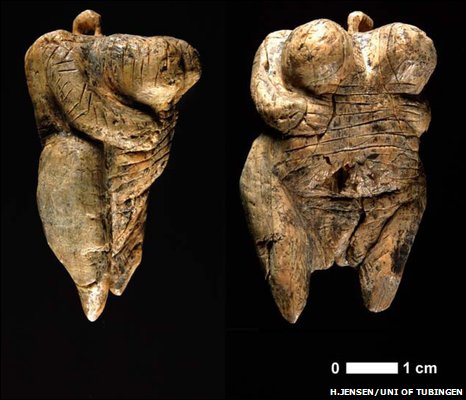
Morgan Meis ponders that 36,000 year old sculpture revealed a few weeks ago:
That humans of 40,000 years ago with roughly the same cognitive apparatus as ourselves would be far more interested in the business of nooky ought to come as little surprise. To be human is to be concerned with screwing. Not just to do it, but to be concerned about it. That our earliest examples of art would reflect sexual obsession is downright poetic. It fits in quite nicely with all the other developments, the "major, mutation-driven reorganization in the cognitive capacities of the human brain," that were happening around the time that the Venus was carved. Having more complicated brains and caring about sex are not, all joking aside, conflicting developments. To the contrary, it would be hard to imagine calling any early hominid truly human without thinking of it as a sexual being.
Playing With Google
Weekend fun. The comments in that post read like found poetry.
What Happens When Pot Isn’t Pot Anymore?
Saletan wonders:
Drugs can be, and are being, re-engineered every day. Nicotine and caffeine appear in new forms. Cannabis is an herb, then a powder, then a capsule, and now a spray, with significant chemical adjustments along the way. (….The Marijuana Policy Project argues that the spray formulation has already been eclipsed by a better way to filter and deliver the drug's therapeutic benefits: vapor.) How do you fight an enemy that keeps changing? How do you recognize when it's no longer your enemy?
Every feat of re-engineering challenges our moral and legal assumptions. In the case of Sativex, two positions are under attack: the left's lazy tolerance of recreational marijuana in the guise of legalizing medical marijuana and the right's opposition to medical marijuana on the grounds that it's just a pretext. By refining, isolating, and standardizing pot's medicinal effects, pharmaceutical companies are showing us how to separate the two uses. Are you for symptom relief or getting stoned? That used to be a fuzzy question. Now it's concrete: Do you want the reefer or the spray?
Saddam’s Throne
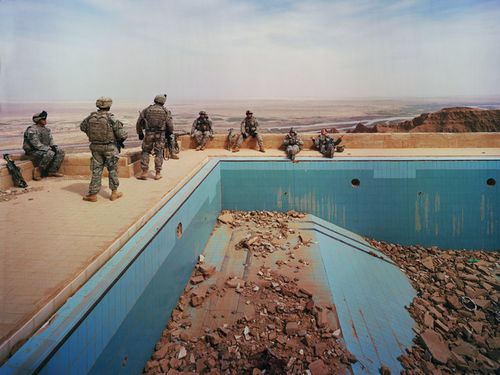
Richard Mosse has an incredible photo series on Saddam's palaces. From an interview with the artist:
The most interesting thing about the whole endeavor for me was the very fact that the U.S. had chosen to occupy Saddam's palaces in the first place. If you're trying to convince a population that you have liberated them from a terrible dictator, why would you then sit in his throne? A savvier place to station the garrison would have been a place free from associations with Saddam, and the terror and injustices that the occupying forces were convinced they'd done away with. Instead, they made the mistake of repeating history. This is why I've titled this body of work Breach. "Breach" is a military maneuver in which the walls of a fortification (or palace) are broken through. But breach also carries the sense of replacement—as in, stepping into the breach. The U.S. stepped into the breach that it had created, replacing the very thing that it sought to destroy.
More pictures here.
(Hat tip: Kottke)
Bibi And The Settlements
It's a deadlock between Washington and Jerusalem. This is the gist so far:
The Obama administration is wary of allowing natural growth in settlements because past Israeli governments used that as a pretext for rampant building, said Martin Indyk, a former U.S. ambassador to Israel. "Washington has a strong enough memory of what Netanyahu did with natural growth last time he was prime minister, which is basically drive a settlement truck through that loophole," he said…
After his return from meeting with Mr. Obama in Washington last week, Mr. Netanyahu ordered a few structures built by teenage settlers on private Palestinian land in the West Bank razed. But none of them were among the 26 [illegal settlements], and settlers quickly started rebuilding some of them. Meanwhile lawmakers from Mr. Netanyahu's party responded coldly to his proposal. "The message from the party was clear: We were not chosen by voters to evacuate Jews from their property," a Likud lawmaker said after a party meeting Monday.
Israel Matsav's Carl notes:
As I tried to explain to someone in the US last week, what people outside Israel don't understand is that even though Netanyahu managed to push Moshe Feiglin out of the 'realistic' 19th slot into an unrealistic 36th slot on the Likud's slate, Feiglin was the big winner of the Likud primary. Netanyahu had attempted to fill the party slate with the likes of Uzi Dayan and Assaf Hefetz. But Feiglin endorsed people like Boogie Yaalon and Benny Begin and Michael Ratzon and those are the people who took the top positions in the Likud's slate. Netanyahu has very little room to maneuver within his own coalition.
Peter Juul wants more economic development on the West Bank if a two-state solution is going to fly.
The Pandora Of Magazines?
Farhad Manjoo wonders whether personalized magazines will ever take off. He reviews the new personalized magazine from Time Inc:
Mine isn't an echo chamber that merely reflects my narrow views. Instead, reading it is a bit listening to Pandora, the online service that serves up songs based on my musical preferences. Like Pandora—and like the best magazine editors—Mine exposed me to stuff that I liked but probably wouldn't have sought out on my own. I don't have much of a patio, but I still found Mine's tips for organizing my outdoor furniture pretty handy. (The article first appeared in Real Simple.) Similarly, even though I'd never heard of Tony Mandarich, I couldn't put down the Sports Illustrated story chronicling the former NFL tackle's effort to atone for his steroids-laden past.
Sure, I could have found many of these articles online; in fact, reading Mine often feels like reading a great link blog. But Mine is more fun to read than whatever's on my computer screen—it's more portable, more aesthetically appealing, and easier to curl up with. So far, no digital technology can replicate the pleasure of a full-color glossy magazine.
 The Dish