State Human Development Index Debunked

by Richard Florida

Columbia University statistician Andrew Gelman is not impressed:

The 50 states don't vary much by life expectancy, literacy, and school enrollment. Sure, Hawaiians live a few years longer than Mississippians, and there are some differences in who stays in school, but by far the biggest differences between states, from these measures, are in GDP. The average income in Connecticut is twice that of Mississippi.

To check out the relation between HDI and income, I loaded in the tabulated HDI numbers and plotted them vs. some state income numbers … The correlation between the two rankings is 86%…

I think they should've just gone with the traditional measure of human underdevelopment in U.S. states: distance from the Canadian border.

Update: The discussed map is incorrect. Click here for the real map from the Social Science Research Council's American Human Development Project.

The GOP Discovers Orwell

by Chris Bodenner

The Cheney quote I just posted reminds me of a similar statement made by Senator Pat Roberts (R-KS), who is railing against the idea of sending Gitmo detainees to Fort Leavenworth – the military's only maximum-security prison:

Obviously, the Guantanamo Bay I'm speaking of houses 'terrorists.' I've been there and there are 'terrorists' at Gitmo! Not 'enemy combatants' fighting in an 'Overseas Contingency Operation' – but terrorists, against whom we must wage a War on Terror because they continually plan to launch attacks against us.

Any readers know of similar examples?

Quote For The Day

by Chris Bodenner

"Behind the overwrought reaction to enhanced interrogations is a broader misconception about the threats that still face our country. You can sense the problem in the emergence of euphemisms that strive to put an imaginary distance between the American people and the terrorist enemy. Apparently using the term “war” where terrorists are concerned is starting to feel a bit dated. So henceforth we’re advised by the administration to think of the fight against terrorists as, quote, “Overseas contingency operations,"" – Dick Cheney, in his AEI speech today. Italics mine.

More jaw-dropping cognitive dissonance below:

In the event of another terrorist attack on America, the Homeland Security Department assures us it will be ready for this, quote, “man-made disaster” – never mind that the whole Department was created for the purpose of protecting Americans from terrorist attack.

And when you hear that there are no more, quote, “enemy combatants,” as there were back in the days of that scary war on terror, at first that sounds like progress. The only problem is that the phrase is gone, but the same assortment of killers and would-be mass murderers are still there. And finding some less judgmental or more pleasant-sounding name for terrorists doesn’t change what they are – or what they would do if we let them loose.

How Pilots Evaluate Risk

by Lane Wallace

Just one more note on the subject of risk (discussed previously here) …

As mentioned in that previous post, most people underestimate the risks associated with driving, in large part because it's a familiar activity and we feel some measure of control in the process (whether or not that's really true). At the same time, most people overestimate the risks associated with flying on airliners, because it's not a familiar activity, and they don't feel as if they're in control. 

Thought I should add … ironically, pilots (I'm specifically talking general aviation pilots, here) often have the same trouble accurately estimating the risks associated with flying that most drivers have estimating the risks of driving. And for the very same reasons.

We all tend to underestimate the risks of activities that are familiar, and where we feel as if we're in control. And when it comes to flying, the pilots are in control. Or, at least, it feels that way. Especially because the risk of a collision, high on roads, is very low in the air. 

In recognition of this fact, the general aviation industry (general aviation meaning smaller, non-airline aircraft) has begun putting much more emphasis on risk assessment and risk management skills in private pilot training, in recent years. Can risk management training overcome our innate human tendencies? Not entirely. But if we gave the same kind of training to drivers on the road, my guess is that it would at least reduce the number of accidents … the same goal trainers are trying to achieve in the small airplane world, as well.  

Obama’s Challenge

by Patrick Appel

Marc reported yesterday:

Already, the facts on the ground have forced Obama to change his assumptions about how the detainees will be tried. It had been the hope of administration legal advisers that a majority of the 240 – perhaps a large majority – would be tried in federal courts. Then they discovered that the evidentiary thresholds for doing so were too high given the quality of information the Bush government had collected about the detainees, and they subsequently concluded that Article III trials wouldn't be as swift as an option that they wanted to reserve for only a couple dozen high-value detainees: the military commissions.

But by the time it became clear to the administration that most of the detainees would have to have their day in military court, Republicans had already dug a moat around the Democrats, pressing them to severely limit the President's hand.  That's one reason why Harry Reid was eager to get [yesterday's] vote out of the way; it prevents even more damaging amendments from reaching the floor, amendments which might have forced the administration to give up entirely on its goal of closing Guantanamo Bay.

Ackerman parses this. Digby piles on. The situation at Gitmo was inherited from the Bush administration but that doesn't excuse repeating their mistakes.

More Hipsters

by Richard Florida

Chris points to "blipsters." But hipster bashing (blipsters included) is a growing sport. Music critic Carl Wilson provides perspective.

[T]he hipster thing is more an outcropping of the mainstream (American Apparel division) than a functional subculture. But for all its internal conformism it's still a mode of flamboyant aesthetic display and that still makes a lot of people uncomfortable and resentful in itself. At its best the hipster is the new Dandy, the semi-subversive who overloads the system by over-subscribing to it (conspicuously consuming) and yet undermines it by seeming as if the real source of their cooperation is that they can't take the system seriously enough to bother to oppose it …

There was a time when this kind of self-expression signified something more than fashion. Today, hipsterism has become just one of several archetypal uniforms – pin-striped banker, polo-wearing preppie, khaki-clad techie, and the like.

Class and Entrepreneurship

By Richard Florida

We all know the power of an Apple or a Google to create new business models and generate massive new wealth. But, long ago, the great economist Joseph Schumpeter argued that the formation of new entrepreneurs lies behind the great "gales of creative destruction" which set in place new firms and industries and revolutionize old ones.

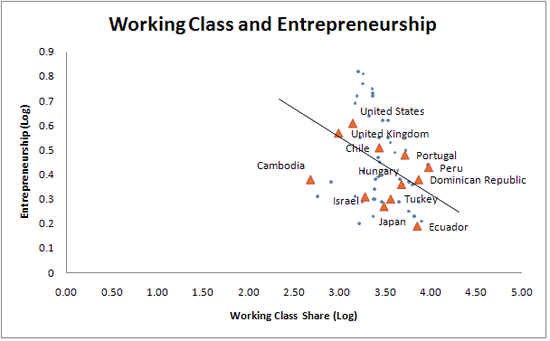
The last couple of days, we've looked at how class effects economic growth and innovation. We now look at the relationship between class and entrepreneurship. In the graphs below, Charlotta Mellander compares countries' performance on the Global Entrepreneurship Index developed by economist Zoltan Acs to shares of the creative class and working class.

Again, the results speak for themselves. Entrepreneurial countries are creative class countries. Those with high percentages of the creative class have higher scores on the Global Entrepreneurship Index.

The opposite is true of countries with a large share of the working class. Their scores on the Global Entrepreneurship Index are considerably lower.

Workingclass  

Source of all graphics: Martin Prosperity Institute


Cheney Reax

by Chris Bodenner

The full speech is here. Townhall rounded up YouTube highlights and Josh Marshall summed up in Tweet form. Andrew's reaction is here. As a follow-up to my post featuring Kristol and Roth, here's some more key commentary:

Steve Benen:

The speech was striking in its lack of anything new or compelling. … Looking at counter-terrorism as a law-enforcement matter is a mistake; Obama, Democrats, and the New York Times are putting us at risk; except for all of the spectacular failures, Cheney's approach to national security was effective; torture is good, but releasing torture memos is bad; the rule of law is "an elaborate legal proceeding"; Obama is only worried about impressing Europe; and someday, historians will agree that Bush/Cheney was just terrific.

Dave Weigel:

Cheney talks about the run-up to 9/11, the events of 9/11, where he was on 9/11 (”I’ll freely admit that watching a coordinated, devastating attack on our country from an underground bunker at the White House can affect how you view your responsibilities”), … the threat of a “9/11 with nuclear weapons,” and how the administration prevented another 9/11. In all, he mentions “September 11? or “9/11? 25 times.

HuffPo's Allison Kilkenny:

Cheney went on to mock Obama's philosophy of compromise. "In the fight against terrorism, there is no middle ground, and half-measures keep you half exposed." Again, I find myself in the odd position of agreeing with Cheney. When it comes to torture, there is no middle ground and there is no such thing as a little torture. It's always wrong, and those that torture and allowed torture should be prosecuted.

Greg Sargent:

One key moment from the [speech]: He called on Obama to use his presidential powers to declassify the intelligence that Cheney says will prove torture worked, ensuring that this debate will continue. … It’s kind of remarkable that in a speech that spent so much time attacking Obama as dangerous for our country Cheney also asked Obama for help in salvaging his legacy.

NRO's

A serious, important speech. Politicians and the media seem unduly impressed by favorability polls, often drawing unwarranted conclusions from them. Since Cheney has relatively high unfavorables, it's assumed that the public dismisses his statements.    It would be interesting to see the results of a more finely calibrated poll, one that compares how well-respected, competent, and effective the subject is perceived to be relative to similarly situated individuals. As a friend succinctly puts it, "When that big asteroid finally heads toward Earth, who's the person you'd most want to be in charge?" I suspect Cheney would score at or near the top. 

Jim Geraghty:

But in a nutshell, the Cheney argument is, "it worked." And when he notes that after 9/11, the administration and all of the various government agencies managed to prevent another attack on American soil for 2,689 days, it's a rather illuminating figure. … If there is another successful and terrible terror attack, either on U.S. soil or on a U.S. target abroad, the immediate moment will be too terrible to hear the words "I told you so." But if, God forbid, that day comes, we will know that indeed Dick Cheney did tell us so.