The Unbalanced

by Andrew

A simple note having now read the former vice-president's despicable and disgraceful speech. It confirms the very worst of him, and reveals just how callow, just how arrogant, and just how reckless and unrepentant this man is and has long been. There was not a whisper of regret or reflection; there was a series of lies and distortions, a reckless attack on a graceful successor, inheriting a world of intractable problems, and a reminder that while serious men and women will indeed move on, Cheney never will. He remains a threat to this country's constitution as he remains a stain on its honor and moral standing. I never believed I would hear a vice-president of the United States not simply defend torture but insist on pride in it, insist on its honor. But that is what he said, with that sly grin insisting that fear always beats reason, that violence always beats dialogue, and that torture is always an American value.

He repeats this core untruth:

In public discussion of these matters, there has been a strange and sometimes willful attempt to conflate what happened at Abu Ghraib prison with the top secret program of enhanced interrogations. At Abu Ghraib, a few sadistic prison guards abused inmates in violation of American law, military regulations, and simple decency. For the harm they did, to Iraqi prisoners and to America's cause, they deserved and received Army justice. And it takes a deeply unfair cast of mind to equate the disgraces of Abu Ghraib with the lawful, skillful, and entirely honorable work of CIA personnel trained to deal with a few malevolent men.

This "strange and sometimes willful attempt to conflate what happened at Abu Ghraib prison with the top secret program of enhanced interrogations" is the sober conclusion of the Senate Armed Services Committee Report, as well as every report issued getting to the bottom of Abu Ghraib.

It was a function of a policy of abuse and torture and mistreatment of prisoners in the war on terror in every theater of combat, directed and emanating from the will of Dick Cheney via the pen of George W Bush. It is simply impossible to review the evidence and conclude otherwise and no one, outside the Cheney cocoon, has been able to sustain the fiction that Cheney proposes as fact. The attempt to separate this from his own highly controlled, personally directed program of torture and abuse and coercion is a deep and malicious and wilfull lie. It may be what Bush wishes to believe. But Cheney knows otherwise. His speech was therefore not a patriotic defense of what he thinks is best for this country; it was a vile and deliberately divisive attempt to use the politics of fear and false machismo against the stability of the American polity.

He has clearly learned nothing; and will remain a threat to this country's ability to fight terror and defend its values. The president will remain above this, as he should, as Cheney seeks further to divide and destabilize this country in a futile attempt to rescue his reputation. But his reputation is unrescuable, his crimes a matter of record, and his character now indelibly written in history. Our job is to never let him forget it, to never let history be re-written and to remain resolute in bringing both him and those who attacked us to justice. And that is in the presidential oath of office.
Dish Bait

by Chris Bodenner

TYWKIWDBI casts a line, and we bite:

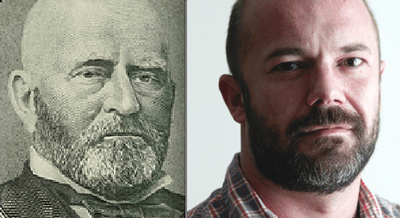
A Time magazine editorial addressed [the fact that only five US presidents have been bald] several years ago. Now an artist has shown us how six famous Americans would look with a bald or shaved head. In the absence of other facial hair, Washington and Hamilton look like alopecia victims or chemotherapy patients. Ulysses S. Grant, however, is another matter. With that full, slightly graying beard, he reminds me of someone. The shape of the ear. The eyebrows, nose, lips, eyes. Wait, wait… don't tell me…

Side-by-side

He'll be back Monday today.

The Re-Balancing Reax

by Patrick Appel

Chris already rounded up reaction to Cheney's speech, so I thought I'd do the same for Obama. His stance of infinite detention remains worrying. Fallows:

Taken at his word, he's saying: Congress can do the investigating, the courts (and my Department of Justice) can prosecute. In theory, this works out well. A new president moves ahead; the System provides accountability. We'll see.

Greg Sargent:

Obama’s return to persuasion mode is itself an acknowledgment that Republicans have succeeded in framing the debate and that the GOP attacks were creating deep consternation among Congressional Dems. One interesting thing to watch will be whether Obama’s speech reassures Dems in Congress or whether they persist in believing that they remain vulnerable to the GOP attacks. Our bet is the latter.

DiA:

Mr Obama has probably won back his base today, liberals outside of Washington who chose him over Hillary Clinton, in large part because of his moral clarity on terrorism. But he is unlikely to have won over his party in Congress, badgered every day by Republicans and reporters on whether they'd let terrorist prisoners back into their districts. That's going to take more infighting and ugly details.

Joshua Keating:

Obama's point that "unlike the Civil War or World War II, we cannot count on a surrender ceremony to bring this journey to an end" was a fairly good rebuttal to Cheney's arument that because there has not been a repeat of the 9/11 attacks, the Bush administration's antiterrorism tactics should be "continued until the danger has passed." Of course, it's unlikely to ever be clear when the danger has passed, meaning that the extraordinary authority that Cheney believes the president should be afforded will only be afforded at the president's own discretion.

Josh Marshall:

there seems to be a thought out there that it's much better to find other countries to detain some of the Gitmo detainees. This is deeply silly. If these are people you really, really don't want escaping you won't send them to any other countries. You'll incarcerate them in US prisons. The record in other countries, particularly in the Middle East, is not good at all.

Tim Fernholz:

We definitely need new standards. But the impression I get from the speech is that if we can't find ways to prosecute these dangerous people — and "can't prosecute" means is that we can't legally prove they are actually dangerous — they'll remain in jail indefinitely with no recourse. It is…a dangerous precedent. But in all honesty I can't imagine that Obama, or any other president, would make a different choice.

Allahpundit:

He could simply release the guys we don’t have enough evidence (or enough usable evidence) to prosecute and then have the CIA shadow them forever. But the public would go berserk and his national security credibility would be destroyed, so instead he falls back on some squishy “oversight” process in lieu of the right to a speedy trial. So much for cherished values. The irony is that his compromise on this sounds a lot like Clinton’s recommended compromise for torture in ticking-bomb scenarios: We know the CIA’s going to do it whether it’s legal or not, so we might as well create a judicial oversight mechanism, possibly involving torture warrants, to make sure there’s a check on it. That’s essentially the route The One’s going here vis-a-vis indefinite detention. Why not do it with torture, too?

Human Rights Watch:

…allowing detention without trial creates a dangerous loophole in our justice system that mimics the Bush administration's abusive approach to fighting terrorism.

Andrew's take is here.

Cheney Hates Us For Our Freedom

by Chris Bodenner

Zachary Roth points out "the most radical argument" of Cheney's "extremely radical" speech. Cheney:

And when [our enemies] see the American government caught up in arguments about interrogations, or whether foreign terrorists have constitutional rights, they don't stand back in awe of our legal system and wonder whether they had misjudged us all along. Instead the terrorists see just what they were hoping for – our unity gone, our resolve shaken, our leaders distracted. In short, they see weakness and opportunity.

Rule of law and democratic debate – even years after the emergency of 9/11 – are deemed weaknesses by this man. Roth:

In other words, the very act of debating torture, or the process by which we try detainees, is encouraging terrorists to strike. The implication, of course, is that dissent of any kind is dangerous.

Except, of course, the dissent of a former vice president openly repudiating a sitting president's policies on the cable news circuit, claiming his policies will endanger American lives. That's being a "grownup" and "statesman," according to Kristol:

Obama's is the speech of a young senator who was once a part-time law professor–platitudinous and preachy, vague and pseudo-thoughtful in an abstract kind of way. This sentence was revealing: "On the other hand, I recently opposed the release of certain photographs that were taken of detainees by U.S. personnel between 2002 and 2004." "Opposed the release"? Doesn't he mean "decided not to permit the release"? He's president. He's not just a guy participating in a debate. But he's more comfortable as a debater, not as someone who takes responsibility for decisions.

(Unlike Dick "Stuff Happens" Cheney.)  My translation of Cheney's speech: they hate us for our freedom, so let's just get rid of the freedom part and then we'll be safe.

“Over the Wall”

Jumpingthewall 

by Lane Wallace

Illustrator Christoph Niemann's exhibit "Over the Wall," posted on the New York Times website this week, is a simple piece of work. In a captioned series of woven paper sculpture images, Niemann–who says the Berlin Wall was only an abstract notion when he was growing up in southwest Germany–describes his recent move back to Berlin. Living in the Bernauer Strasse neighborhood, which awoke on August 13, 1961 to a new national boundary running down the middle of the street, Niemann says the Wall has now become far more real to him, even though it's been gone for almost two decades.

I understand. For one thing, history almost always becomes more personal, and real, in the places it unfolded. But I also remember the Berlin Wall. I was an exchange student in Germany in 1978, and I remember the ghost stations Niemann talks about … populated by soldiers, guns, and dogs, but no waiting passengers. I remember the eerily cemented windows along the mined and fortified border zone, and the memorials to people who had died trying to get across. I remember, after spending time on the eastern side of the Wall, my relief at seeing the checkpoint back to the western side. And my discomfort, even at the time, at recognizing how undeservedly lucky I was, to be able to pass easily through a barrier that no one else around me could. 

As Niemann is discovering, a place like that, where so much anguish was spilled, bleeds its pain into the air long after any physical structures of its past are dismantled. Even now, Germans struggle with the Wall's legacy. Some western residents resent having to pay to rebuild the east. Some eastern residents still feel like second-class citizens. In 2006, I spent time again in the eastern part of Germany, and found some residents who even said that, while they liked the free access to consumer goods, they missed the security of the Russian state. 

On some level, the impact of the Wall will probably continue to be felt in Germany until everyone who lived with it, and remembers it, has died. But while that day and shift will undoubtedly be a good thing for Germany's collective citizenry, it will represent a loss, as well. For there is something important, and powerful, in the remembered stories of the people whose lives were affected by the Wall … a point Niemann clearly feels and understands.

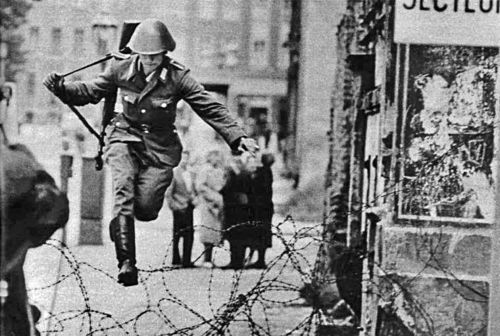
Niemann talks about a couple of those individuals in his captions … a woman who became the first to die while attempting to jump over the wall from an apartment window, and an East German soldier whose successful leap to freedom over the barbed wire, when the border was first closed, has become an iconic image from that day. 

That photo, which has been widely acclaimed, is a terrific action shot, to be sure. And it reinforces all our most cherished notions of victory and a burning desire for freedom, even in the soldiers paid to oppose us. But for my money, the attention should have been given to another photo taken that day–one far less available and known in the world, but arguably far more powerful. (I came across it in Berlin, in 1978, but I couldn't even find a copy of it on the internet to link to here.) It's a photo of another East German soldier along the barbed wire barricades. But instead of leaping to his own freedom, he's reaching down to help a small boy over the wire. A boy who'd gotten left behind in the chaos of people fleeing and families caught on different sides of the border. The soldier is young, and his eyes, looking warily over his shoulder, are full of fear. And yet, he persisted. 

The boy escaped. The soldier did not. He was seen helping the boy and, moments later, was taken away. And, at least as of 1978, nobody had ever been able to find out what happened to him. 

The stories all matter. But of all the stories that I, like Christoph Niemann, found in the lingering shadows of the Berlin Wall, that's the one that's stayed with me. Because risking your life for your own freedom is one thing. Risking it, or sacrificing it, for the sake of someone you don't even know–someone you have orders to kill–speaks to something far more profound. Which is why even today, almost 50 years after his probably death, and 20 years after the Wall came down … that soldier gives me hope. 

The Nashville Effect

by Richard Florida

Two members of rock-n-roll royalty are getting married. A couple of weeks ago, news broke that White Stripes drummer Meg White and guitarist Jackson Smith (son of legendary MC5 founder the late Fred "Sonic" Smith and singer-songwriter Patti Smith) plan to tie the knot later this month. While both are born-and-bred products of Detroit's legendary music scene, their nuptials will take place 500 miles south in Nashville, Tennessee.

A few years ago, Meg's ex-husband and current bandmate Jack White made the move from Detroit to Nashville. Inspired by his time there producing Loretta Lynn's Van Lear Rose and the city's warm embrace of those who aim to "write hits," Jack White now lives there full-time with his family, and his new side project: The Dead Weather is based out of his new multi-purpose headquarters in the city.

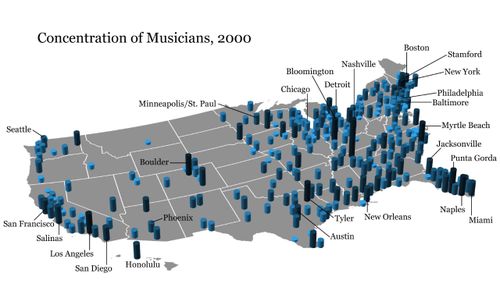
The White's trips down I-75 are part of a broader trend. While conventional wisdom holds that modern technology allows musicians to work from anywhere they choose (while weakening the influence of traditional record labels and rights-management organizations), the reality is music, like many other industries, is actually becoming more concentrated and clustered over time.

Nashvilleffect

(Source: Martin Prosperity Institute, Music and Entertainment Economy Project)

In 1970, Nashville was a minor center focused on country music. By 2004, only New York and L.A. boasted more musicians. The extent of its growth was so significant that when my research team and I charted the geographic centers of the music industry from 1970 and 2004 using a metric called a location quotient, Nashville was the only city that registered positive growth. In effect, it sucked up all the growth in the music industry.

While Nashville may not possess the size and scale of New York City, the celebrity-making allure of L.A., the top-40 hit-making appeal of Atlanta, or even the critical cachet of Austin or Montreal, across many genres it possesses the world's best writing and studio talent and the best recording infrastructure. Today, it's home to over 180 recording studios, 130 music publishers, 100 live music clubs, and 80 record labels. It's turned into the Silicon Valley of the music business, combining the best institutions, the best infrastructure, and the best talent. And, like Silicon Valley's broad reach across many high-tech fields from hardware to software, biotech to green energy, Nashville has become the center for multiple musical genres from country and gospel to rock and pop, attracting top talent from across the United States and the globe.

Thinking About Cap And Trade, Ctd

by Patrick Appel
Manzi responds to the Dish's readers:

1.    Everybody agrees that if Waxman-Markey becomes law, and it does not lead to a global, binding and enforced agreement to severely reduce global greenhouse gas emissions, then it makes U.S. taxpayers worse off economically.

2.    I have presented an economic argument that even if such a global agreement were achieved it would accomplish in the best case a net increase in NPV of global consumption of 0.2%, and a practical argument that it would almost certainly reduce global economic welfare. These specific arguments remain undisputed.

3.    Those who argue that Waxman-Markey would lead to a global agreement have provided no evidence that it would have this negotiating effect, and are presenting what is, at best, a pretty idiosyncratic negotiating premise that by giving away our leverage as one participant in a collective action problem we will somehow increase our ability to get others to sacrifice on our behalf.

Well, That Changes Things

by Patrick Appel

A reader writes:

Isikoff's reporting has been exaggerated.  According to the secondhand account, Obama was asked:

…one of those present raised the idea of criminal prosecution of at least one Bush era official, if only as a symbolic gesture.  Obama dismissed the idea, several of those in attendance said, making it clear that he had no interest in such an investigation.  Holder […] reportedly said nothing.

Obama is correct to reject any call for using the DoJ as a conduit for symbolic gestures.  This is not the function of the DoJ.  Deciding what is a crime and what isn't, moreover what is a prosecutable crime and what isn't, is not and should never be reduced to partisan gestures of symbolism.

The fact that Holder sat silent as Obama reaffirmed this obvious point means nothing because Holder has said as much publicly all along.  The fact that this obvious point was missed by most of those reporting shows how far Obama and Holder's DoJ have to go to restore the proper application of the rule of law.  This stance alone is a major break with Bush's DoJ and policies.

It sounds like the left wanted Obama to make the DoJ into exactly what Obama, and the left for that matter, derided about the Bush DoJ–the partisan, rather than fair and impartial, arbiter of justice.

I agree with this. I watched that video late last night, and somehow didn't notice this detail. I looked for Isikoff's story to verify my take but it wasn't posted until this morning. This changes my reading of the civil liberties meeting and this morning's speech substantially.

Taking Up Space

Traffic

by Richard Florida

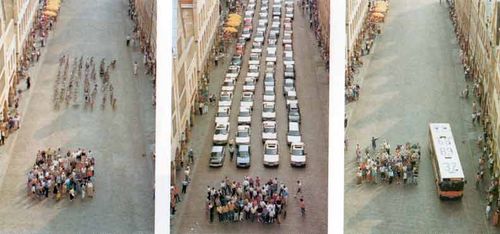
Image via SUNY Stonybrook Department of Geosciences (h/t: Ian Swain, Martin Prosperity Institute). This poster, courtesy of the city of Muenster, Germany, illustrates the different amounts of space taken up by different kinds of transit.

  • Bicycle – 90 sq. m for 71 people to park their bikes.
  • Car – 1000 sq. m for 72 people to park their care (avg. occupancy of 1.2 people per car).
  • Bus – 30 sq m for the bus.