by Chris Bodenner
He would sound like this.
by Chris Bodenner
He would sound like this.
By Lane Wallace
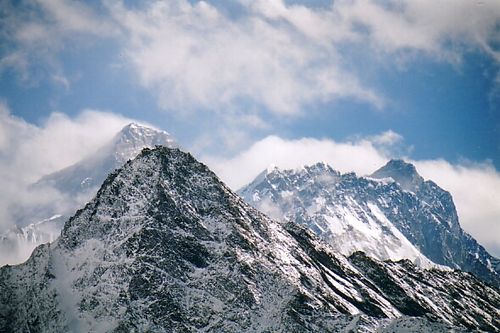
On Tuesday, Mt. Everest claimed yet another victim. Wu Wenhong was 40 years old … an amateur climber from China who summited successfully, but succumbed to altitude sickness and/or exhaustion on the descent.
 May is the best month of the year to attempt the Everest summit, so it's generally the time when most of the deaths occur. It was 13 years ago this month that the disaster chronicled by Jon Krakauer in Into Thin Air claimed 8 lives in a single day. By wild coincidence, I was hiking in the shadow of Mt. Everest just before that tragedy occurred; friends and I even spent a day with two climbers who, just two weeks later, would be caught up in the drama.
 "What we get from this adventure," he said, "is just sheer joy. And joy is, after all, the end of life. We do not live to eat and make money. We eat and make money to be able to enjoy life. That is what life means, and what life is for."
"For me, climbing was always about transcendence. In that spell that risk and fear, barely tamed by skill and nerve, cast over me, I found a blissful escape from the petty pace of normal life."
by Richard Florida
James Surowiecki notes that:
"[In] 2008, for the first time in sixteen years, the finance and insurance industry shrank. Since 1980, this sector's share of the economy has grown by almost half. Now, apparently, the worm has turned."
A couple of months earlier, Eric Janzen predicted that:
As more and more risk pollution rises to the surface, credit will continue to contract, and the FIRE economy–which depends on the free flow of credit–will experience its first near-death experience since the sector rose to power in the early 1980s. The FIRE economy–which depends on the free flow of credit–will experience its first near-death experience since the sector rose to power in the early 1980s.
The FIRE economy – which stands for finance, insurance, and real estate – is extraordinarily concentrated geographically. FIRE made up a whopping 40 percent of Charlotte, North Carolina's economy in 2006. But that didn't make it the most FIRE-dependent economy in the nation. That distinction goes to Des Moines, Iowa. FIRE made up roughly a third of total economic activity in Bridgeport and Hartford, Connecticut; Bloomington, Illinois; and greater New York, as well as resort towns like Naples, Florida; Myrtle Beach, South Carolina; and Ocean City, New Jersey.
But, as of yet, the popping of the FIRE bubble doesn't appear to be having any substantial effect on regional unemployment. There was no statistical relationship at all between the FIRE share of regional economies and the unemployment, measured as either the Feb. 2009 unemployment rate and as the change in that rate between Feb. 2008 and Feb. 2009, according to number-crunching by my colleague Charlotta Mellander. There was a slight positive correlation between real estate and both the unemployment rate (0.13) and the year-over-year change in unemployment (0.17).
But one aspect of real estate economies – construction – does appear to put regions at substantially greater risk. The correlation was higher between regional share of the construction industry and the unemployment rate (0.18) and even more so for year-over-year change in unemployment (0.23).
Hard to say why, but one reason may be that regions with a large share of finance and insurance jobs are economically more diverse. Or perhaps finance and insurance workers have skills that are more flexible, enabling them to shift jobs relatively more easily than say construction workers or blue-collar workers in general.
One thing is clear: the recession continues to hit hardest at older industrial regions and those with sprawl-driven, construction-heavy economies. Those with large shares of finance and insurance jobs seem to be adjusting relatively well.
by Patrick Appel
Dave Roberts, one of the best environmental writers out there, evaluates the watered down Waxman bill and the green divide on it (with Krugman, Gore, and Obama still supporting it but Greenpeace dissenting):
It comes down to how you see the big picture and the larger forces of history…Those who have turned against the bill think there will be one chance to do this; they cite the Clean Air Act to show how crappy compromises get cemented in place in legislation and become very, very difficult to reopen. They’re worried that if a weak bill is put in place, by the time the country seriously revisits it it could well be too late. It blows the one chance.
The bill’s supporters think history is on their side. They see the most important goals as establishing a long-term declining cap on CO2 (the 2030 and 2050 targets remain strong in W-M), getting a carbon trading system up and running, and above all shifting off the status quo trajectory. They also point out that the U.S. desperately needs something to take to the international climate talks in Copenhagen in December. Only a show of good faith will get the rusty gears of multilateral negotiation turning again, and that process, too, cannot wait. As time passes, they say, climate change will hit harder, increasing political pressure to strengthen the system. States will accelerate their own programs; clean businesses will gain size and lobbying muscle; everyone will get much more serious about the problem and cognizant of the opportunities. This is the beginning of a journey that will only gain, not lose, momentum.
Who’s right? It depends on what time of day you ask me.
by Chris Bodenner
The FBI arrested four men last night for attempting to bomb two Bronx synagogues. Hilzoy reacts:
This raises the difficult question: what should we do with these would-be terrorists while they await trial? And if they are convicted, what then? I assume that if it's too dangerous to move people at Guantanamo to the United States, it must be much too dangerous to allow these jihadists to run loose in our prisons. After all, they might provide financing for other jihadists from their supermax cells, or radicalize other prisoners, or use special Terrorist Mind Control Techniques to create a whole army of brainwashed convicts under their complete control. I'd suggest killing them, cutting them into pieces, and shipping their parts to parts unknown immediately.
I'm waiting for Harry Reid to hold a press conference demanding that the suspects not be transferred from their police cars to a prison cell (i.e. "released").
by Chris Bodenner
Crowley picks apart FBI chief Mueller's "lame riff" against bringing detainees to the US:
If you're worried about radicalization of others, take extra care to limit the unsupervised contact these prisoners have with fellow inmates. Financing? Does a terror cell you really need–or even want–a guy in prison to handle that? And the "potential for attacks," it seems to me, is already there. We've been worrying about that for about 8 1/2 years now. Are we more likely to be attacked because some Gitmo guys are in a Colorado Supermax? Invading Iraq and torturing people wasn't reason enough?
The civilians of Iraq and Afghanistan have endured eight years of collateral damage yet our political establishment says we can't handle the collateral fear of a few dozen men in shackles.
by Patrick Appel
Joshua Tucker wonders if the GOP is smarter than it first appears:
by Patrick Appel
Marc Lynch looks at a new Zogby study on public opinion in six Arab countries:
by Richard Florida
Earlier this week I posted on the best cities for college grads to launch their careers. But what are the top countries new grads are looking to?
The same survey asked both American and foreign-born students to name the best countries in which to do so.
Most Popular Countries for College Grads to Launch Their Careers
|
American |
Foreign Born |
|
1. United Kingdom |
1.United Kingdom |
|
2. China |
2.China |
|
3. United States |
3.United States |
|
4. France |
4.Hong Kong |
|
5. Australia |
5.India |
|
6. Japan |
6.Japan |
|
7. Germany |
7.Australia |
|
8. Hong Kong |
8.Germany |
|
9. Spain |
9.Canada |
|
10. Italy |
10.France |
Source: CareerCast.com
The United States ranked third among both groups – behind the UK and China. Both groups also favored Hong Kong, Australia, Japan, Germany, and France, while foreign students named India and Canada as among the 10 best countries to start their work lives.The high ranking of the UK puzzles me, while the high ranking for China excites me.
If nothing else, these findings corroborate other studies and data points which suggest the United States may be losing some of its allure as the globe's center for economic opportunity. But at least our students seem more inclined to go out and embrace the world.
by Patrick Appel
Charles Homans profiles Henry Waxman and his climate change bill
In many respects, where climate change is now looks a lot like where tobacco was in the early ’90s. Public opinion was cautiously on Waxman’s side then, narrowly favoring limits on smoking and regulation of the industry. Waxman spent the next fifteen years patiently battling to shift the political consensus, leveraging broad but shallow popular support against a small but determined opposition. But if the fight over climate change looks too much like the fight over tobacco, we’re in trouble, because here are the brutal facts:
The 2007 report of the Intergovernmental Panel on Climate Change—the gold standard of conservative risk assessment—advises that governments start curbing emissions no later than three years from now. Delaying any further will undermine what may be the final chance to stabilize temperatures below a level that will otherwise become catastrophic within the next century. Most climatologists believe that if moderately ambitious targets on the order of Waxman’s bill are not met by 2020, we will be helpless to stop warming trends before they hit a tipping point, beyond which there is nothing we can do. Officials and staffers close to the negotiating process admit that digging in and fighting for fifteen years is not an option this time around.
 The Dish