by Patrick Appel
Isikoff gets a scoop:
Visit msnbc.com for Breaking News, World News, and News about the Economy
by Patrick Appel
Isikoff gets a scoop:
Visit msnbc.com for Breaking News, World News, and News about the Economy
by Chris Bodenner
The Onion does our job for us by rounding up the big news of the day:
Police Slog Through 40,000 Insipid Party Pics To Find Cause Of Dorm Fire
by Patrick Appel
Doesn't look like it.
by Richard A. Posner
In his first inaugural address, at the pit of the Great Depression in March 1933, Franklin Roosevelt famously said: "This great Nation will endure as it has endured, will revive and will prosper. So, first of all, let me assert my firm belief that the only thing we have to fear is fear itself–nameless, unreasoning, unjustified terror which paralyzes needed efforts to convert retreat into advance." This was considerably overstated, since there was more to fear than fear itself, and the fear–given the unemployment rate of 25 percent and the fact that output had fallen by a third since 1929–was not unreasoning or unjustified.
But Roosevelt was on to something.
A sharp drop in the economy–what we are experiencing today–can generate fears or anxieties that retard economic recovery. The explanation for this effect requires drawing a distinction between "risk" and "uncertainty." The former (for purposes of the distinction) is a risk to which a probability can be assigned–a calculable risk, such as a 20 percent chance of rain tomorrow. The latter word, "uncertainty," refers to a risk that cannot be quantified: the risk of a terrorist attack, for example. The two concepts actually form a continuum, because one can have more or less confidence in an estimate of a risk, less or more uncertainty.
Decisions by businesses to invest long term are examples of economic decisions that are made in a setting of considerable uncertainty, because so much that cannot be anticipated may happen to upset the expectations on which the investment was made and cause it to flop. Yet businessmen make such investments all the time. Are they rational in doing so? Well, they are collectively rational, because if no one were really to engage in a business venture without an exact knowledge of the risk, there would be no business, no economy. The human race would not have gotten far without a genetic predisposition toward venturing in circumstances of uncertainty. The ancestral human environment, in which we evolved, was pervaded by uncertainty, so that an extreme aversion to uncertainty would have frozen activity.
Some people are more averse to uncertainty than others, but–and here is the connection between the risk/uncertainty distinction and our current economic distress–almost everyone is more averse to uncertainty the greater the uncertainty is. This is implicit in such expressions as "fear of change" and "fear of the unknown." These are rational fears because change alters the environment that one knows and because an unfamiliar environment is often full of potential menace, though perhaps of opportunity as well. It makes sense to "freeze" temporarily, as a way of gaining time to learn more about one's new environment and adjust to it.
In an economic setting, the natural "freeze" reaction to increased uncertainty is to increase one's cash balance, to hoard in other words, and thus, for the businessman, to reduce investment. (Were it not for this reaction to uncertainty, an increase in uncertainty would stimulate rather than dampen investment. The reason is that uncertainty implies a widening in the range of possible outcomes of an investment decision, and because the investor has limited solvency and anyway his personal assets are shielded if he operates in the corporate form, his downside risk is truncated, but there is no limit on his profiting from the investment if it's a success.) Cash does not yield any return (except in a deflation, when the purchasing power of money increases, so that money grows in value without being invested), but it has value because of its liquidity. If you have an unexpected expense, you can pay it immediately rather than having to liquidate an asset, such as a house, which may take time, and in addition the asset may have to be sold at a distress price to raise the cash that you need to pay the expense.
The greater the uncertainty of the economic environment, the more likely one is to need "emergency" cash, and so the more cash one will hold, despite the sacrifice of potential profits from investing rather than hoarding the cash.
The crash of the banking industry last September greatly unsettled the economic environment of the banks, and led them to hoard cash. Today the banks are holding a total of more than $800 billion in "excess reserves," compared to about $2 billion a year ago; the term refers to cash that the banks are free to lend (as distinct from their "required reserves"). On the consumer side of the market, personal consumption expenditures are down and savings in the form of cash or close equivalents such as a checkable money market account are up. People who have lost or fear losing their jobs hoard cash to be able to pay expenses should they be unable to hold on to their jobs or find a new job quickly.
Hoarding in these circumstances is individually rational, but it is collectively irrational because it does not contribute to economic activity. We see this in the reduction in purchases of luxury items from retailers like Saks and Neiman Marcus; the effect is to reduce the sales revenues of these stores, which causes them to lay off employees, which reduces those employees' incomes, which causes a reduction in purchases by them, and thus in sales to them, and thus in employment, and so on in a dismal downward spiral.
If I am correct that "fear of the unknown" and resultant hoarding increase with the uncertainty of the environment, then anything that the government does to reduce that uncertainty is positive from the standpoint of early recovery from the depression and anything it does to increase that uncertainty is negative. The government is doing some things that reduce uncertainty and other things that increase it. On the positive side are the enhanced unemployment benefits, which reduce the uncertainty of the unemployed and of people who fear becoming unemployed concerning their possible emergency needs for cash. (At the same time, it reduces the urgency of the unemployed to find new jobs, but perhaps there are very few jobs for them to find.) Also on the positive side, I believe, is the $787 billion stimulus program, which, if it succeeds in reducing unemployment even slightly, will make people who are employed less fearful of losing their jobs and therefore less fearful about spending rather than hoarding. The stimulus program also raises confidence by signaling the government's determination to do whatever is required to speed recovery from the depression.
On the negative side is increased government interference in business, as in the limits on executive compensation imposed on banks and other businesses that have received federal bailouts and in the credit card legislation now passed by both houses of Congress; the threat of greatly increased regulation of financial institutions; the huge budget deficits that the government's longer-range (post-depression) social and economic programs will create; and the prospect of pro-union labor legislation. All these measures, even in the proposal stage, increase the uncertainty of the economic environment for business–and for consumers too. But the negative effect on consumers may be offset by their feeling that the flurry ot programs shows that the government really is "doing something" to restore and increase prosperity. In that respect, the programs may have the same positive psychological effect as the New Deal programs that, at the same time they uplifted the spirits of consumers, dampened those of businessmen.
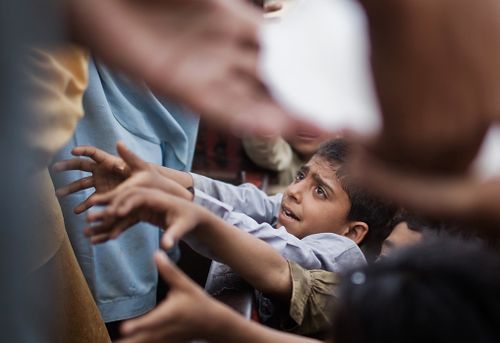
Young children, internally displaced due to the Pakistan Army's offensive against the Taliban, in Swat and Buner, scramble to get a piece of ice being handed out by aid workers at the Chota Lahore relief camp on May 20, 2009 in Swabi, Pakistan. Hundreds of thousands of people are believed to have been displaced as a result of military operations against the Taliban. Over 150,000 Internally Displaced Persons (IDP's) who have fled Swat, Buner and Lower Dir, face harsh living conditions in camps. (Daniel Berehulak/Getty)
by Patrick Appel
A reader writes:
I took the time to go to the Manzi post, and then clicked through a bit further. There are several problems with his piece.
First, he quotes Knappenberger's analysis of the impact of Waxman-Markey on future temperatures. The temp changes brought by Waxman-Markey are minuscule because Knappenberger assumes that ONLY the US acts to reduce emissions. Everyone in the debate thoroughly understands that if this were to happen Waxman-Markey would be a waste of time. Further, even when Knappenberger says he’s going to look in 2nd post at what happens if the world follow us, guess what – no impact on temps. Why? Because he continues to leave out the developing world because basically everyone knows they won’t do anything! Again, we all understand that if China and India and all the other big emitters stay on sidelines, it is wasted effort. So, the stated “benefits” of Waxman-Markey, looked at in this way are of course near zero.
Second, not all leading economists working on this issue think it will cost a lot (in terms of economic impacts). It won’t be free, but it is not going to drag the economy down. Every analysis I’m aware of shows some reduction in overall economic growth of at most a percent or two – the baseline continues to grow. So rather than being 100% wealthier by set date, we are only 98 or 99% wealthier.
It looks to me as though this story was done in terrific hurry (it happens), or Manzi intentionally has set up a strawman in effort to support an agenda. Either way, very unfortunate.
Another reader adds:
Manzi is largely correct on his central point: Waxman-Markey's emissions targets, if adopted only by the United States, will likely lead to a net economic loss for the United States, because the avoided temperature increase will be so small.
However, if W-M becomes a model for the rest of the world, it starts to look pretty good, even by Manzi's own standards. Chip Knappenberger estimates that, if the whole world were to adopt the targets in W-M, global temperatures would be about 2.4 degrees Celsius lower in 2100 than they otherwise would have been. (This is a much larger effect — perhaps 12 times larger — than if the United States were to go it alone.) Remember, Manzi says that a 4 degree increase in temperature will lead to a loss of 3 percent of global economic output. Thus, by his own math, a worldwide W-M program would avoid a loss of 1.8 percent in global economic output. This number is more than twice the EPA's estimate of the cost of W-M in 2050 (0.8 percent in consumption).
In other words, if the whole world were to adopt the emissions reductions in W-M, it appears that it would pass a benefit-cost test.
Manzi sort of addresses this issue in his original post. He correctly claims that it's "loading the dice" in favor of W-M to assume that the rest of the world — particularly Asia, upon whom truly beneficial climate mitigation depends — will follow the U.S.'s lead. But what if they do? Manzi argues that, "even if the whole world were to enact similar restraints on emissions, the cost / benefit economics would still not be compelling." His own math suggests he's wrong.
Moreover, Manzi ignores perhaps the most fundamental economic point of all: emissions of greenhouse gases impose external costs, which, to maximize economic welfare, need to somehow be addressed. The best way to address these externalities is by putting a price on carbon through a carbon tax or a cap-and-trade system. (This is Econ 101. It's the same underlying rationale for imposing a gas tax.) Certainly, one can argue about what the carbon price ought to be. $10 per ton? $20? $80? And one can certainly make a compelling argument that W-M (though its emissions targets) places too high a price on carbon. But no good economist would argue that the optimal price is no price.
I wonder what Manzi thinks the proper price ought to be.
by Patrick Appel
A reader writes:

by Richard Florida
Tata – the Indian mega-conglomerate that launched the $2,000 car – has created a housing division which is building new apartments ranging from $7,800-$13,400 dollars outside Mumbai (pointer via Planetizen). Business Week's Prashant Gopal explains:
Tata's housing division is targeting a segment of the market that was largely overlooked during the housing boom. India's builders were concentrating on building shiny new high rises and mansions on golf courses … Luxury flats in Mumbai can cost more than ones in Manhattan. But these apartments won't be luxurious. The Tata apartments will be built on 67 acres in Boisar, an industrial area where many lower-wage commuters already rent. These apartments will be absolutely tiny. The carpeted area of the smallest units will be 218 square feet, too small even for most Manhattanites. The largest units would be about 373 square feet.
Check out the pictures, floor plans, and payment plans here.
by Richard Florida
Where does democracy come from? What are the social, demographic, and economic factors that shape the onset of democracy in a country and its subsequent stability and subsequent development?
This is a question that has vexed social scientists for decades. A new study puts the question to perhaps its most systematic test yet.
Researchers from ETH Switzerland and Georgetown University used a statistical procedure called "extreme bounds analysis" to test the salience of 59 factors identified in more than three million previous statistical regressions (h/t: Charlotta Mellander). The study finds a "humbling result": Out of all those studies, all those variables, and all those millions of statistical analyses, just five factors predict the emergence of democracy, while four predict its survival.
Most surprising of all is the role played by economic growth, measured as gross domestic product (GDP) per capita. The study finds that GDP per capita is negatively associated with the transition to democracy. Contrary to "modernization theory", the study finds that richer countries are not more likely to become democracies. Richer countries are more likely to remain democracies once they become one.
by Patrick Appel
Manzi responds:
Anyone? In other Waxman-Markey news, MoJo has reports on the climate lobby trying to shape the bill and on Waxman's speed reader. Wonkroom summarizes the EPA study Manzi cites in his post.
 The Dish