Roots Of The Deinstitutionalization Movement

A reader writes:

The reader's dating the deinstitutionalization

movement to the Reagan years was an understandable error,  but an error all the same. In the mid-1970s, I worked for the Ohio Department of Mental Health and Mental Retardation as part of a wave of idealistic young administrators who implemented the first round of laws that led to deinstitutionalization.

These laws evolved directly from the civil rights and anti-war movements, and many of the activists like me who lead this fight had grown up in this era.  Deinstitutionalization was also fueled to some degree by the counterculture's acceptance of nonstandard views of reality — think R. D. Laing — and the sense that people who weren't "normal" had a right to live freely in society.

The Reagan years were the rocky shoal on which these visions crashed.  Running institutions became very expensive once higher staffing and treatment levels were mandated by law, and community based treatment initially seemed both cheaper and more humane.  Of course, both institutions and community programs proved highly vulnerable to the budget cutting encouraged by supply siders.  The mentally ill and developmentally disabled usually have neither economic nor political power, so they are more vulnerable than most to the Calvinism and Social Darwinism that are the shadow side of American Conservatism.

When I see homeless people on the streets here in Detroit, I often think of the residents I knew in the institutions in Ohio.  I am not wise enough to tell you whether they are better off now than they were before.  The institutions of the 1960s were often dreadful places.  The streets seem just as dreadful, in a different way.

Quote For The Day

by Chris Bodenner

"I would just say to my colleagues who made those statements, you ought to take a look at some of our security facilities in the United States, and you ought to have a little more respect for the men and women who are corrections officers and put their lives on the line every single day to keep us safe and to make sure that those who are dangerous are detained and incarcerated. The reality is that we’re holding some of the most dangerous terrorists in the world right now in our federal prisons, including the mastermind of the 1993 World Trade Center bombing, the shoe bomber, the Unibomber, and many others.," – Dick Durbin, supporting the troops.

The Party Of Activist Judges

by Chris Bodenner

Atlantic correspondent James Warren speaks with David Strauss, a University of Chicago Law School professor with long ties to the Supreme Court. Strauss:

This President–like Clinton, but unlike the Republicans–doesn't have a Supreme Court-centered agenda. He's not trying to move the Court in a dramatic new direction or to get the Court to make important changes in society.

There's a contrast with the Republicans (at least the wing of the party that cares the most about the courts), who would like to see dramatic movement on abortion, school prayer, government aid to religion, affirmative action, property rights, maybe federalism and Congressional power. This isn't a partisan point–in the '60s the Democrats had a Court-focused civil rights agenda. But they don't now.

Gordon Silverstein drew a similar distinction in his great TNR piece on Souter, "The Last Conservative." The retiring justice has a stare decisis, or "let it stand," approach to court decisions — the truly conservative approach. But because the Warren Court laid down a layer of liberal rulings in the '50s and '60s, Souter's tendency towards the status quo causes movement conservatives to brand him as a liberal. And so the pendulum swings.

Black Hipsters

Kanye-hipsters

by Chris Bodenner

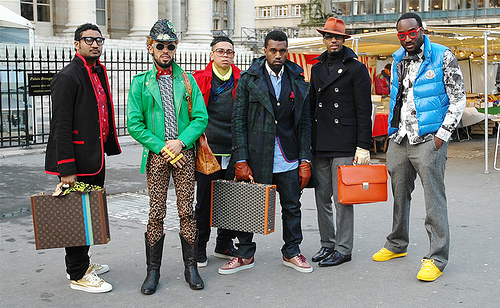
Dayo Olopade reports from the mashup generation:

The hipster tendency to turn social difference into spectacle seems odd for blacks who are already, by virtue of their minority status, very visible. But this speaks to another, broader trend—which is that this culture is about total liberation. Allin Bond, the black president of Happy Hour Clothing, which sells bright graphic T-shirts and other blipster-friendly attire, notes that “we are in kind of a mash-up culture. Rap is cool; smart rap is real cool; the ‘80s came back hard,” he says.

See more blipsters in the slideshow.

(Photo: Kanye West and his entourage, by JakandJil)

Ask The Audience: Mental Health, Ctd

by Patrick Appel

A reader shares:

Give the mentally ill too much freedom and a number of them end up in jail. Give too much power to relatives and relatively healthy people can lose their freedom.

I have an uncle, only five years older than I. He’s spent a fair amount of time in the system starting as a juvenile – underage drinking, drug possession, vandalism. After juvenile hall, he was removed from his father’s house and placed with an older sister where he lived for about a year until he turned 18. More arrests for drinking, DUI, possession and an arrest for felony burglary at 22, for which he served two years in prison. He received several diagnosis during these years – depression, personality disorders, was even referred to as a sociopath by one institution – but no treatment.

The following 25 years saw more DUI’s, a marriage and annulment, drug possessions, theft. The last 5 or so have been the most harrowing. He found Crystal Meth. The decline from the already low was rapid and frightening. He would often show up at my father’s house (his oldest brother) going off about Peak Oil or some other World-Ending Event and leave in a rage. It got to the point my mother wouldn’t allow him in the house and my father had to drive off somewhere with him and try to reason with him. Obviously to no avail. There was nothing anyone could do – nothing short of getting him committed which no matter how many phone calls, arrests, stints in the county detox and outright pleading with the authorities, it just wasn’t going to happen. He hadn’t really hurt anyone. I mean, there wasn’t any blood anywhere so he was causing no real damage to himself or anyone else, right?

About a year ago I was awoken by the pacing of my dog. Thinking he wanted to go outside, I got up to let him out. In hindsight I should have known what was coming next: as soon as I opened the bedroom door my dog dropped his nose to the ground and started moving around the house instead of just trotting over to the front door. Being in a 5 am fog, it just didn’t click. Then out of the corner of my eye, I saw my uncle standing in the dining room about 20 feet away. With a gun.

I didn’t recognize him at first. He was wearing a black hooded sweatshirt and the sun was just starting to come up. He was about 30 lbs lighter than the last time I’d seen him, black-dark circles under his eyes. And the eyes…tar pits. There was no one there. No light. My uncle kept repeating the same thing: “We have a problem”.

I called to my husband, he came out. My uncle wanted us to go outside with him. My husband said he’d go outside, but I was staying right there. My uncle started to raise the gun to force the issue, and he went to the kitchen drawer and pulled out my husband’s gun. He’d been in the house for some time, even hiding other things that could have been used as weapons. My husband started going out the door drawing him outside. As soon as my uncle was on the porch, pointing two guns at my husband’s head, my husband turned, pulled my uncle off his feet with the barrel of one gun, and wrestled him to the ground. I went out to the porch and went after the handgun he’d taken from the drawer. I got pushed off and away at some point, it was then my uncle started firing. I was shot twice. I went after the handgun again, my husband still wrestling with him. I wasn’t able to get the gun away from him, so I ran inside to call for help. Then more gunshots – bullets whizzed through my house.

Before it was over, my uncle held the handgun to my husband’s head and pulled the trigger. Thank God it was empty. He was completely out of ammunition at this point. My husband threw him on the ground and ran inside, locking the door just as my uncle hit it full force. My uncle got in his car and drove away, leaving behind night-vision goggles and a 10” knife. The police think that if it weren’t for my dog being in the bedroom with us – he would have stabbed us to death in our sleep.

It’s now a little over a year later, and we still haven’t gone to trial. Now all of the sudden he’s mentally ill and he needs treatment, not incarceration. You see he was just so angry that my father never took my uncle’s conspiracies seriously, that he figured killing me would be a great way to get back at my dad.

I have a rather large family, Catholics on one side. Just counting siblings, aunts/uncles, cousins it totals out at 36. My brother came to the hospital, my parents came to my house after I was released. My father cried like a baby when he saw me. It makes me cry when I think about that. My mother said she was glad he came to my house instead of hers. That makes me cry too. The aunt that took my uncle in as a teenager came to a court hearing all the way from Belize, she said not to take it personally, he didn’t mean to shoot me. And I didn’t mean to have these scars and to have basically lost a year of my life. Haven’t heard from anyone else. I probably don’t want to.

You want to know the real kicker? He was caught three weeks prior to shooting me, in a house not far from my brother’s house, with a gun. He’s a felon, and they released him without bail.

He was “relatively healthy” before this happened. And he’s “relatively healthy” now that he’s medicated.
Rebranding The War On Terror

by Chris Bodenner

Jack Goldsmith, the former OLC chief, makes the case that Obama has just repackaged, and thereby strengthened, the Bush/Cheney approach to terrorism. Greenwald homes in:

None of Goldsmith's analysis is grounded in the proposition that Obama hasn't yet acted to change Bush policies, thus rendering a nonsequitur the response that "Obama needs more time; it's only been 4 months." Goldsmith is describing affirmative steps Obama has already announced to adopt the core Bush "terrorism" policies.

Andrew has said Obama deserves the benefit of the doubt until at least the end of the summer campaign in Af-Pak. Adam Serwer counters:

Either there's due process or there isn't. …  Because the instinct of the "respectable intellectual center" is to find whatever position seems to lie between two "extremes" and stick to it, Obama's almost wholesale embrace of Bush counterterrorism policies can be sold as a "compromise." But if you believed the last administration was "extreme" in its assertion of executive power, than this one is too.

Ask The Audience: Libraries, Ctd

by Patrick Appel

A reader writes:

As a public librarian in a large metropolitan city, I can attest that our patronage is up…substantially now more than ever due to people seeking out resume advice, and our usage of computers has skyrocketed.  Which goes to show you one thing: people need libraries.

Regardless whether they own their computer, many patrons still need assistance in navigating the 'Net, or advice on how to compose a resume, or where and how to use the templates available on word processing programs. Or they come for information on community resources to assist in their job search, or simply to discover free events in their community for their families.

They come for book discussions and debates, for senior "Wii" programs, for children's play-reading times, for how to start your own business seminars, for teenage events that encourage good reading and learning habits, or simply to just enjoy reading the racks of magazines and newspapers knowing all the time they are all…free.

But they also read. A lot. Fiction and non-fiction books are still checked out. There is a warm, fuzzy comfortable-ness about taking home books and reading – especially escapist type of genres.

But what can a library do to stay relevant?  It still needs 'place.'  A library was always a place first.  A haven to escape the hustle and bustle of their jobs, or even their family home. A place where every square inch of information and recreational reading is there at their fingertips. A place where librarians still answer reference questions and are available to help them navigate that almost-overwhelming mass of information that is thrown at them each day on the 'Net, TV and radio and in newsprint.

In short, the library is still the most precious gift we give ourselves as a nation. Librarians are now more than the old-fashioned point-that-dewey-out individual-they are now information miners, resume makers, recreational reading advisors, gamers, events-planners for all ages.

The library is the still the best place in town.

Another reader adds:

My inclination is to say that libraries could very well become central to communities — but that they'd have to shift emphasis from distributing information to editing it.

"Librarianship" is a skill that is only becoming more important. The question that the librarian seeks to answer is, I think, a defining one: How can I deal intelligently with this mass of information?

I think a great many of your readers go to the Daily Dish to answer that very question. They go as one goes to library: not only does the blog provide content (the analytic function of blogging), but it sorts through it (the curatorial function of blogging). Libraries do both. They provide content and they help people sort through it.

But as the former becomes more accessible, the latter becomes more important.

Some ideas would be this. Libraries should focus on:

Community

  1. Hyperlocal news aggregation

Discovery

  1. Personalized reading lists and recommendation like "new books you might like" and "new articles you might like"

Editing

  1. Helping people create information consumption regiments
  2. Parsing paragraphs and quotes from books and aggregating them
  3. Collecting book reviews

Shorting Obama

by Patrick Appel

Jonathan Chait wonders if it is the best strategy:

I'm not saying the economy will recover or that Obama will stay popular. Quite possibly, four years from now we could still be mired in a worldwide depression and Obama could be facing dismal — who knows, even Bush-like — popularity ratings. The world is unpredictable. But isn't there a pretty decent chance that the economy will have recovered, and Obama's policies will look fairly wise in retrospect? Do Republicans want to make any political plans for this contingency?

DiA has more thoughts.

In Defense of the Liberal Arts, Ctd

by Patrick Appel

Julian Sanchez responds to Lane:

I think Wallace actually gets it backwards here: The great value of a liberal arts education is that it prepares you to be relatively happy even if you find yourself working in a corrugated cardboard factory. Partly because books are cheap, and cultivating the ability to take great pleasure in a well-crafted novel lowers you hedonic costs down the road. But more broadly because the liberal arts might be described as a technology for extracting and constructing meaning from the world. If you know your Hamlet, you know that’s all the difference between a prisoner and a king of infinite space.