Class and the Wealth of Nations

by Richard Florida

Living through the current economic downturn, none of us take economic prosperity for granted anymore. We're aware now, more than ever, of how important it is to cultivate the things that contribute to long-run economic growth and sustained prosperity as well as to regulate and cope with those which can come to jeopardize that prosperity.

Economists mainly agree that there are two things that power long-run economic growth. Thanks to the Nobel-prize winning work of Robert Solow, we know that technology is one. Human capital is another. Detailed empirical studies by Harvard's Robert Barro and others show the connection between human capital and economic growth.

But what about class – does it matter?

Using data from the International Labour Organization, Charlotta Mellander developed class profiles for nations of the world. The graphs below show the relationship between two main classes – the creative class and the working class – and two common measures of economic growth - gross domestic product (GDP) per capita and total factor productivity (TFP).

The results could not be more striking.

The creative class is strongly related to both GDP per capita and total factor productivity. In preliminary statistical analysis conducted by Mellander, the creative class effect was even stronger than that from the well-established human capital measure.

Now look at the graphs for the working class. Societies with large concentrations of the working class have lower levels of GDP per capita and total factor productivity.

Source of all graphics: Martin Prosperity Institute

Tomorrow, I tackle the relationship between class and innovation.

In Defense of the Liberal Arts, Ctd

by Patrick Appel

A reader writes:

Thank you Lane Wallace for your defense of liberal arts.  I graduated from Carleton College in 1998, and at the time I wondered if all the time I'd spent in sociology, music theory, history, and economics courses would have been better spent back in the biology lab working on my major subject. 

I didn't find work in biology, but in IT, as at the time the world was in the full swing of the internet boom.  As such, I wondered if I should have taken more than the four computer science courses I had taken.  While my friends who went to technical schools found work right away, I had to cast about quite a bit, and had to learn on the fly.  I eventually made it to a settled job, and without getting into my rather diverse job history since then, I'm doing pretty well.

Here's the thing — I'm only 33, and many of the technical skills I learned both in biology and in computer science courses in college are obsolete just 11 years later.  With the job market as uncertain and changing as it is now, it's many of my "distribution" courses and the ones I took for fun that are becoming the most useful.  Most importantly, though, Carleton's emphasis on writing skills, which seem to be endangered at many universities, has been a major difference-maker in my career.  That alone has opened numerous opportunities for me.

I understand the need for technical skills, but frankly one can learn most of those raw technical skills in about a year at a decent community college.  If you're going to commit four years of your life in your prime to education, it ought to be on skills that are going to last more than a decade.  With the rate of technological change, there's not one technical course of study I would be willing to point to now and be confident that the skills learned there will be relevant 20 years from now.  On the other hand, history, philosophy, sociology, economics, the outlines of scientific inquiry, mathematical theory, and yes, most of all, the ability to write, I have utmost confidence will serve the student well in any job discipline.

Face Of The Day

Idatomagetty2
The 47 million year old fossilized remains of a primate is seen at the American Museum of Natural History May 19, 2009 in New York City. 'Ida' is the most complete fossil primate ever found, it was preserved in Germany's Messel Pit and measures approximately 3 feet in length. Norwegian paleontologist Dr. Jorn Horum of the University of Oslo led the team that has secretly studied the fossil for the past two years. (Photo by Mario Tama/Getty)

Why Does Healthcare Cost So Much, Ctd

by Patrick Appel

A reader writes:

In response to your reader who points out the wisdom in an insurance company spending $20 for the blood pressure medicine, rather than high costs for treating a stroke, you note that it's unclear that preventive care saves money.  But I think you are confusing two very different things:  your reader was talking about routine, low-cost care (which, the reader implies, can nip a condition in the bud and prevent its escalation), but you link to a discussion of whether various measures, including preventive screenings, save money.  I think there is indeed plenty of data to support the idea that routine care that keeps conditions under control is much more cost-effective than getting care only when the condition becomes severe, catastrophic, etc. 
(That's one of the reasons that ER care is so expensive — people wait until they have the heart attack because they can't afford the cholesterol meds, for example.)  I recall a New York Times series a few years ago about treatment of diabetes, where they discussed how it's much more cost effective to pay for nutrition counseling than to deny payment for this kind of early intervention and instead only pay for the treatment when the diabetes has progressed, requiring insulin, dialysis, surgery to amputate limbs, etc., but that hospitals could not keep their counseling programs open because the insurers wouldn't pay for it.  Similarly, a friend's husband was denied coverage for inpatient alcohol treatment, then ended up falling — while drunk — and sustaining a major head injury, costing the insurer far more than the detox would have cost. 
 
Another reader:

I'm a pharmacist (recent graduate – within the past few years – with a Doctor of Pharmacy degree, for whatever that's worth), and I strongly believe that preventative medicine can make a huge difference in terms of saving costs down the road.

Looking at this link, I can see the merits and disadvantages of the different strategies specifically mentioned.

More research – It can be useful to have more information at one's fingertips, certainly!  However, from professional experience, there are a number of different medications that differ, in terms of efficacy and side effects, for each individual patient.  This is perhaps due to their own genetic code, and once we understand more about the field of pharmacogenomics, we may be able to better select a given medication for a given patient.  Comparing different types of drugs may be more useful, in this regard, versus comparing a half-dozen drugs in the same class.  Do beta blockers or calcium channel blockers work better?  Does one have a greater incidence of heart issues down the road, comparatively speaking?  That sort of information would be more useful, I'd think.

More preventive screenings – Definitely something that can be useful, but I'm not sure if a doctor's office is the best location for regular screenings/checkups.  Pharmacists are more than qualified to do basic labwork and screenings, and the Asheville Project is a great example of that. The Asheville Project was a 5-year long study of diabetic patients in North Carolina.  They were monitored frequently by their local pharmacist, who made appropriate referrals to their physician as necessary.  They were put on more medications, yes, which did increase costs in the short term.  However, in the long term:

The total mean direct medical costs per patient per year decreased between $1622 and $3356.

The City of Asheville estimated it gained $18,000 per year in employees’ productivity.

Helping to control serious medical conditions (diabetes is the most notable, but other conditions such as respiratory conditions, for example) could help cut medical costs down the road, of course, but would also have a direct impact on the productivity of the American workforce.  Presuming that employers continue to pay for employee health insurance, it is to their benefit to help control these sorts of conditions to limit their own out of pocket costs.

Of course, this is a change that would likely take at least a few years to see direct results – particular for conditions such as high blood pressure and high cholesterol.  Certainly there will be some short-term benefit, but it may not off-set the costs as much, especially initially.  However, in the long term, I firmly believe that this sort of spending will save money overall, both in terms of costs directly saved and money saved by increased productivity of the American workforce.

Better organized patient data – I'm reading this to be some sort of national patient charting system, which would enable a doctor at Hospital A to see what medications a patient is taking from another physician at Clinic B.  This would help to minimize drug interactions – and drug duplication.  Additionally, if pharmacists had access to patient labs and basic information (height and weight, for example), we could better assess the appropriateness of medication dosages.  This is especially relevant for antibiotic usage in children or in those with kidney or liver dysfunction.

In conclusion, I don't know that Obama's savings proposals are necessarily "the answer."  However, I think they're a good start – and I don't think that refusing to pay for basic medications (blood pressure, cholesterol, diabetes drugs) is any method to saving our health care dollars in the long run.

Mobile and Creative

by Richard Florida

Patrick points to the Economist's synopsis of  this new study of the relationship between living abroad and creativity. Creative people are curious by nature. There is a also a close connection between creativity and experience seeking – in psychology speak, open-to-experience personalities; and open personalities are more likely than others to move. Creative people constantly – and chronically – seek out new experiences, they are also frequent movers. That said, the study is careful to point out that:

[C]urrent studies cannot rule out the reverse pathway: that creative people may be more likely to live abroad than noncreative people, a plausible possibility that we noted in the introduction. However, although we acknowledge that creative people may indeed be especially likely to live abroad, we believe that the effects of living abroad are not simply a proxy for creative personality, and that our results suggest the experience of living abroad seems to be important in and of itself.

The Mystery Of Great Prose, Ctd

by Patrick Appel

A reader writes:

I bow humbly before the altar of Strunk and White. Every student of the English language should read "Elements" at least once. But as for why "These are the times that try men's souls" is better than "Times like these try men's souls" — supposedly the evident superiority is unexplainable — I'll give it a go:

First of all, "These are the times that try men's souls" does not mean the same thing as "Times like these try men's souls." The first is specific, singular. It's the here and now, in which everybody alive is wholly invested. It's troubling and unique. The uncertainty adds mystique and mystery. "Times like these try men's souls" has none of that. It tells us that other times such as these have existed and will exist again, and that we are just another set of people challenged by circumstance. We are not special. Our challenges are not exceptional. But everybody wants to be special, even if they're simply projecting themselves into a grand piece of literature.

Falling Further

by Richard Florida

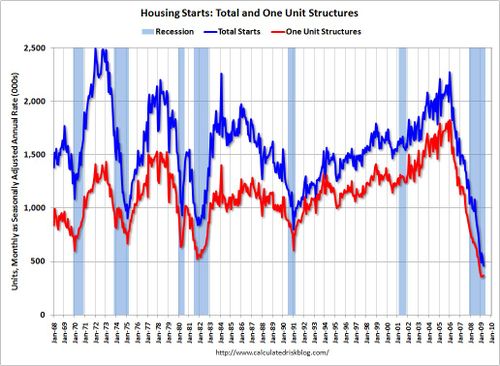
Housing starts dipped to record lows in April. Just 357,000 single family homes were started last month, while total starts feel to 458,000 – an all-time record low. HousingStartsMay2009

The Financial Times highlights the global scale of the real estate crisis:

The slump across global commercial property markets has accelerated since the turn of the year, with the emerging markets in particular struggling under the combination of capital value and rental falls. The pace of decline in capital values accelerated in the first quarter, while almost every country in the world is reporting a slide in rents …

Better Standards

by Patrick Appel

Ryan Avent advocates for a higher gas tax rather than fuel efficiency standards:

What I’d like, as most of you know, is a series of substantial increases in the gas tax, to begin taking effect in 2011. This would have the same effect on vehicle fleets, more or less, as mileage standards. It would also encourage people to drive less, and it would reduce emissions among drivers who choose to purchase used vehicles, and it would provide revenues to build cleaner transportation infrastructure, and it would encourage consumers to continue substituting away from petroleum, reducing the economic impact of any future oil spike.

So to me, this is better than nothing, but I’d much rather see someone in Washington do some political heavy lifting on a policy to make drivers pay more for gas.

Megan isn't happy with the fuel efficiency standards but thinks "it may be the best of a bad set of policy choices." And Bradford Plumer wonders whether implementing the standards indicates we have hit peak gasoline consumption.

Fear 1, Dems 0

by Chris Bodenner

Senate Democrats today blocked the $80 million Obama requested to shut down Guantanamo by 2010, insisting on a more detailed plan before doing so. But Joe Klein thinks they simply got spooked:

Guantanamo is a symbol of American brutality that needs to be expunged to the extent possible by closure, as soon as practicable. We have a system of military prisons that would be perfectly adequate to handle the detainees who are not returned to the home countries. Apparently, President Obama is going to give a speech on this topic on Thursday–but the Senators just couldn't wait 48 hours while the Republicans and cable newsistas were scaring their constituents. Yet another profile in courage.